The Spider Who Wove the First Web Myth Meaning & Symbolism
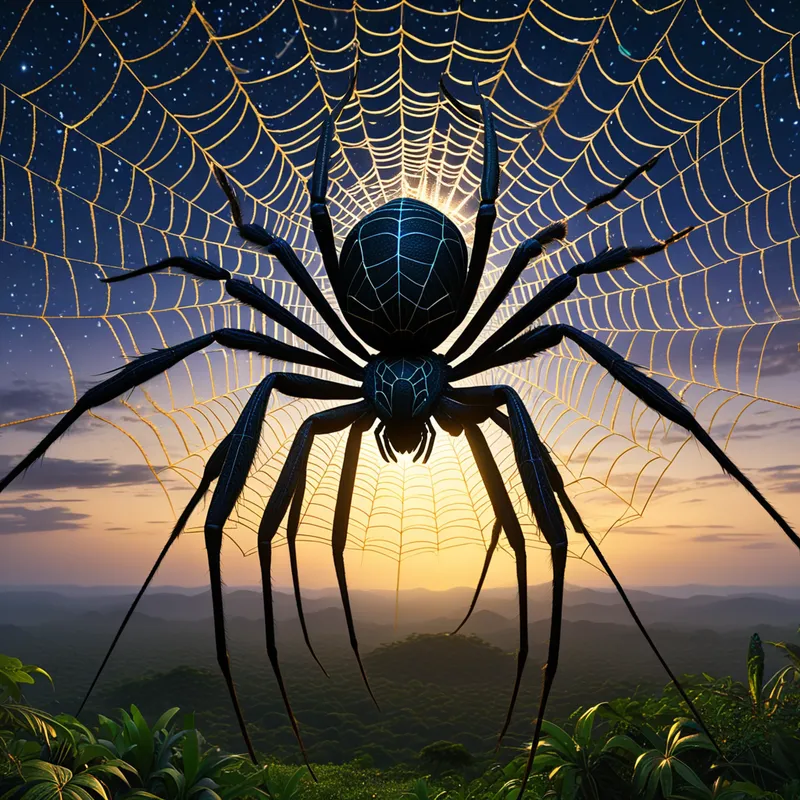
In the time before time, a spider, through patience and sacrifice, wove the first web, connecting all things and gifting humanity with the pattern of reality.
The Tale of The Spider Who Wove the First Web
In the time before time, when the world was soft and new, there was only the great, silent hum of potential. Nyame had scattered the stars like seeds, and Asase Ya cradled the first roots in her dark soil. But between the sky and the earth, there was a vast emptiness—a space of unspoken words, unconnected thoughts, and lonely journeys.
In this space lived Anansi, the spider. He was not yet the famed trickster of tales. He was a quiet observer, a thinker in eight-legged form. He watched the rain fall in isolated drops. He saw the wind blow without leaving a trace. He witnessed the first humans, children of the earth and sky, struggling to share their thoughts, their stories, their very souls across the distances that separated them. Their words fell to the ground like stones. Their dreams evaporated like morning mist.
A deep sorrow grew in Anansi’s heart—a sorrow for the loneliness of a disconnected creation. He climbed to the highest branch of the first iroko tree, where the breath of Nyame still lingered. He called out, not with a voice, but with the yearning of his spirit. “Great Nyame, Father of All,” his soul-spun prayer whispered, “the world is beautiful, but it is silent. Each being is an island. Where is the thread that binds? Where is the pattern that explains?”
The sky did not answer with thunder, but with a profound, resonant silence that was itself an answer. Anansi understood. The pattern was not given; it must be made. The connection was not found; it must be woven.
He descended to a sacred grove, a place where the veil between worlds was thin. There, he began the great work. From the very substance of his being—from his patience, his wisdom, his longing—he drew forth the first thread. It was not silk, but solidified intention. He anchored it to a stone of kra, the enduring self. He stretched it to a sprouting seed, symbol of potential. Back and forth, in and out, he moved. He danced a geometry of necessity. Each movement was a prayer. Each intersection, a meeting point of ideas.
The work was excruciating. To pull the thread from himself was to pull from his own life-force. He grew weak. His vibrant form dulled. The first web was not spun from abundance, but from sacrifice. As he wove the final, central strand, connecting all points to a single, sacred nexus, the world held its breath.
Then, with the first light of dawn touching the web, a miracle occurred. Dew from the breath of Asase Ya collected on the strands. Each droplet caught the light of Nyame’s sun, fracturing it into a thousand colors. In those droplets, the stories of the world began to reflect and refract. The wind, passing through, hummed a new song—the song of connection. The first human to see it did not see a trap, but a tapestry. They saw their own life, their relationships, their place in the cosmos, mirrored in that radiant, intricate design. Anansi, exhausted and transformed, had not just woven a web. He had woven the very principle of connection, the pattern of all patterns, the first and ultimate story.
Cultural Origins & Context
This foundational myth of the first web is woven into the oral traditions of several West African peoples, most prominently the Akan of Ghana and Côte d’Ivoire. It is a cornerstone of the vast narrative cycle surrounding Anansi, who evolves from this primordial creator-figure into the clever, sometimes mischievous, culture hero who brings stories, wisdom, and sometimes chaos to humanity.
The tale was not merely entertainment; it was a vital pedagogical and cosmological tool. Told by griots (oral historians, poets, and musicians) and elders by firelight, it served multiple societal functions. It explained the innate human need for and capacity to create systems—language, society, law, art. It positioned the spider not as a lowly insect, but as a divine architect, teaching respect for the intricate interconnectedness of the natural world. The myth also modeled the value of wisdom gained through patient observation and the transformative power of sacrificial creativity, establishing a spiritual and ethical framework for the community.
Symbolic Architecture
At its core, this myth is a profound map of [consciousness](/symbols/consciousness “Symbol: Consciousness represents the state of awareness and perception, encompassing thoughts, feelings, and experiences.”/) itself. The [Spider](/symbols/spider “Symbol: Represents creativity, feminine energy, and the weaving of destiny, as well as potential feelings of entrapment or anxiety.”/) is the archetypal [Creator](/symbols/creator “Symbol: A figure representing ultimate origin, divine power, or profound authorship. Often embodies the source of existence, innovation, or personal destiny.”/), but one who operates from a state of perceived lack or yearning. The empty [space](/symbols/space “Symbol: Dreaming of ‘Space’ often symbolizes the vastness of potential, personal freedom, or feelings of isolation and exploration in one’s life.”/) between sky and [earth](/symbols/earth “Symbol: The symbol of Earth often represents grounding, stability, and the physical realm, embodying a connection to nature and the innate support it provides.”/) represents the unformed psyche, the potential field of the mind before it structures experience.
The first web is not a physical object, but the primordial act of mind perceiving relationship where none existed—the birth of meaning from chaos.
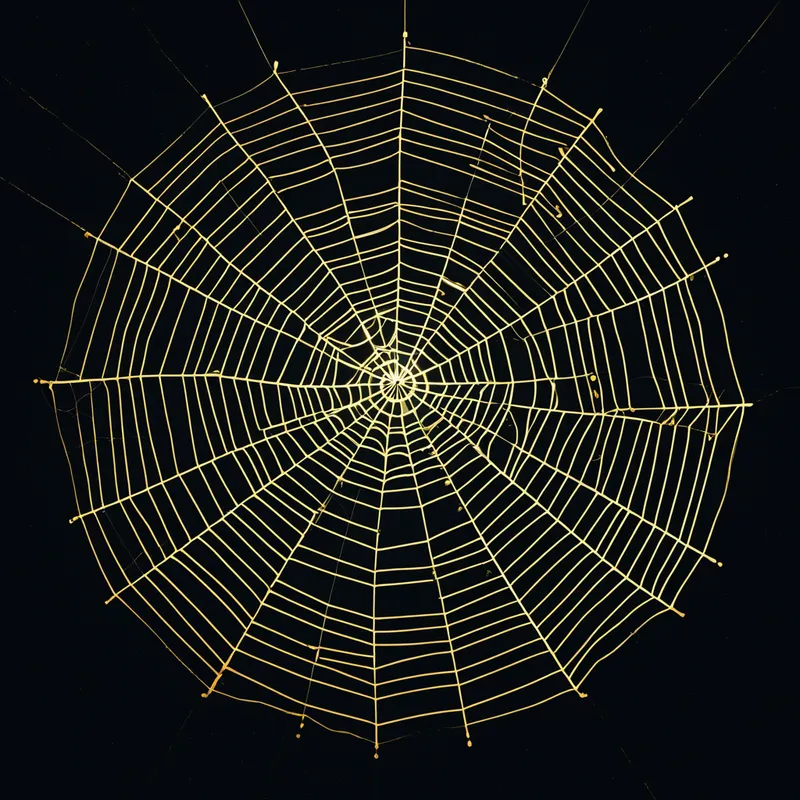
The web is the ultimate [symbol](/symbols/symbol “Symbol: A symbol can represent an idea, concept, or belief, serving as a powerful tool for communication and understanding.”/) of interconnectedness. Each strand is a thought, a [relationship](/symbols/relationship “Symbol: A representation of connections we have with others in our lives, often reflecting our emotional state.”/), a cause, an effect. The intersections are nodal points of realization—the “aha” moments where separate ideas [fuse](/symbols/fuse “Symbol: A safety device that breaks an electrical circuit when overloaded, symbolizing protection, limits, and controlled energy flow.”/) into new understanding. The central point, where all strands meet, symbolizes the integrated Self, the point of consciousness from which one can perceive the entire [pattern](/symbols/pattern “Symbol: A ‘Pattern’ in dreams often signifies the underlying structure of experiences and thoughts, representing both order and the repetitiveness of life’s situations.”/) of one’s [life](/symbols/life “Symbol: The symbol of ‘Life’ represents a journey of growth, interconnectedness, and existential meaning, encompassing both the joys and challenges that define human experience.”/). The sacrificial draining of Anansi’s own life-force to create it speaks to a fundamental psychological [truth](/symbols/truth “Symbol: Truth represents authenticity, honesty, and the quest for knowledge beyond mere appearances.”/): consciousness, the act of creating a coherent “world,” requires immense psychic [energy](/symbols/energy “Symbol: Energy symbolizes vitality, motivation, and the drive that fuels actions and ambitions.”/). We must give of our own undifferentiated being to forge the structures that will, in turn, define us.
The Dreamer’s Resonance
When this myth activates in the modern psyche, it often manifests in dreams of intricate networks: neural pathways, city grids, mycelial networks, or of course, spiders and webs. To dream of weaving a web, or being caught in one you are creating, signals a profound process of psychic integration underway.
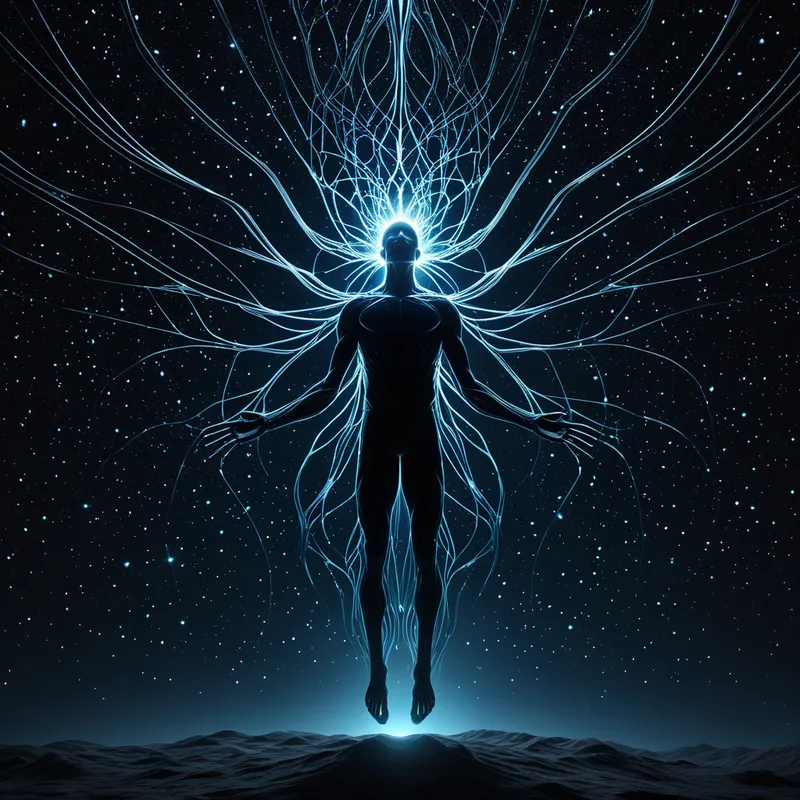
Somatically, this can feel like a tingling or buzzing awareness across the body, a literal feeling of “connecting the dots.” Psychologically, it is the process of linking disparate life experiences, traumas, talents, and relationships into a coherent narrative. The dreamer is doing the work of Anansi: taking the raw, isolated threads of memory and emotion and actively weaving them into a meaningful pattern. A dream of a beautiful, dew-covered web at dawn suggests successful integration and the dawning of new self-understanding. A dream of a torn or chaotic web may indicate a feeling of fragmentation, a life where the connections feel forced or broken, calling for a patient re-weaving.
Alchemical Translation
The myth models the alchemical opus, the great work of individuation. The prima materia, the raw material, is the lonely, disconnected state of the early psyche (“the empty space”). The spider’s sorrow is the nigredo, the darkening, the conscious recognition of this painful state that initiates the work.
The act of weaving is the albedo and citrinitas—the whitening and yellowing—processes of purification and illumination. Here, patience and careful observation (Anansi’s traits) are the essential solvents. Each strand laid is a conscious insight, a reconciled conflict, an accepted shadow. The sacrifice of life-force is non-negotiable; old, unconscious energies must be transmuted into the thread of conscious structure.
The completed web, glistening with reflected light, is the rubedo, the reddening, the final stage of the alchemical process: the creation of the Philosopher’s Stone, which in psychological terms is the achieved, resilient, and radiant Self.
For the modern individual, the “first web” we weave is our own operating system of consciousness. It is the narrative we construct to make sense of our existence. The myth teaches that this is not a passive process. We are all Anansi, called to the sacred grove of introspection. We must draw the thread from our own substance—our experiences, our pain, our joy—and actively, patiently, and sacrificially weave the unique, intricate, and beautiful pattern that is our authentic life. The gift is not the finished web, but the realization that we are both the weaver and the web, the creator and the creation, eternally capable of re-weaving our world.
Associated Symbols
Explore related symbols from the CaleaDream lexicon:
- Spider — The archetypal creator and weaver of fate, representing patience, strategic thinking, and the power to construct the reality-shaping patterns of consciousness.
- Web — The ultimate symbol of interconnectedness, representing the fabric of reality, destiny, neural networks, and the intricate system of relationships that define a life.
- Sacrifice — The essential act of giving up undifferentiated life-force or energy to create a higher-order structure of meaning, consciousness, or culture.
- Thread — The fundamental unit of connection, representing a thought, a story, a relationship, or a single line of destiny being drawn out and placed within a larger pattern.
- Dream — The inner realm where the weaving first takes place, the nocturnal workshop where the psyche connects disparate images and emotions into narrative meaning.
- Pattern — The emergent order from chaos, the visible design of the web that reveals the underlying logic, beauty, and interconnectedness of all things.
- Creator — The archetypal force that brings new forms into being, not from nothing, but from the raw material of longing, observation, and inner substance.
- Connection — The core principle gifted by the myth, the psychic and spiritual force that binds isolated experiences into a coherent whole, ending existential loneliness.
- Light — The illumination that occurs when the web is complete, representing consciousness, understanding, and the revelation of hidden beauty in the structure of life.
- Sky — The realm of potential, spirit, and divine inspiration (Nyame), from which the vision for the web is received.
- Earth — The realm of manifestation, body, and raw material (Asase Ya), which provides the anchor points and substance for the web’s creation.
- Journey — The patient, iterative process of weaving itself, representing the lifelong psychological work of building and understanding the self.