The Sphinx of Thebes Myth Meaning & Symbolism
A winged monster with a deadly riddle terrorizes Thebes until Oedipus solves it, revealing the tragic nature of man's journey toward self-knowledge.
The Tale of The Sphinx of Thebes
Hear now of a time when the air above Thebes grew heavy, not with storm, but with dread. The city, once proud beneath the gaze of Cadmus, was held in a grip of silent terror. For upon the sacred mountain path, the road that coiled like a serpent to the city gates, a sentinel had taken its throne. It was not a god, nor a titan, but a creature born of monstrous lineage: the Sphinx.
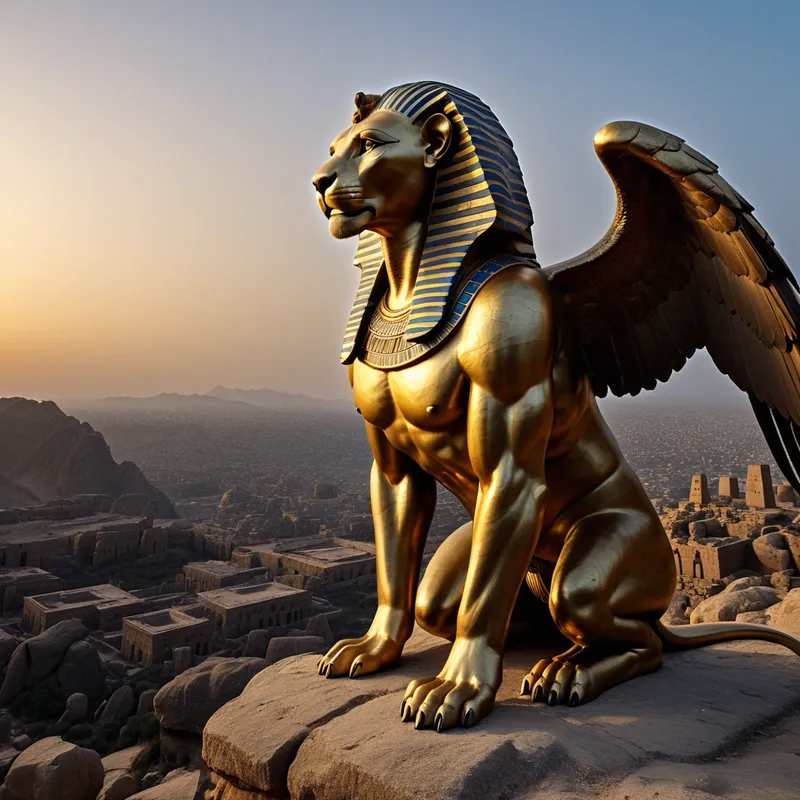
She was a vision of terrible beauty. Her body was that of a lioness, powerful and sleek, muscles coiled like ropes beneath a tawny hide. From her shoulders sprang the vast, feathered wings of an eagle, casting a great shadow that swept across the sun-baked rocks. But it was her face that froze the blood—the calm, knowing face of a woman, with eyes that held the chill of deep, still waters. She had been sent, some whispered, by the wrathful goddess Hera, or perhaps by the war god Ares, to punish the house of Thebes for its sins.
Her method was a cruel art. She did not pounce with claw and fang alone. She posed a riddle, a conundrum woven from the very thread of existence, spoken in a voice that was both melodious and cold as stone.
“What goes on four legs in the morning, two legs at noon, and three legs in the evening?”
This was her toll. The young men of Thebes, the pride of their families, drawn by fate or foolish courage, would ascend the path. They would stand before her, smelling the dry dust and the faint, wild scent of her form. They would hear the riddle. And when, in their desperation, they guessed wrong—a dog, a river, the sun itself—the Sphinx would unleash her fury. With a scream that tore the sky, she would descend, and another son of Thebes would be dashed upon the rocks below, a broken offering to an unanswerable question. The city mourned. King Laius was dead, lost on a journey, and now his brother, Creon, acting as regent, promised the throne and the hand of the widowed queen, Jocasta, to any man who could break the curse.
Then came a traveler, a man with a limp in his soul and a prophecy dogging his steps: Oedipus. He had fled his home in Corinth, fearing an oracle that said he would kill his father and marry his mother. Weary, angry at the gods, he climbed the path to Thebes. He found the creature waiting, her eyes holding a strange recognition, as if she had been expecting him all along.
The riddle hung in the air between them. Oedipus, the man who had already walked many roads, listened. He did not think of beasts or celestial bodies. He thought of life. Of its arc. And the answer, so simple, so devastating in its truth, came to him.
“Man,” he said, his voice steady despite the pounding of his heart. “For in the morning of his life, he crawls on all fours as an infant. At the noon of his life, he walks upright on two legs. And in the evening of his life, he supports himself with a staff, a third leg.”
A profound silence followed. The Sphinx did not scream. She did not attack. She stared at this mortal who had seen the pattern she guarded. In that moment, the power of the riddle—its ability to kill by revealing ignorance—was broken by the power of its answer, which revealed a truth too profound to bear. With a cry that was neither of rage nor triumph, but of a purpose fulfilled and a vigil ended, the Sphinx hurled herself from the precipice, shattering on the rocks below. The road to Thebes was open. The city hailed Oedipus as its savior and king. But the true answer to the riddle, and the deeper knowledge it implied, was a burden he would carry straight into the heart of his own tragedy.
Cultural Origins & Context
The myth of the Sphinx of Thebes is most famously preserved in the Theban Cycle, particularly through the tragedies of Sophocles in his Oedipus Rex. Its roots, however, are likely far older, echoing through an oral tradition that predates written Greek literature. The figure of the riddling monster is a pan-cultural archetype, but the Greek Sphinx—distinct from the Egyptian guardian—embodies a specific Hellenic tension between raw, chthonic power and the defining human faculty of logos, reasoned speech and intellect.
In the social context of ancient Greece, the myth served multiple functions. Performed in the civic-religious space of the theater, it was a collective ritual. It reinforced the cultural value of cleverness (mētis) and the peril of ignorance. The Sphinx’s riddle was not just a puzzle; it was a boundary marker. To solve it was to prove one’s worth as a civilized, thinking being, worthy of entering the polis and assuming kingship. To fail was to be cast out, literally, into the realm of death and chaos she represented. The myth also functioned as a crucial narrative hinge, the triumphant prelude to the devastating tragedy of Oedipus, setting the stage for the ultimate exploration of fate, knowledge, and self-blinding revelation that defines the Theban saga.
Symbolic Architecture
The Sphinx is not merely a monster; she is the embodiment of the Ultimate Question that blocks the path to selfhood. She represents the terrifying, feminine aspect of the unconscious that guards the threshold to deeper knowledge. Her composite form is a symbolic totality: the lion’s body signifies raw instinct and animal power; the eagle’s wings represent spiritual aspiration and height; the human face is consciousness itself, but one turned enigmatic and deadly.
The guardian of the threshold does not demand a fight, but a realization. Its power is annulled not by force, but by the light of conscious understanding.
The riddle is the core of her power. It is an initiation test posed by the psyche itself. Its subject—Man—is the answer the seeker must become to pass. Oedipus’s correct answer is a moment of profound psychological integration. He names the human condition in its totality: dependency, autonomy, and frailty. In doing so, he does not just defeat an external monster; he temporarily synthesizes the disparate parts of his own being. However, his answer is intellectual. He knows about man, but he does not yet know himself. The tragedy that follows is the brutal, lived experience of that riddle applied to his own life.
The Dreamer’s Resonance
When the pattern of the Sphinx manifests in modern dreams, it rarely appears as a literal winged lion. Instead, the dreamer encounters an impossible problem, a looming authority figure with an unmeetable demand, or a situation where failure feels catastrophic and final. The somatic feeling is one of paralysis, of being “stuck” on a path with a terrible price for proceeding ignorantly.
Psychologically, this dream signals a critical impasse in the individuation process. The dreamer is at a life threshold—perhaps a career change, the end of a relationship, or a deep internal crisis—where old identities and solutions no longer work. The “riddle” is the new, more complex demand of the Self. The dream-Sphinx represents the accumulated, unconscious anxiety about this step forward, often fused with parental or societal expectations (the “Hera” or “Ares” that sent it). To remain is to stagnate; to guess blindly is to be psychically “dashed on the rocks.” The dream calls for a period of deep introspection, to find the personal answer that integrates one’s entire life journey, not just a clever, borrowed solution.

Alchemical Translation
The myth models the alchemical process of solutio (dissolution) and coagulatio (coagulation), the breaking down of the old, rigid form and its reconstitution into a higher synthesis. The Sphinx’s reign represents the nigredo, the blackening, where the conscious ego is paralyzed by the shadowy, complex demands of the unconscious. Oedipus’s journey to the mountain is the separatio, the separation from his old life (Corinth) and his confrontation with the material.
His solving of the riddle is the moment of illuminatio, a flash of insight that names and thus begins to integrate the shadow. The Sphinx’s self-destruction symbolizes the dissolution of the old, monolithic complex once its secret is known.
The treasure hard to attain is not the kingdom or the bride, but the conscious relationship with the totality of one’s own nature, from crawling infant to dying elder.
For the modern individual, the alchemical translation is clear. Our “Thebes” is a state of wholeness we wish to enter. Our “Sphinx” is the inner complex—often a knot of fear, pride, and inherited narrative—that blocks the way with an ultimatum. The work is not to slay it with willpower, but to engage with its riddle: to contemplate the full arc of our being, our dependencies, our strengths, and our inevitable vulnerabilities. The answer that releases its grip is always a truth about ourselves we have been avoiding. The triumph is temporary, as Oedipus shows, for solving the outer riddle only grants entry to the far more painful inner one. But it is the essential first step in the psychic transmutation from one who is acted upon by fate, to one who, through painful self-knowledge, begins to participate consciously in its unfolding.
Associated Symbols
Explore related symbols from the CaleaDream lexicon: