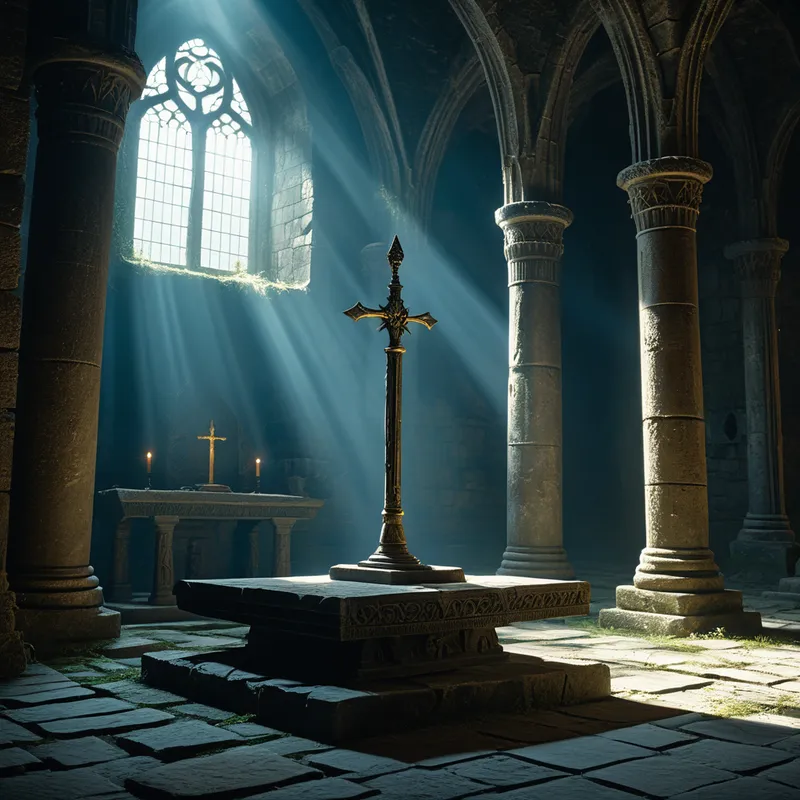
The Spear of Longinus Myth Meaning & Symbolism
The sacred lance that pierced Christ's side, later found by Arthur's knights, symbolizing the wound that holds the key to redemption and kingly power.
The Tale of The Spear of Longinus
Listen now, and hear the tale not of a sword, but of a spear. In the time of shadows, when the world was rent by the death of a god, a Roman centurion stood upon a hill of skulls. The air was thick with the scent of iron and myrrh, the sky a bruised purple. His name was Longinus, a man of duty, his eyes clouded not by malice, but by the dust of a thousand marches and the weariness of a soul grown hard as his armor.
Before him hung the King of the Jews, life ebbing from a crown of thorns. A cry tore the heavens, and then… silence. To confirm the passing, Longinus raised his hasta. It was not an act of cruelty, but of final, grim office. He thrust the point forward. It met resistance, then slid home. From the wound flowed not just blood, but water—a torrent of grace and grief that splashed upon the soldier’s hands, his face. In that moment, the scales fell from his eyes. The hardness in his heart shattered like ice in spring. He dropped to his knees in the mud, the spear falling from his grasp, now a thing both cursed and consecrated.
Centuries turned. The spear, this Lance of Destiny, was lost to the world, its power sleeping like a dragon in a deep hoard of time. Then arose a king, Arthur, who pulled a sword from a stone to claim a hollow throne. He built a fellowship of the finest knights, the Round Table, and set them to a quest not for land or gold, but for the most sacred of relics: the Sangreal, the Holy Grail.
The quest was a mirror, showing each knight not a path, but his own soul. Many failed, lost in forests of their own pride or desire. But for the purest, like Galahad, and the seeking, like Percival, the way led to a mysterious, hidden castle—the Castle of Corbenic. There, in a chamber vibrating with silent power, they witnessed a solemn procession. Maidens carried the veiled Grail. And before it, a page bore a spear.
This was no warrior’s weapon. From its silver tip fell a single, perpetual drop of blood into a vessel of gold. The air hummed with the memory of the hill, the scent of the storm, the echo of the cry. The spear was the companion to the cup; the wound to the healing; the question to the answer. To behold it was to understand that the quest was never for an object, but for the integration of a divine fracture—the piercing that made wholeness possible. The knight who comprehended this did not seize the spear; he was pierced by its meaning, and in that spiritual wounding, found his quest’s end.

Cultural Origins & Context
The weaving of the Spear of Longinus into the tapestry of Arthurian romance is a later, profoundly Christianized thread. The core Arthurian legends, rooted in Welsh and Brythonic folklore, originally centered on a warlord defending Britain from Saxon invasion. With the work of writers like Chrétien de Troyes and, most significantly, the anonymous authors of the Vulgate Cycle in the 13th century, the narratives were transformed into spiritual allegories for a medieval Christian audience.
The spear entered this mythos as part of the Grail literature. It functioned as a crucial symbolic counterpart to the Grail itself. Told in monastic scriptoria and recited in noble courts, these stories served a dual societal function. For the aristocracy, they provided a model of chivalry redirected from martial conquest to spiritual pursuit. For the wider culture, they offered a mythic framework for understanding divine grace, sin, and redemption. The spear was not merely a relic; it was a narrative device that deepened the mystery, insisting that the path to the divine (the Grail) necessarily passes through the reality of sacred suffering and sacrifice (the Spear).
Symbolic Architecture
The Spear of Longinus is an axis mundi of profound paradox. It is the instrument of death that confers life; the object of violence that becomes a font of grace.
The wound is not the opposite of wholeness, but its most sacred aperture.
Psychologically, the spear represents the necessary, transformative wounding of the ego. The centurion Longinus is the archetypal unconscious man, acting out of conditioned duty and spiritual blindness. The piercing is an act that, in its very completion, shatters the perpetrator’s worldview. The blood and water that touch him symbolize the inundation of the conscious mind by the contents of the unconscious—the lifeblood of instinct and the cleansing waters of spirit. He is baptized not in water, but in the direct experience of the numinous through an act he himself committed.
In the Grail Castle, the bleeding spear alongside the Grail establishes a cosmic syzygy. The Grail (the feminine, containing vessel) and the Spear (the masculine, penetrating principle) together symbolize the coniunctio oppositorum—the sacred marriage of opposites required for creation, healing, and individuation. The questing knight who understands this sees that the goal is not to possess, but to be reconstituted by this unity. The perpetual drop of blood signifies the timeless, ongoing nature of this sacrifice in the psychic realm; the divine is continually wounded by the reality of the human condition, and from that wound flows the potential for redemption.
The Dreamer’s Resonance
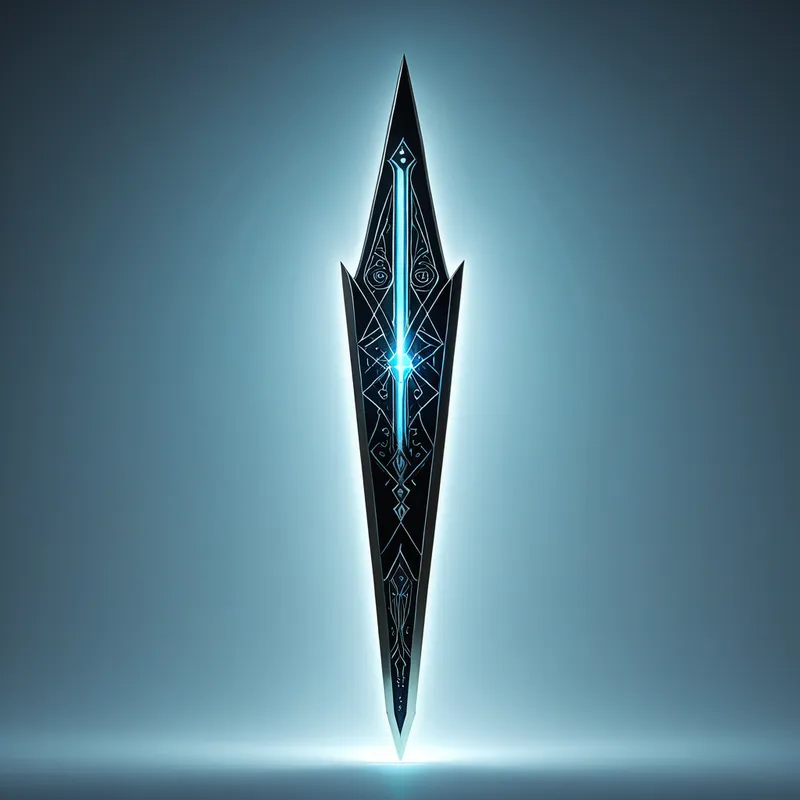
When the Spear of Longinus manifests in a modern dream, it signals a profound somatic and psychological process: the encounter with the Sacred Wound. This is not a trivial injury, but a core fracture related to one’s essential nature or destiny.
The dreamer may find themselves holding the spear, feeling its terrifying power and immense guilt. This somatic state often correlates with a waking-life situation where one’s actions, perhaps undertaken out of duty, ambition, or ignorance, have caused a deep rupture—in a relationship, a career, or one’s self-image. The psyche is presenting the tool of the wound, forcing a confrontation with one’s own capacity to pierce and be pierced.
Alternatively, the dreamer may be the one observing the bleeding spear, filled with awe and sorrow. This resonates with the process of acknowledging a wound received—a betrayal, a loss, a foundational trauma. The perpetual drop of blood is the psyche’s way of stating that this wound is alive, it is still feeding the unconscious, and it holds a mystery. The dream is an invitation to stop trying to stanch the flow and instead to contemplate it, to ask what sacred knowledge or potential for compassion is contained within this unhealed place. The somatic feeling is often one of poignant ache mixed with eerie calm.

Alchemical Translation
The myth of the Spear models the alchemical stage of nigredo and the crucial transition to albedo. For the modern individual on the path of individuation, the quest for the Grail (symbolic of the Self, wholeness, or life’s ultimate meaning) inevitably leads to the discovery of the Spear.
One does not find the treasure without first confronting the guardian of the threshold, which is often one’s own unwitting act of violence or profound vulnerability.
The initial thrust of the spear represents the necessary dissolution. This is the painful deconstruction of the persona, the crumbling of lifelong illusions, the “piercing” insight that shatters a naive worldview. Like Longinus, we often perform this act ourselves through choices that lead to crisis. This is the nigredo, the dark night of the soul, where one is stained by the blood and water of one’s own unconscious contents.
The alchemical work begins with holding that spear—owning one’s wounding capacity and woundedness—without looking away. The transformation occurs when, like the questing knight in Corbenic, one can behold the spear and the Grail together. This is the albedo. It is the realization that the wound (the spear) and the healing (the Grail) are two aspects of the same divine process. The psychic transmutation is the integration of this paradox: our deepest fractures are not flaws to be hidden, but sacred sites where the transcendent enters our humanity. To achieve a degree of wholeness, we must carry the conscious knowledge of the spear within us, not as a weapon, but as a relic—a testament to the cost of consciousness and the grace that flows only through broken vessels. The quest ends not in possession, but in this humble, awe-filled understanding.
Associated Symbols
Explore related symbols from the CaleaDream lexicon: