
The Space Between Thoughts Myth Meaning & Symbolism
A journey into the silent, luminous gap between mental formations, revealing the unconditioned ground of being beyond all stories.
The Tale of The Space Between Thoughts
Listen. Before the first word, before the first memory, there is a silence so vast it contains all sound. This is not our story, but the story of what watches all stories unfold.
In the ancient grove of Bodhi, a prince sat with his back against [the world](/myths/the-world “Myth from Tarot culture.”/). His name was Siddhartha, but the name was just another thought, another ripple on a deep pond. Around him, the army of Mara raged. They were not demons of flesh, but of mind. Regrets rose like choking smoke—visions of a palace left behind. Desires whispered with the voices of lost loves, promising pleasure if he would only move. Doubts swarmed like locusts, hissing that his quest was folly, that this silence was mere emptiness, a void of meaning.
He did not fight them. He did not welcome them. He simply sat, and in sitting, he began to notice the cracks in the onslaught. Between the crashing wave of regret and the searing flame of desire, there was… a gap. A sliver of pure, unclaimed sky. Between the drumbeat of doubt and [the chorus](/myths/the-chorus “Myth from Theater culture.”/) of fear, a breath. Not his breath, but the breath of existence itself.
Mara, seeing his army falter, sent his final weapon: his own daughters, embodiment of Ultimate Delight. They danced a dance of perfect meaning, of consummate story. “Be this,” they sang. “Achieve that. Become the hero, the savior, the enlightened one!” The seduction was not of flesh, but of identity—the most profound thought of all: I am.
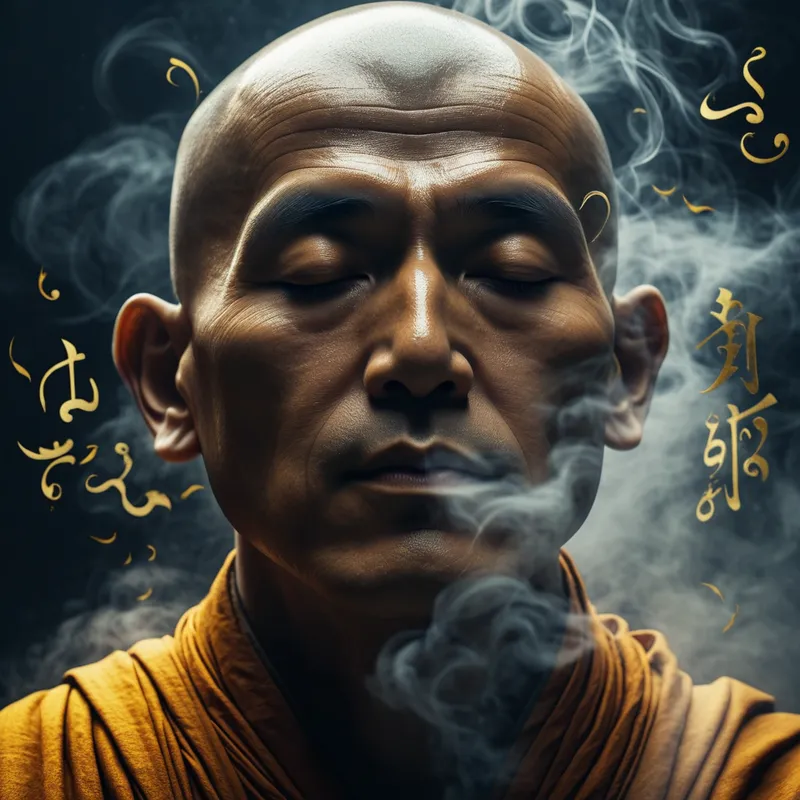
The prince touched [the earth](/myths/the-earth “Myth from Hindu culture.”/). His fingers brushed the cool, enduring soil. And in that touch, he did not find an answer, but a doorway. He let the thought “I am the one who is tempted” arise. He watched it. And then, he let it go. In the release, he did not fall into nothingness. He fell into the space between the thought of “I” and the next thought. It was not blank. It was vibrant, alive, luminous with a knowing that knew no object. It was the unconditioned ground from which all conditions—all thoughts, all sensations, all armies of Mara—arose and passed away like reflections on a still lake.
The armies vanished, not in defeat, but because their host—the clinging mind—had ceased to give them quarters. The dawn star rose in the east, and it is said its light was no brighter than the peace that now rested, unmoving, in that space between all things.
Cultural Origins & Context
This is not a myth of gods and monsters in the traditional sense, but the core narrative of the human mind as presented in the Buddhist tradition, particularly in the Pali Suttas. The “story” is the biographical account of [the Buddha](/myths/the-buddha “Myth from Buddhist culture.”/)’s awakening, but its true transmission has always been an oral, experiential one, passed from teacher to student in the context of meditation instruction.
Its societal function was revolutionary. In the context of ancient Indian philosophies obsessed with eternal souls (atman) and cosmic principles (brahman), this “myth” pointed to a freedom found not in acquiring a better identity or merging with a divine source, but in discerning the fundamental nature of the cognitive process itself. It was taught not to entertain, but to instruct; its listening was meant to be a form of practice, training the mind to look for the very gaps it describes. It democratized liberation, making it accessible not through ritual or birthright, but through direct investigation of one’s own moment-to-moment experience.
Symbolic Architecture
The myth’s [architecture](/symbols/architecture “Symbol: Architecture in dreams often signifies structure, stability, and the framing of personal identity or life’s journey.”/) is a precise map of the [psyche](/myths/psyche “Myth from Greek culture.”/). Siddhartha under the [Bodhi tree](/symbols/bodhi-tree “Symbol: The sacred fig tree under which Siddhartha Gautama attained enlightenment, symbolizing awakening, wisdom, and the interconnectedness of all life.”/) represents the embodied self, grounded in mindfulness, facing the totality of its own content. Mara and his armies symbolize the entire phenomenal world of [samsara](/myths/samsara “Myth from Buddhist culture.”/)—not as an external evil, but as the projected [drama](/symbols/drama “Symbol: Drama signifies narratives, emotional expression, and the exploration of human experiences.”/) of craving, aversion, and delusion. Every worry, every fantasy, every [memory](/symbols/memory “Symbol: Memory symbolizes the past, lessons learned, and the narratives we construct about our identities.”/) of [loss](/symbols/loss “Symbol: Loss often symbolizes change, grief, and transformation in dreams, representing the emotional or psychological detachment from something or someone significant.”/) or [anticipation](/symbols/anticipation “Symbol: A state of excited expectation about future events, often involving hope, anxiety, or readiness for what is to come.”/) of gain is a [soldier](/symbols/soldier “Symbol: A soldier in dreams often symbolizes duty, sacrifice, and the struggle for self-discipline. It can also indicate feelings of loyalty or conflict, both externally and within oneself.”/) in Mara’s legion.
The hero’s journey is not to slay the dragon, but to realize the dragon is made of smoke, and you are the sky that holds it.
The pivotal [moment](/symbols/moment “Symbol: The symbol of a ‘moment’ embodies the significance of transient experiences that encapsulate emotional depth or pivotal transformations in life.”/)—touching the [earth](/symbols/earth “Symbol: The symbol of Earth often represents grounding, stability, and the physical realm, embodying a connection to nature and the innate support it provides.”/)—is the ultimate [gesture](/symbols/gesture “Symbol: A non-verbal bodily movement conveying meaning, emotion, or intention, often symbolic in communication and artistic expression.”/) of grounding in bare [reality](/symbols/reality “Symbol: Reality signifies the state of existence and perception, often reflecting one’s understanding of truth and life experiences.”/), the direct sensory experience prior to conceptualization. It is a return to the suchness of things. The [space](/symbols/space “Symbol: Dreaming of ‘Space’ often symbolizes the vastness of potential, personal freedom, or feelings of isolation and exploration in one’s life.”/) between thoughts, then, is the central [symbol](/symbols/symbol “Symbol: A symbol can represent an idea, concept, or belief, serving as a powerful tool for communication and understanding.”/). It is [Sunyata](/myths/sunyata “Myth from Buddhist culture.”/) in its most intimate, accessible form. It is not a [thing](/myths/thing “Myth from Norse culture.”/), but the suchness of [awareness](/symbols/awareness “Symbol: Conscious perception of self, surroundings, or internal states. Often signifies awakening, insight, or heightened sensitivity.”/) itself, unconditioned and deathless.
This space is not a refuge from experience, but the very field in which experience is known. It is the mirror, not the reflection.
Psychologically, it represents pure [consciousness](/symbols/consciousness “Symbol: Consciousness represents the state of awareness and perception, encompassing thoughts, feelings, and experiences.”/) without an object, the observing Self distinct from [the ego](/myths/the-ego “Myth from Jungian culture.”/)’s narrative. It is the gap in conditioning where genuine [choice](/symbols/choice “Symbol: The concept of choice often embodies decision-making, freedom, and the multitude of paths available in life.”/) and freedom become possible.
The Dreamer’s Resonance
When this myth stirs in the modern unconscious, it rarely appears as an ancient prince under a tree. Instead, it manifests in dreams of profound liminality. The dreamer finds themselves in an elevator between floors, forever. They walk down a hallway where doors labeled with their worries (“Work,” “Family,” “Past”) remain shut, and the hallway itself stretches into a peaceful, white infinity. They may float in a silent, dark ocean, or stand in a library where all the books are blank.
The somatic experience upon waking is key: a deep, resonant calm, often accompanied by a sense of expansion or lightness. Psychologically, this dream pattern signals a crucial process. The psyche is practicing dis-identification. The ego, the “thought-made self,” is undergoing a temporary dissolution, allowing the dreamer to taste the ground of being. It often occurs during periods of intense stress or life transition, when the habitual narrative of self is overloaded and the system seeks respite in the foundational awareness beneath the story. It is not an escape, but a homecoming to the psyche’s most basic, silent operating layer.

Alchemical Translation
The alchemical work modeled here is the transmutation of identified suffering into liberating awareness. The base metal is the egoic mind, which takes every thought, feeling, and sensation to be solid, real, and self-defining. The fire of [the opus](/myths/the-opus “Myth from Alchemical culture.”/) is sustained, gentle attention.
The process begins with observation (watching Mara’s armies). This is the [nigredo](/myths/nigredo “Myth from Alchemical culture.”/), the blackening, where one confronts the shadowy, chaotic content of the mind without flinching. The crucial alchemical secret is in the next step: not to transform the content, but to notice [the vessel](/myths/the-vessel “Myth from Alchemical culture.”/) that holds it. This is the discovery of the space—the albedo, or whitening. The impurity (identification) begins to separate from the pure (awareness).
The goal of this alchemy is not to create a perfected ego, but to discover the gold that was never not there: the innate, radiant nature of mind itself, always present in the gap.
Finally, the [rubedo](/myths/rubedo “Myth from Alchemical culture.”/), or reddening, is the integration. It is not that thoughts cease, but that they arise within and as the open space, no longer staining it. One returns to the world—to relationships, work, and creativity—but from the unshakable foundation of the “earth-toucher.” The individual is no longer solely the thinker, but the spacious, compassionate awareness within which thinking, feeling, and being unfold. This is the culmination of individuation: not a solidified self, but a Self realized as boundless, clear, and at peace with the perpetual, beautiful flux of its own manifestations.
Associated Symbols
Explore related symbols from the CaleaDream lexicon: