The Soul Bird Suns Myth Meaning & Symbolism
A myth of celestial birds whose flight creates the suns, embodying the soul's journey from fragmentation to wholeness through courage and sacrifice.
The Tale of The Soul Bird Suns
Listen, and hear the tale whispered on the wind that sweeps the high steppe, a story older than the first horse’s hoofbeat on the eternal grass. In the time before time, when the world was a cradle of deep, silent blue, there was no sun. Only the Etugen, the dark and nurturing earth, and the Tengri, the vast and empty sky, existed in a breathless embrace. The people, the animals, the very stones slept in a twilight without warmth or shadow.
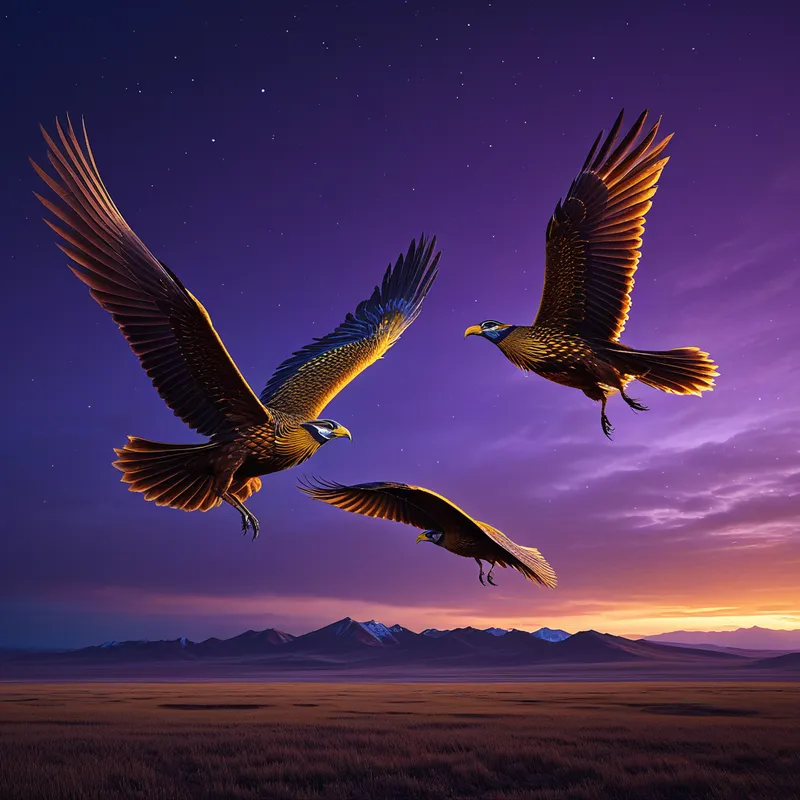
But in the secret heart of the World Mountain, where the roots of reality drink from the Dalai, three great birds were born from a single, silent wish of the earth. They were the Sülde Tengeriin Shuvuun Nars, the Soul Birds of the Heavenly Sun. Their feathers were not of quill and keratin, but of condensed potential, one of Dawn’s promise, one of Day’s strength, and one of Dusk’s memory. They knew their purpose: to bring light by becoming light.
The eldest, with feathers of molten copper, stepped to the eastern lip of the world. With a cry that cracked the silence like the first thunder, it beat its wings. It did not fly through the sky, but into it, its form unraveling into a great, blazing disc that painted the heavens in rose and gold. But the effort was immense. As it ascended, it felt the cold void of Tengri seeking to extinguish its fire. It had to pour its very essence, its sülde (soul-spirit), into its flight, sacrificing its singular bird-form to become the source of dawn.
The second, with feathers of brilliant gold, saw its sibling’s transformation and felt not fear, but a fierce resolve. It launched itself into the now-brightening sky to follow the path. Its flight was the steady, burning arc of noon, a relentless offering of vitality that warmed the soil and gave life its rhythm. Yet, to maintain this sacred duty, it too had to continually sacrifice, to burn a part of itself each day to fuel the great fire, knowing it must dive into the western abyss each evening, spent and dim.
The youngest, with feathers of shimmering electrum, watched the cycle of sacrifice—the glorious birth and the painful descent. Its task was the most perilous: to carry the sun’s essence through the underworld of the night, to be reborn each dawn. Its flight was invisible to the waking world, a desperate, guided journey through the land of shadows and forgotten things, protecting the fragile seed of light within its breast. Each night was a battle against dissolution, a journey where it was neither bird nor sun, but a lonely, determined spark in absolute darkness.
And so the cycle was forged. Not by a command, but by a courageous choice. Not by a single act, but by an eternal, willing sacrifice. The birds, in becoming the suns, ceased to be themselves, yet in doing so, they became the very pulse of the world. Their flight is the day; their sacrifice, the light; their endless journey, the promise that darkness is never final, but a passage.
Cultural Origins & Context
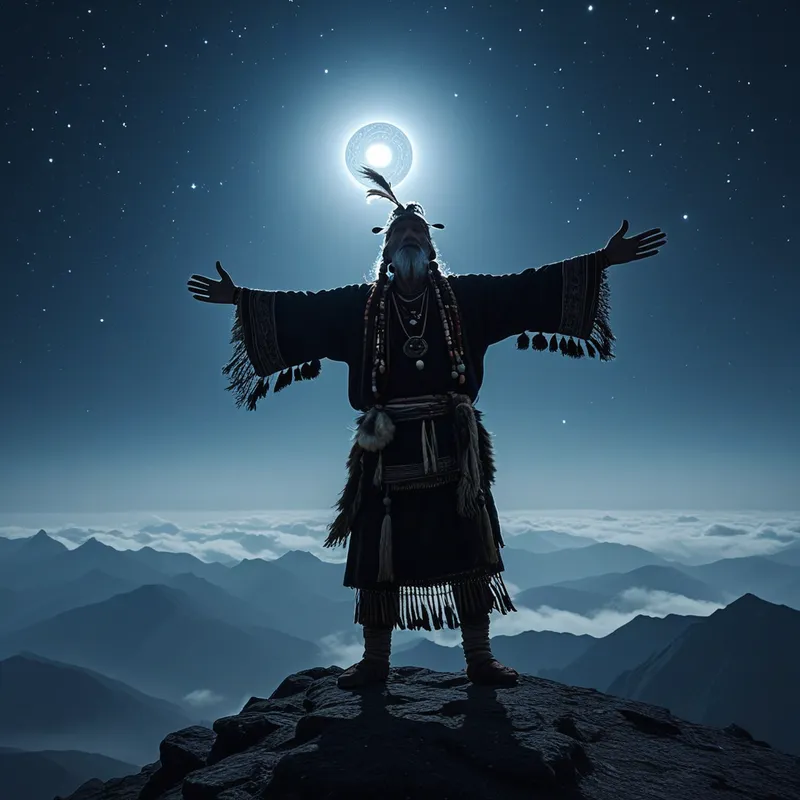
This myth finds its roots in the ancient, animistic worldview of the Mongolian peoples, where every mountain, river, and sky held a conscious spirit (ezen). It was not a story confined to a single sacred text, but a living narrative carried in the oral traditions of shamans (böö) and storytellers. Recited during the long winter nights in the warmth of the ger, or invoked in rituals seeking harmony between earth (gazar) and sky (tenger), the tale served a profound societal function.
It explained the cosmic order—why the sun rises and sets—but more importantly, it modeled the ideal relationship between the individual and the cosmos. The soul birds’ willing sacrifice for the greater whole mirrored the nomadic ethos of community survival, where the individual’s needs were secondary to the tribe’s. The myth taught resilience: just as the sun-bird endures the terrifying journey through the underworld each night, so too must people endure hardship, trusting in the cyclical nature of life and the eventual return of the light. It was a spiritual map, charting a course of courage, duty, and the ultimate offering of one’s essence for a purpose greater than oneself.
Symbolic Architecture
At its core, the myth of the [Soul](/symbols/soul “Symbol: The soul represents the essence of a person, encompassing their spirit, identity, and connection to the universe.”/) [Bird](/symbols/bird “Symbol: Birds symbolize freedom, perspective, and the connection between the earthly and spiritual realms, often representing the soul’s aspirations or personal growth.”/) Suns is a profound [allegory](/symbols/allegory “Symbol: A narrative device where characters, events, or settings represent abstract ideas or moral qualities, conveying deeper meanings through symbolic storytelling.”/) for the [structure](/symbols/structure “Symbol: Structure in dreams often symbolizes stability, organization, and the framework of one’s life, reflecting how one perceives their environment and personal life.”/) and [journey](/symbols/journey “Symbol: A journey in dreams typically signifies adventure, growth, or a significant life transition.”/) of the psyche. The three birds represent different aspects of the [soul](/symbols/soul “Symbol: The soul represents the essence of a person, encompassing their spirit, identity, and connection to the universe.”/) or [consciousness](/symbols/consciousness “Symbol: Consciousness represents the state of awareness and perception, encompassing thoughts, feelings, and experiences.”/).
The soul is not a singular, static stone, but a flight of three—the impulse, the action, and the memory—circling the heart of the self.
The first bird, becoming the [dawn](/symbols/dawn “Symbol: The first light of day, symbolizing new beginnings, hope, and the transition from darkness to illumination.”/), symbolizes the [impulse](/symbols/impulse “Symbol: A sudden, powerful urge or drive that arises without conscious deliberation, often linked to primal instincts or emotional surges.”/), the new [idea](/symbols/idea “Symbol: An ‘Idea’ represents a spark of creativity, innovation, or realization, often emerging as a solution to a problem or a new outlook on life.”/), the spark of inspiration or the courageous first step into the unknown. Its sacrifice is the [death](/symbols/death “Symbol: Symbolizes transformation, endings, and new beginnings; often associated with fear of the unknown.”/) of pure potential to become manifest [reality](/symbols/reality “Symbol: Reality signifies the state of existence and perception, often reflecting one’s understanding of truth and life experiences.”/). The second bird, the steady sun of day, represents the sustaining will, the conscious ego that must labor, expend [energy](/symbols/energy “Symbol: Energy symbolizes vitality, motivation, and the drive that fuels actions and ambitions.”/), and maintain order in the face of [life](/symbols/life “Symbol: The symbol of ‘Life’ represents a journey of growth, interconnectedness, and existential meaning, encompassing both the joys and challenges that define human experience.”/)’s [entropy](/symbols/entropy “Symbol: In arts and music, entropy represents the inevitable decay of order into chaos, often symbolizing creative destruction, impermanence, and the natural progression toward disorder.”/). The third, navigating the [night](/symbols/night “Symbol: Night often symbolizes the unconscious, mystery, and the unknown, representing the realm of dreams and intuition.”/), is the unconscious self, the [carrier](/symbols/carrier “Symbol: A tool or object that transports, holds, or conveys something from one place to another, often representing responsibility, burden, or the movement of ideas.”/) of the vital spark through the darkness of the unknown, of [trauma](/symbols/trauma “Symbol: A deeply distressing or disturbing experience that overwhelms the psyche, often manifesting in dreams as unresolved emotional wounds or psychological injury.”/), of all that is repressed and unseen. Its journey is the essential, hidden work of the psyche that makes [rebirth](/symbols/rebirth “Symbol: A profound transformation where old aspects of self or life die, making way for new beginnings, growth, and renewal.”/) possible.
The cyclical [flight](/symbols/flight “Symbol: Flight symbolizes freedom, escape, and the pursuit of one’s aspirations, reflecting a desire to transcend limitations.”/)—the daily death and rebirth of the sun—mirrors the psychological process of renewal. We cannot shine indefinitely without a [period](/symbols/period “Symbol: Periods in dreams can symbolize cyclical patterns, renewal, and the associated emotions of loss or change throughout life.”/) of descent, of introspection, and of navigating our inner shadows. The myth posits that wholeness (büren) is not a state of constant light, but the [acceptance](/symbols/acceptance “Symbol: The experience of being welcomed, approved, or integrated into a group or situation, often involving validation of one’s identity or actions.”/) and [integration](/symbols/integration “Symbol: The process of unifying disparate parts of the self or experience into a cohesive whole, often representing psychological wholeness or resolution of internal conflict.”/) of this essential, rhythmic journey between the poles of our being.
The Dreamer’s Resonance
When this myth stirs in the modern dreamer, it often signals a critical phase of psychic integration or a call to a daunting but necessary sacrifice. To dream of a brilliant bird struggling to take flight may reflect an awakening talent or spiritual calling that feels costly to pursue—the fear of “burning up” one’s old identity. To dream of a sun that is a wounded bird, or a light that flickers and dies, can point to exhaustion of the sustaining ego, a “burnout” where one’s vital energy feels consumed by daily demands with no period of restorative darkness.
The most potent resonance comes in dreams of the night journey: finding a small, warm, golden egg in a dark cave; guiding a faint light through a labyrinth; or hearing the desperate flutter of wings in a void. These are somatic echoes of the third bird’s task. They indicate that the dreamer is in the midst of a profound inner transition, carrying the fragile core of their identity through a period of depression, grief, or deep uncertainty. The dream is not a warning of failure, but a recognition of the mythic scale of the inner work being undertaken—the soul’s necessary voyage through its own underworld to achieve rebirth.
Alchemical Translation
For the individual on the path of individuation—the process of becoming psychologically whole—the Soul Bird Suns offer a master blueprint for psychic transmutation. The alchemical work is not about creating something new from nothing, but about sacrificing our limited forms to release our inner light.
Individuation is the willing dissolution of the ego-bird into the sun of the Self, a sacrifice that feels like annihilation but results in illumination.
The first bird’s flight is the nigredo, the initial confrontation with the shadow and the death of the naive self. We must sacrifice comfortable ignorance to embark on the journey. The second bird’s steady arc is the albedo, the hard, conscious work of purification—building a life of meaning, enduring the heat of responsibility, and sustaining our values. The third bird’s night passage is the citrinitas, the yellowing or awakening to the inner light within the darkness, followed by the rubedo, the final reddening or glorious rebirth at dawn.
The modern seeker is called to embody all three birds. We must have the courage to launch our inspirations (first bird), the discipline to maintain our commitments (second bird), and the profound trust to endure the dark nights of the soul where all seems lost, holding fast to the inner spark (third bird). The ultimate “gold” produced is not worldly success, but an integrated consciousness that understands itself as both the sacrificer and the sacred light, eternally engaged in the cycle of becoming.
Associated Symbols
Explore related symbols from the CaleaDream lexicon:
- Sun — The ultimate manifestation of the Soul Birds’ sacrifice, representing consciousness, vitality, and the realized Self that emerges from cyclical struggle.
- Bird — The archetypal symbol of the soul, spirit, and transcendence, specifically here embodying the courage to sacrifice one’s form for a higher purpose.
- Soul — The essential sülde or spirit-force that is both the fuel for and the essence of the transformative flight, the core identity that journeys.
- Journey — The central narrative and psychological motif, representing the soul’s obligatory passage through phases of light and darkness to achieve wholeness.
- Sacrifice — The foundational act of the myth; the willing giving up of a limited state of being to enable a greater, life-giving reality to emerge.
- Rebirth — The guaranteed outcome of the cyclical journey, symbolizing psychological renewal, the dawn after a dark night, and the promise of continuous transformation.
- Shadow — The realm of the night journey, representing the personal and collective unconscious that must be traversed to protect and carry the light.
- Light — The product of sacrifice and the goal of the journey, symbolizing consciousness, awareness, hope, and the illuminating power of the integrated psyche.
- Sunset — The moment of necessary descent and sacrifice, the end of a cycle that is not a defeat but a passage into the transformative underworld.
- Bridge of Souls — Symbolizes the perilous path of the third bird through the underworld, the psychic connective tissue that links death and rebirth, darkness and dawn.
- Sunstone Amulet — A talismanic representation of the captured essence of the soul-bird’s light, a symbol of carrying one’s inner sun through personal darkness.
- Thunderbird — Resonates as a mighty, storm-related variant of the celestial bird, emphasizing the tremendous power and disruptive force required for cosmic creation and change.