The Solar Barque Myth Meaning & Symbolism
The sun god Ra sails his barque through sky and underworld each day and night, battling chaos to ensure the world's rebirth at dawn.
The Tale of The Solar Barque
Listen, and hear the story that never ends, the journey that is taken every moment since the first dawn.
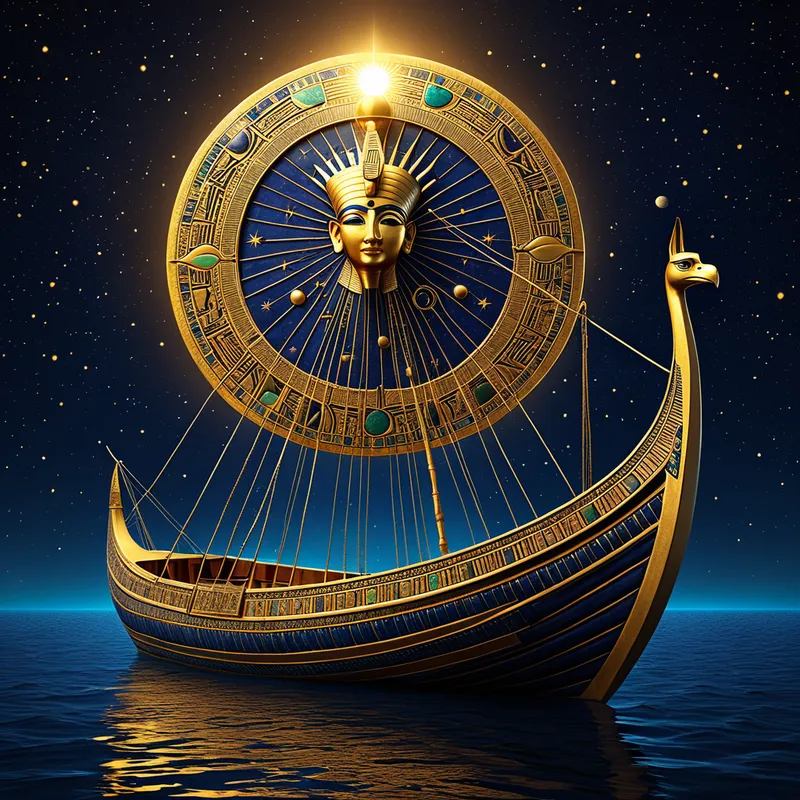
In the beginning, before the beginning, there was only the dark, silent waters of Nun. From those waters, the god Ra willed himself into being. His light was the first thing. And for his light to travel, he created a vessel: a barque of unimaginable splendor, forged from celestial fire and the heartwood of the first tree. This was the Mandjet, the Day Barque.
Each morning, Ra is born anew from the womb of the sky goddess Nut. He steps into the Mandjet, and his radiance floods the deck. The crew—gods of wisdom, magic, and order—take their stations. Thoth records the course. Maat stands at the prow, her feather of truth ensuring the path is straight. And so the great voyage begins, sailing across the blue river of the daytime sky, bringing life, warmth, and time to the world below.
But the sky river has an end. As afternoon deepens, the barque approaches the western mountains. The light grows old, tinged with copper and gold. Ra, now an aging king, prepares for the more terrible journey. At the horizon, he is met by the Mehen serpents and the fierce god Set, whose strength is needed for what comes next.
The barque slips into the Duat. This is no gentle night. This is the twelve-hour realm of the dead, a subterranean river winding through caverns of fire, lakes of darkness, and fields of silent spirits. The Day Barque transforms, becoming the Mesektet. Ra himself changes, taking the form of a ram-headed man, a god of the deep, hidden sun.
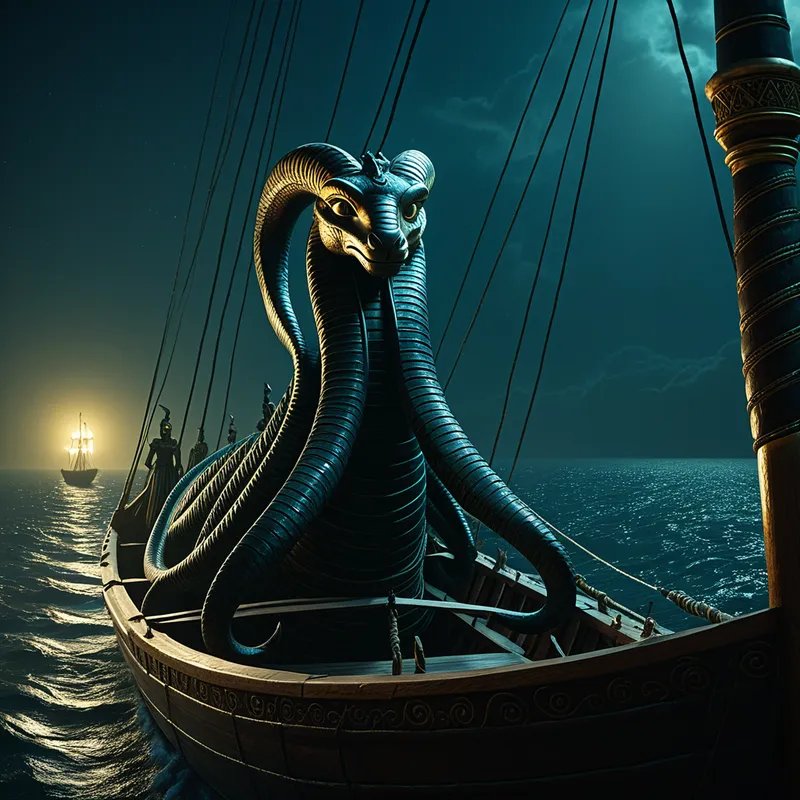
And here, in the third hour, the great enemy waits. Apophis. A serpent of pure nothingness, so vast its coils could crush the world. It rises from the black waters, not to eat, but to un-create. To swallow the river, the barque, Ra, and all of creation back into the Nun. The boat pitches violently. Darkness swallows the light. The crew shouts invocations. Set, the defender, plunges his great spear into the serpent’s hide. Magicians on board cast binding spells. Mehen the serpent coils protectively around the barque itself. In a tumult of roaring water, hissing chaos, and blazing divine magic, Apophis is repelled—wounded, bound, but never destroyed.
Wounded but victorious, the barque sails on. Through the middle hours, Ra communes with the blessed dead, his light giving them momentary life. He merges with Osiris, the lord of the Duat, in a mystical union of solar and chthonic power. The old sun god is rejuvenated in the secret caverns.
Finally, after the twelfth gate, the barque, now carrying the newborn sun, approaches the eastern horizon. The scarab god Khepri pushes the solar disk from the depths. The Mesektet emerges, transforming once more into the Mandjet. Ra, young and radiant again, steps into the dawn sky. The world breathes. Birds sing. Another day is granted. The journey is complete, only to begin again.
Cultural Origins & Context
This was not merely a story for the ancient Egyptians; it was the fundamental operating principle of reality. The myth is pieced together primarily from a collection of funerary texts known as the Amduat, along with the Books of Gates and Caverns, found painted on the walls of royal tombs in the Valley of the Kings. These were not for public storytelling but were sacred, secret maps for the deceased pharaoh, who was believed to join Ra’s crew in the afterlife.
The myth’s societal function was profound. It explained the sun’s motion, the cycle of day and night, and the seasons. It provided a cosmological model where the constant struggle against chaos (Isfet) was the central drama of existence. Every sunrise was a victory for order (Maat). The Pharaoh, as Ra’s earthly representative, was responsible for maintaining this Maat through right rule and ritual, ensuring the solar barque’s journey—and thus the world—continued.
Symbolic Architecture
At its core, the Solar Barque is a perfect symbol for the conscious self, the ego, navigating the waters of existence. The sun represents the light of consciousness, awareness, and life-force.
The journey is not a straight line of progress, but a necessary descent into the depths for the sake of renewal. No dawn is possible without the peril of the night.
The Duat is the unconscious—the personal and collective shadow, the realm of memory, trauma, forgotten potentials, and instinct. Sailing through it is not optional; it is the requirement for the transformation of the psyche. Apophis symbolizes the psychic force of entropy: depression, meaninglessness, fragmentation, and the pull toward dissolution. The battle is not for annihilation, but for containment—the ego must face its own potential for disintegration without being destroyed by it.
The union of Ra and Osiris in the depths is perhaps the most potent symbol: the marriage of the conscious principle (the traveling king) with the unconscious, structuring principle of the soul (the lord of the dead). This is the alchemical coniunctio, the integration that leads to wholeness and rebirth.
The Dreamer’s Resonance
When this myth stirs in modern dreams, it often manifests not as an Egyptian tableau, but through its core patterns. To dream of a boat on a night sea, especially one feeling besieged or lost, can echo the Mesektet’s journey. The “crew” may appear as supportive friends, inner resources, or forgotten skills that emerge in a crisis.
Dreams of being trapped in tunnels or subterranean landscapes, particularly if there is a sense of moving toward a light, mirror the passage through the Duat. The confrontation with a monstrous serpent or formless, engulfing darkness directly parallels the battle with Apophis. This is the psyche signaling a critical phase of shadow-work. The somatic feeling is often one of profound dread or weight, a “dark night of the soul” where the dreamer’s foundational sense of self is under threat. The dream is not a prophecy of failure, but a depiction of the process already underway—the ego’s necessary and terrifying engagement with the depths for the sake of eventual renewal.

Alchemical Translation
For the individual, the myth of the Solar Barque is a master blueprint for individuation. It models the psychic transmutation required to move from a brittle, sun-bleached consciousness to a resilient, solar consciousness that includes the night.
The first step is the recognition of the necessary descent. Our culture prizes perpetual daylight—productivity, positivity, constant growth. The myth insists that the fruitful path requires a voluntary turning toward the interior darkness, the neglected aspects of the self. This is the entry into the Duat.
The treasure is found not in avoiding the serpent, but in the gathering of one’s inner crew—courage (Set), wisdom (Thoth), integrity (Maat)—for the confrontation.
The battle with Apophis is the core alchemical operation. It is facing the inner chaos that whispers of meaninglessness, that seeks to unravel hard-won achievements and identities. The victory is not annihilation—chaos is a perpetual force—but in the act of holding the vessel together. It is the ego’s task to contain this conflict, to prevent total dissolution, and to keep the journey moving.
The final, crucial transmutation is the union of Ra and Osiris. Psychologically, this is the integration of the adaptive, outward-facing persona (the solar king) with the deep, archetypal core of the psyche, the Self (the lord of the underworld). One emerges from this process not simply restored, but fundamentally reconstituted—reborn with the dawn as a more complex, grounded, and whole being. The individual becomes, like the sun, a traveler who understands that their light is born from, and returns to, the fertile darkness.
Associated Symbols
Explore related symbols from the CaleaDream lexicon: