The Sixteen Kingdoms of Yoruba
A foundational Yoruba myth describing the divine establishment of sixteen original kingdoms, each with unique rulers and spiritual significance in West African cosmology.
The Tale of The Sixteen Kingdoms of Yoruba
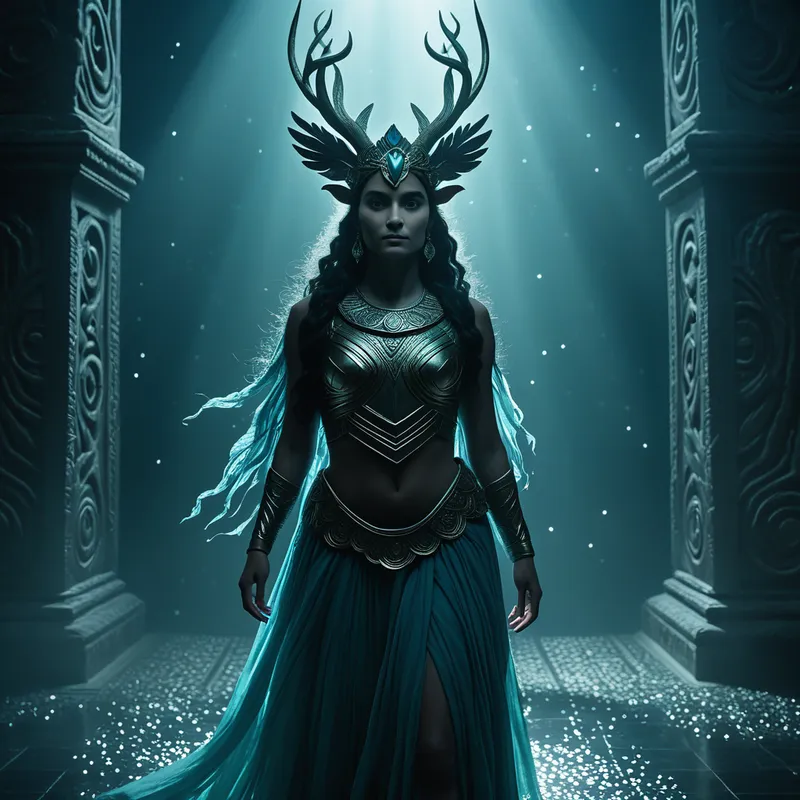
In the beginning, when [the world](/myths/the-world “Myth from Tarot culture.”/) was still soft from the breath of [Olodumare](/myths/olodumare “Myth from Yoruba culture.”/), [the earth](/myths/the-earth “Myth from Hindu culture.”/) was a vast, undivided wilderness. Humanity lived in scattered clusters, knowing no law but survival, no order but the whim of the elements. The Orisha looked upon this [chaos](/myths/chaos “Myth from Greek culture.”/) with concern, for the human spirit, a spark from the divine, was floundering without a vessel to contain and direct its light.
From the heavenly realm of Orun, the command came. [Orunmila](/myths/orunmila “Myth from Yoruba culture.”/), the witness to destiny, cast the sacred palm nuts. The pattern they formed was clear: sixteen vessels were needed. Sixteen sacred crowns, each a fragment of the original sovereignty of [Oduduwa](/myths/oduduwa “Myth from Yoruba culture.”/), the progenitor. It was decreed that sixteen of [Oduduwa](/myths/oduduwa “Myth from Yoruba culture.”/)’s most worthy descendants and chiefs would be chosen, each to receive a portion of the divine authority, a sliver of the original Ase that founded the world.
And so, the great dispersal began. From the sacred city of Ile-Ife, the navel of the world, the chosen ones set forth. They did not go as conquerors with armies, but as vessels carrying sacred relics: a lump of earth from Ife, a beaded crown, a staff of office, the blessings of specific Orisha. Their journeys were epic dreams, fraught with trials sent by both the earth and the unseen world. Some were guided by mystical animals—a talking bird, a wise serpent. Others were tested at river crossings by spirits demanding proof of their destined right.
One prince, destined to found the kingdom of Oyo, carried the fiery Ase of Sango. His kingdom would be one of dynamism, [justice](/myths/justice “Myth from Tarot culture.”/), and formidable political will. Another, bearing the deep wisdom of [Olokun](/myths/olokun “Myth from Yoruba culture.”/) and Oshun, settled where the waters were generous, founding a realm of artistry, trade, and profound spiritual depth. Yet another, guided by the stern principles of Ogun, cleared a kingdom from the stubborn forest, a society built on craftsmanship, resolve, and the transformative power of the forge.
Thus, the sixteen kingdoms arose: Oyo, Benin, Ketu, Sabe, Popo, Owu, Ila, Ijesha, Ekiti, Ondo, Ijebu, Egba, Ife, Ado, Owo, and the Ewe. Each was a unique expression of the whole, a distinct note in a harmonic scale of governance. They were not mere territories, but living entities, each with its own Ori (spiritual head), its own [covenant](/myths/covenant “Myth from Christian culture.”/) with the ancestral and divine worlds. The myth tells not of a perfect, static creation, but of a divine seeding. The power struggles, the alliances, and the wars that followed were not a falling away from this ideal, but the necessary and fraught process of these sixteen divine sparks learning to relate, to balance, and to define their shared existence on the fertile, demanding earth.
Cultural Origins & Context
The myth of the Sixteen Kingdoms is the Yoruba civilization’s foundational political and spiritual charter. It emerges from the historical reality of the Yoruba city-states, which shared a common language, cosmology, and origin in Ile-Ife, yet were fiercely independent and often competitive. The myth provides a sacred framework for this paradox of unity and plurality. It answers the profound question: How can there be many kings if sovereignty is one?
By rooting all authority in the singular, heavenly-sanctioned lineage of Oduduwa and dispersing it to sixteen original founders, the myth creates a cosmology of checks and balances. No one kingdom could claim ultimate supremacy without violating the divine distribution. The historical primacy of Ile-Ife as the spiritual source was balanced by the temporal power of kingdoms like Oyo and Benin. This narrative served as a constitutional principle, a way to legitimize rulership, negotiate inter-kingdom relations, and understand political history as an unfolding of divine destiny, guided by the divination of Orunmila. It transforms politics from mere human ambition into a sacred drama with cosmic stakes.
Symbolic Architecture
At its core, this myth is an archetypal [blueprint](/symbols/blueprint “Symbol: A blueprint represents the foundational plan or design for something, often symbolizing potential, structure, and the mapping of one’s inner self or future.”/) for the [emergence](/symbols/emergence “Symbol: A process of coming into being, rising from obscurity, or breaking through a barrier, often representing birth, transformation, or revelation.”/) of [consciousness](/symbols/consciousness “Symbol: Consciousness represents the state of awareness and perception, encompassing thoughts, feelings, and experiences.”/) from undifferentiated unity. The primordial, chaotic [earth](/symbols/earth “Symbol: The symbol of Earth often represents grounding, stability, and the physical realm, embodying a connection to nature and the innate support it provides.”/) represents the unconscious—fertile but ungoverned. The sixteen kingdoms symbolize the necessary [fragmentation](/symbols/fragmentation “Symbol: The experience of breaking apart, losing cohesion, or being separated into pieces. Often represents disintegration of self, relationships, or reality.”/) of the [psyche](/myths/psyche “Myth from Greek culture.”/) into distinct complexes, faculties, and governing principles. One cannot rule the inner [wilderness](/symbols/wilderness “Symbol: Wilderness often symbolizes the untamed aspects of the self and the unconscious mind, representing a space for personal exploration and discovery.”/) with a single, monolithic command; different aspects of [the self](/myths/the-self “Myth from Jungian culture.”/) require different modes of governance.
The crown is not just a symbol of rule, but of responsibility. Each kingdom’s crown holds a fraction of the original Ase, meaning each ruler carries a portion of the world-sustaining power and is accountable for its right use. To lose one’s crown is not just political defeat; it is a cosmological failure.
The [journey](/symbols/journey “Symbol: A journey in dreams typically signifies adventure, growth, or a significant life transition.”/) from Ife is the individuation journey. The sacred relics—earth, staff, beads—are the core truths and innate potentials one carries from the [source](/symbols/source “Symbol: The origin point of something, often representing beginnings, nourishment, or the fundamental cause behind phenomena.”/). The trials at [river](/symbols/river “Symbol: A river often symbolizes the flow of emotions, the passage of time, and life’s journey, reflecting transitions and movement in one’s life.”/) crossings and in deep forests are the encounters with the [shadow](/symbols/shadow “Symbol: The ‘shadow’ embodies the unconscious, repressed aspects of the self and often represents fears or hidden emotions.”/), the tests of integrity that determine if one’s claimed [identity](/symbols/identity “Symbol: Identity represents the sense of self, encompassing personal beliefs, cultural background, and social roles.”/) is authentic or a hollow pretension. The founding of each [kingdom](/symbols/kingdom “Symbol: A kingdom symbolizes authority, belonging, and a sense of identity within a larger context or community.”/) is the [moment](/symbols/moment “Symbol: The symbol of a ‘moment’ embodies the significance of transient experiences that encapsulate emotional depth or pivotal transformations in life.”/) a coherent [aspect](/symbols/aspect “Symbol: A distinct feature, quality, or perspective of something, often representing a partial view of a larger whole.”/) of the self is successfully established and made functional in the world.
The Dreamer’s Resonance
When this myth stirs in the dreamer’s soul, it speaks to a critical phase of inner development: the move from a monolithic, often tyrannical, sense of self toward a diversified, confederated psyche. One may dream of councils, of multiple rooms in a house, or of receiving a specific, unique tool. This is the call to recognize the “sixteen kingdoms” within—the inner ruler, the artist, the warrior, the nurturer, the sage—and grant each its proper domain and respect.
The myth warns against inner imperialism, where one complex (like the relentless inner critic or the impulsive child) seeks to conquer and suppress all others. The resulting internal civil war manifests as anxiety, depression, or creative paralysis. The healing lies in acknowledging the divine origin of each inner “kingdom,” its right to exist and contribute to the whole under the overarching sovereignty of the Self (aligned with Olodumare’s ultimate authority). It is an invitation to move from inner chaos or inner dictatorship to a wise, cooperative inner governance.

Alchemical Translation
The alchemical process here is [Separatio](/myths/separatio “Myth from Alchemical culture.”/) followed by Ordinatio—the separation of a homogeneous mixture into its constituent parts, and then the intelligent ordering of those parts. The primal clay of Ife (the [prima materia](/myths/prima-materia “Myth from Alchemical culture.”/) of the self) is divided and differentiated into sixteen distinct vessels. Each vessel is then fired in the unique kiln of its founding ordeal, transforming raw potential into a durable, functional form capable of holding the elixir of sovereignty.
The true alchemical gold is not a single, perfect kingdom, but the harmonious relationship between the sixteen. The goal is the Regnum—the integrated kingdom of the Self—where diversity is not erased but orchestrated, creating a resilience and richness impossible in a monolithic state.
Psychologically, this is the work of differentiation and integration. One must first distinguish the various “ruling principles” within—the voice of order, the call of chaos, the demand for love, the need for solitude—and then establish a conscious council between them. The ruler archetype is thus transformed from an autocrat into a wise monarch who listens to the reports from all provinces of the soul before making a decree for the entire being.
Associated Symbols
Explore related symbols from the CaleaDream lexicon:
- Crown — [The vessel](/myths/the-vessel “Myth from Alchemical culture.”/) of sacred authority and ancestral Ase, representing the burden and legitimacy of ruling one’s own inner or outer domain.
- Kingdom — A bounded realm of order and meaning, an archetypal domain of the psyche or society established through conscious effort and divine sanction.
- Journey — The necessary pilgrimage from the unified source into the differentiated world, fraught with trials that test and solidify one’s destined identity.
- Earth — The primal, fertile material of creation and the territory upon which a kingdom is built, symbolizing the grounded reality of the unconscious.
- River — A boundary and a place of testing, where destinies are confirmed and false claimants are washed away by the currents of truth.
- Tree — The lineage and rooted stability of a kingdom, connecting the earthly realm to the ancestral roots and the celestial canopy of the divine.
- Order — The divine principle imposed upon chaos, manifesting as law, structure, and the sacred hierarchy that enables civilization and conscious life.
- Destiny — The pre-ordained pattern revealed by Orunmila’s divination, the cosmic blueprint that each founder-king must embody and fulfill.
- Shadow — The untamed forest and the challenging spirits encountered on the journey, representing the unconscious elements that must be confronted to claim one’s sovereignty.
- Ritual — The sacred acts of foundation—the planting of earth, the receiving of [the crown](/myths/the-crown “Myth from Various culture.”/)—that transform a mere location into a consecrated kingdom.
- Circle — The wholeness from which the sixteen parts emanate, and the ideal of harmonious relationship the kingdoms strive to re-establish amongst themselves.