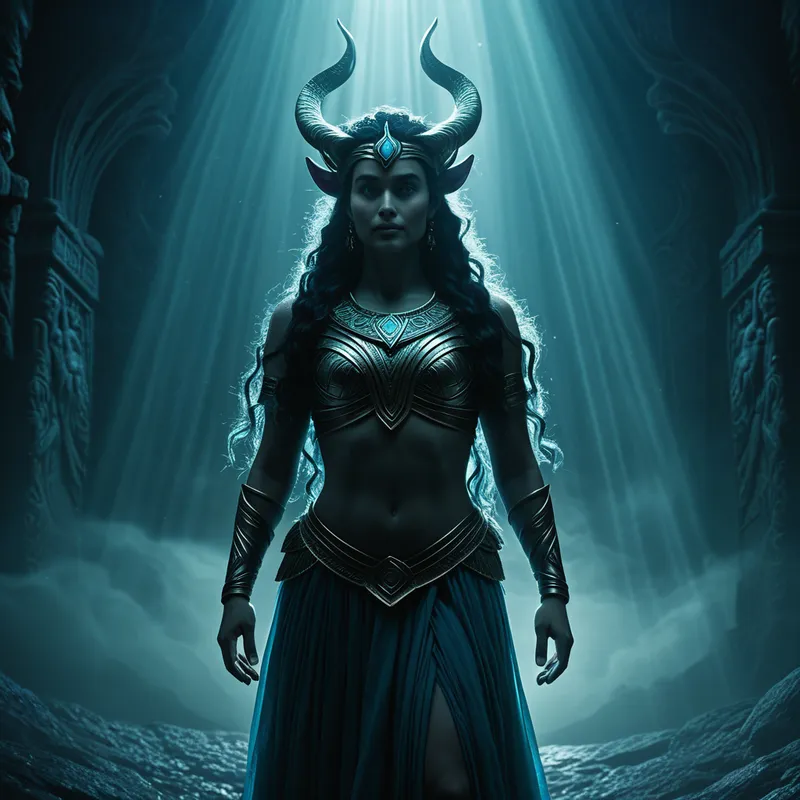
The Six Realms of Samsara
A Tibetan Buddhist cosmology describing six realms of existence where beings cycle through rebirth based on karma, from gods to hell beings.
The Tale of The Six Realms of Samsara
Imagine a great, turning wheel, its rim a blur of endless motion. This is the [Samsara](/myths/samsara “Myth from Buddhist culture.”/), and upon its six spokes are painted the entire spectrum of possible existence. This is not a linear journey, but a ceaseless, cyclical wandering, a dream from which all beings long to awaken.
At the wheel’s zenith lies the Deva-loka, the Realm of the Gods. Here, existence is an endless, luminous afternoon. Beings dwell in palaces of light and wish-fulfilling trees, their every desire instantly met. Time stretches into eons of bliss, and suffering seems a forgotten myth. Yet, a subtle tension hums beneath the splendor. This is a realm of profound distraction, where the intoxicating nectar of pleasure masks the inevitable truth: all things must end. The gods, too, have stored [karma](/myths/karma “Myth from Hindu culture.”/), and when its last traces are spent, the glorious dream shatters. They fall, tumbling from their celestial heights, often into lower realms, gripped by a terror and confusion more acute for having known such perfect peace.
Just below, sharing the same spoke of fortunate rebirth but tinged with envy, is the Asura-loka, the Realm of the Jealous Gods. These beings possess power and splendor nearly equal to the Devas, but they are cursed with a perception of lack. They gaze upon the gods’ celestial tree, whose roots lie in their own realm but whose fruits blossom only in the heavens. Consumed by rivalry and paranoia, they wage endless, futile wars to seize what they believe is rightfully theirs. Their existence is one of magnificent struggle, a perpetual state of aggrieved entitlement where victory is hollow and defeat is ruin. Their suffering is not of deprivation, but of comparison and wounded pride.
Then we descend to the Manushya-loka, the Human Realm. Poised precariously between the higher and lower realms, it is considered the most precious and rare of rebirths. Here, suffering and joy are intermingled in equal measure—birth, aging, sickness, and [death](/myths/death “Myth from Tarot culture.”/) are inescapable, yet so too are love, insight, and the potential for profound understanding. The human condition is defined by this poignant tension: we possess just enough suffering to feel the itch of dukkha, and just enough freedom and intelligence to seek its end. It is a realm of poignant choice, where every action sows seeds for future wandering.
Below humanity, the realms are dominated by increasing fixation and mental obscuration. The Tiryak-loka, the Animal Realm, is governed by instinct and fear. Its inhabitants are driven by basic needs—to eat, to sleep, to mate, to flee. Their world is one of pervasive predation and dull-wittedness, with little room for reflection or growth. They are slaves to their immediate environment and impulses, their consciousness a narrow corridor of survival. The suffering here is the anxiety of the hunted and the blindness of [the hunter](/myths/the-hunter “Myth from African culture.”/), a perpetual cycle of consumption and fear.
Deeper still is the Preta-loka, the Realm of [the Hungry Ghosts](/myths/the-hungry-ghosts “Myth from Buddhist culture.”/). These are beings of profound, metaphysical deprivation. They wander a desolate, twilight landscape, their bodies grotesque—with distended bellies and needle-thin throats. They are consumed by insatiable, specific cravings. Upon finding a morsel of food or a drop of [water](/myths/water “Myth from Chinese culture.”/), it may transform into pus or fire, or slip forever from their grasp. Their suffering is the agony of addiction and unfulfillable want, a psychological state made manifest. They are metaphors for a mind forever grasping at what it can never truly possess.
At the nadir of the wheel lies the Naraka-loka, the Realms of Hell. These are not places of eternal punishment, but karmic experiences of intense, protracted agony, both hot and cold. Beings here are subjected to tortures that mirror the violence and hatred they once cultivated. Time stretches in unbearable lengths, yet it is not infinite. When the karma that propelled them here is exhausted, they are reborn elsewhere. The hells represent the ultimate state of self-created alienation and rage turned inward, a complete identification with unbearable suffering.
And so the wheel turns. A god, exhausted by pleasure, falls. A human, hardened by greed, is born a hungry ghost. A hell-being, its agony spent, ascends to the animal realm. Driven by karma—the inescapable law of cause and effect—and fueled by ignorance, craving, and aversion, consciousness migrates through these six dreams, mistaking each for the only reality.
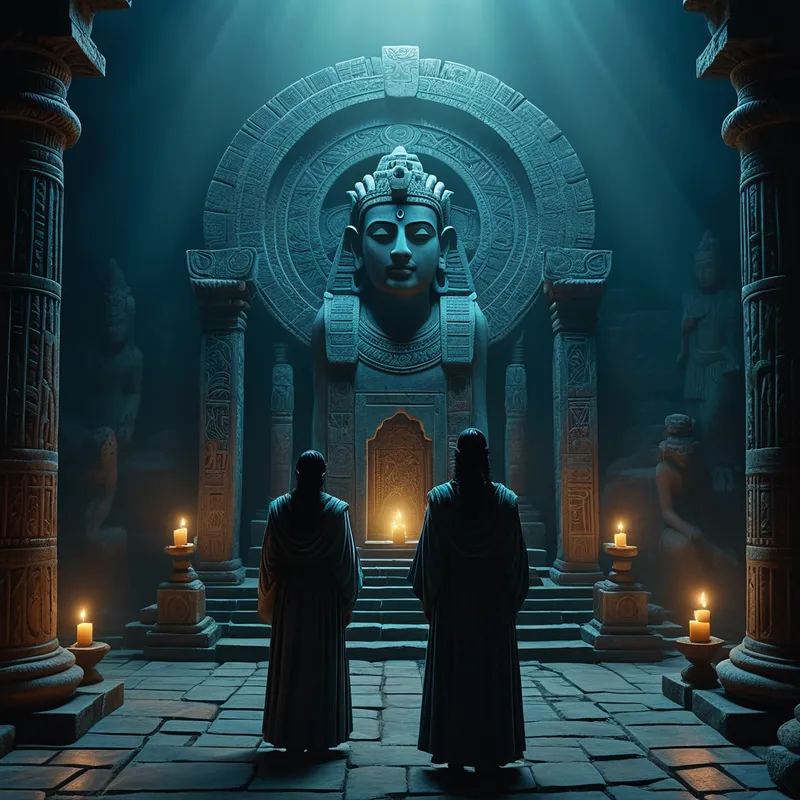
Cultural Origins & Context
The schema of the Six Realms is not unique to Tibetan Buddhism but finds its roots in the ancient Indian spiritual milieu that gave birth to Buddhism itself. [The Buddha](/myths/the-buddha “Myth from Buddhist culture.”/) adopted and profoundly reinterpreted this existing cosmological model, stripping it of any notion of permanent worlds or eternal souls. In his teaching, the realms became understood not as literal, physical planets, but as realms of experience (lokas) primarily defined by the state of mind that births them.
Tibetan Buddhism, inheriting this framework from India, elaborated upon it with immense artistic and contemplative detail. It became the central architecture of their worldview, depicted vividly in thangka paintings, described in liturgical texts, and enacted in ritual dances (cham). The “Wheel of Life” (bhavacakra), held in the clutches of Yama, the Lord of Death, is a ubiquitous teaching tool found at monastery entrances. Its purpose is not to threaten, but to diagnose. It is a map of the [psyche](/myths/psyche “Myth from Greek culture.”/)’s possible conditions, a mirror held up to the samsaric mind in all its bewildering variety. For the Tibetan practitioner, contemplating the realms is a foundational meditation on the nature of suffering (dukkha) and the urgent necessity of liberation.
Symbolic Architecture
The Six Realms are a masterful symbolic [system](/symbols/system “Symbol: A system represents structure, organization, and interrelated components functioning together, often reflecting personal or social order.”/), a [psychology](/symbols/psychology “Symbol: Psychology in dreams often represents the exploration of the self, the subconscious mind, and emotional conflicts.”/) of the conditioned mind. They are not destinations, but conditions. Each [realm](/symbols/realm “Symbol: The symbol of ‘Realm’ often signifies the boundaries of one’s consciousness, experiences, or emotional states, suggesting aspects of reality that are either explored or ignored.”/) is generated by a specific poison or affliction (klesha), which in turn produces a characteristic suffering and a distorted [perception](/symbols/perception “Symbol: The process of becoming aware of something through the senses. In dreams, it often represents how one interprets reality or internal states.”/) of [reality](/symbols/reality “Symbol: Reality signifies the state of existence and perception, often reflecting one’s understanding of truth and life experiences.”/).
The God Realm is the prison of pride and distraction, where the suffering of inevitable loss is hidden beneath a mountain of bliss.
The Hell Realms are the ultimate expression of hatred and aggression, where the mind becomes both the torturer and the tortured, trapped in a feedback loop of its own rage.
The [Human](/symbols/human “Symbol: The symbol of a human represents individuality, complexity of emotions, and social relationships.”/) Realm is powered by desire and attachment, but its unique suffering—the clear [knowledge](/symbols/knowledge “Symbol: Knowledge symbolizes learning, understanding, and wisdom, embodying the acquisition of information and enlightenment.”/) of [impermanence](/myths/impermanence “Myth from Buddhist culture.”/)—is also its potential salvation. The Animal Realm is born of ignorance, a fog of instinctual stupidity. [The Hungry Ghost](/myths/the-hungry-ghost “Myth from Buddhist culture.”/) Realm is the [child](/symbols/child “Symbol: The child symbolizes innocence, vulnerability, and potential growth, often representing the dreamer’s inner child or unresolved issues from childhood.”/) of miserly, addictive craving, and the Jealous God Realm is the domain of competitive envy and paranoia. Together, they form a complete portrait of delusion. The wheel is turned by the three animals at its hub: a pig (ignorance), a rooster (greed/attachment), and a snake (aversion/hatred)—the primal forces that keep [consciousness](/symbols/consciousness “Symbol: Consciousness represents the state of awareness and perception, encompassing thoughts, feelings, and experiences.”/) in bondage.
The Dreamer’s Resonance
To the Western mind, steeped in linear time and a single-life narrative, the myth of the Six Realms offers a radical, liberating, and terrifying perspective. It suggests that our current human life is not a singular event, but one scene in a play that has been running for countless acts. More importantly, it posits that our psychological states are not merely moods, but entire realities we inhabit.
We do not need to believe in literal rebirth to feel the truth of this map. In the span of a single day, a human mind can touch upon all six realms. The smug satisfaction of success (God Realm), the bitter envy of a rival’s promotion (Jealous God), the simple hunger for lunch (Animal Realm), the compulsive scrolling for news or validation (Hungry Ghost), the blinding fury in a traffic argument (Hell Realm), and the poignant, reflective moment of making a conscious choice (the precious human opportunity). The myth tells us that these are not passing feelings, but profound orientations to existence. We are, at every moment, migrating between these inner worlds, building karma with each thought, word, and deed.
Alchemical Translation
Depth psychology finds a powerful ally in this ancient system. The realms can be seen as archetypal complexes, habitual patterns of the psyche that constellate our experience of self and world. Psychotherapy often works to free the individual from the most hellish or hungry-ghostly of these internal prisons.
The journey of individuation is, in this light, the conscious navigation of the Six Realms within. To integrate the shadow is to acknowledge the Hell-being’s rage and the Hungry Ghost’s need without being consumed by them. To achieve a stable consciousness is to move beyond the God Realm’s inflation and the Asura’s paranoia.
The ultimate goal in Buddhism—enlightenment, or [nirvana](/myths/nirvana “Myth from Buddhist culture.”/)—is the shattering of the wheel itself. It is the realization that none of these realms, not even the most blissful or the most tortured, contain a permanent, separate self. It is to awaken from the collective dream of Samsara and recognize the luminous, empty ground from which all these temporary experiences arise and pass away. The path out is [the Noble Eightfold Path](/myths/the-noble-eightfold-path “Myth from Buddhist culture.”/), a practical psychology for purifying the mind, undoing the karmic habits, and seeing reality as it is, thereby stepping off the spinning wheel forever.
Associated Symbols
Explore related symbols from the CaleaDream lexicon:
- Rebirth — The cyclical process of death and re-becoming, driven by karma and unresolved mental afflictions, which propels consciousness through the Six Realms.
- Circle — [The Wheel of Life](/myths/the-wheel-of-life “Myth from Tibetan Buddhist culture.”/) itself, representing the endless, repetitive cycle of Samsara with no inherent beginning or end.
- Mirror — The mind that reflects and constructs the reality of each realm, showing the dreamer the nature of their own karmic projections.
- Hungry Ghost — A being from one of the Six Realms, symbolizing insatiable craving, metaphysical poverty, and the agony of addiction.
- Karma — The universal law of cause and effect, the ethical engine that determines the quality of rebirth within the turning wheel.
- Buddhist [Lotus](/myths/lotus “Myth from Hindu culture.”/) — The flower that rises pristine from muddy water, symbolizing the potential for enlightenment and purity of mind that can emerge from any realm, even the lowest.
- Bridge — The Noble Eightfold Path or the teachings of the [Buddha](/myths/buddha “Myth from Buddhist culture.”/), which provide the only means to cross from the shore of Samsara to the shore of liberation.
- Dream — The essential nature of all Six Realms, vivid and compelling experiences that are ultimately illusory and lacking inherent substance.
- Fire — The burning afflictions of greed, hatred, and delusion that fuel the wheel’s motion, and the transformative wisdom that can consume them.
- Key — The insight into emptiness and selflessness, which unlocks the prison of cyclic existence and opens the door to nirvana.
- Mountain — The arduous, upward path of spiritual practice required to ascend from the lower realms and ultimately transcend them all.
- Ocean — The boundless, samsaric existence of suffering, across which beings drift helplessly until they find the raft of the [Dharma](/myths/dharma “Myth from Hindu culture.”/).