The Sirens' Song from Homer's Myth Meaning & Symbolism
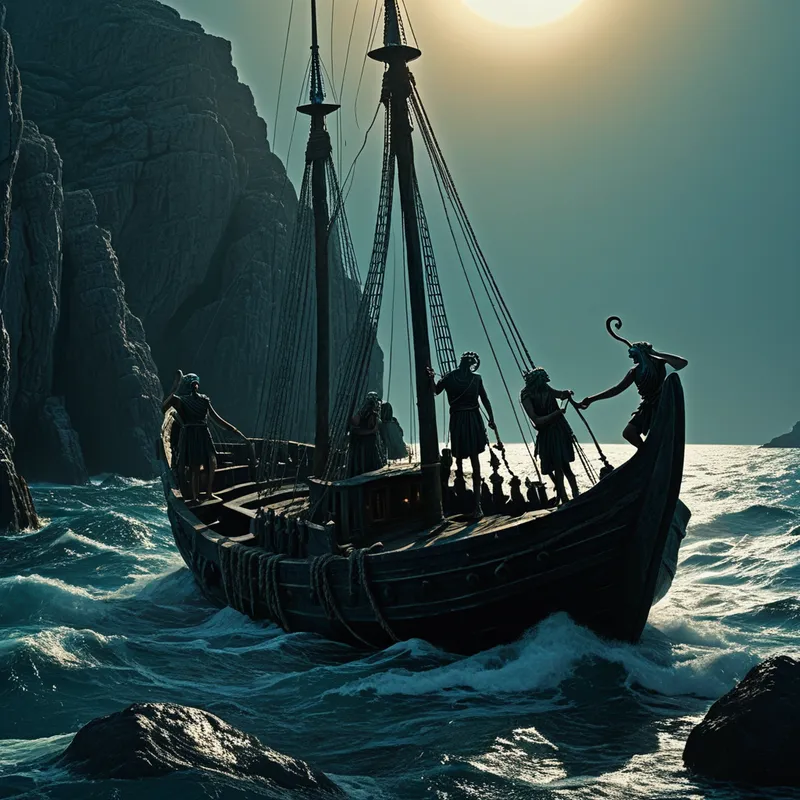
Odysseus, bound to his ship's mast, hears the Sirens' fatal song, a mythic confrontation between irresistible allure and the will to survive.
The Tale of The Sirens’ Song from Homer’s
Hear now, of a passage through waters of forgetting, where [the wind](/myths/the-wind “Myth from Various culture.”/) itself holds its breath. After the horrors of the Cyclops and the seductions of the witch Circe, the weary king [Odysseus](/myths/odysseus “Myth from Greek culture.”/) sought the path home to rocky Ithaca. But the path was lined with perils no sword could parry.
Circe, in her wisdom and pity, warned him of the coming trial. “Soon,” she said, her voice like smoke, “you will sail past the island of the [Sirens](/myths/sirens “Myth from Greek culture.”/). They sit in a meadow piled high with the moldering bones of men, skin shriveled tight on their flesh. Their song—oh, their song! It is honey poured directly into the soul. It promises all knowledge: everything that happens on the fertile earth, all past and future. Any man who hears it, and is not bound, will be drawn. His wife and children will never welcome him home; he will rot on their shore, his ears filled with a melody that has replaced his heartbeat.”
So Odysseus carved beeswax, warm and pliant, and sealed the ears of his crew until they heard only the pulse of their own blood and the groan of the oars. For himself, he demanded a different fate. He ordered his men to bind him to the mast of the ship with unyielding ropes. “And no matter how I beg, how I command, how I threaten,” he instructed, his voice iron, “you must tighten my bonds all the more.”
Then came the stillness. [The sea](/myths/the-sea “Myth from Greek culture.”/) grew glassy. A sweet, cloying fragrance bloomed on the air, carrying the first, faint threads of sound. It was not a melody one hears, but one that becomes. It wove itself into the very fabric of Odysseus’s mind. “Come hither, famed Odysseus, great glory of the Achaeans,” the voices sang, each note a hook in his heart. “Stay your ship and listen to our voices. No one has ever sailed past here in his black ship without hearing the honey-sweet sound from our lips, and he has gone away delighted and knowing more.”
The promise was total. All suffering explained. All mysteries unveiled. The song was the answer to every “why” he had ever whispered into the darkness of war and exile. It was his own deepest longing, given a voice more beautiful than any he had known. The ropes bit into his flesh as he strained against them, his eyes wild, his commands to be released becoming raw, desperate pleas. His loyal men, deaf to the enchantment, saw only a maddened king. They rowed harder, their faces set like stone, and bound him tighter, as he had commanded. The song swelled, a tidal wave of knowing, then faded astern, leaving behind a silence that ached. Only then did they unstop their ears and unbind their weeping captain, who had heard everything, and had survived.

Cultural Origins & Context
This episode is a pivotal moment in [Homer](/myths/homer “Myth from Greek culture.”/)‘s Odyssey, an epic poem composed in the 8th century BCE but rooted in an older oral tradition of bardic storytelling. For the ancient Greeks, the Mediterranean was a realm of both commerce and profound mystery. [The Sirens](/myths/the-sirens “Myth from Greek culture.”/) represent one of many liminal dangers—monsters, whirlpools, clashing rocks—that populated the edges of the known world. The myth functioned as a navigational chart for the soul, not just the ship. It was performed in aristocratic halls, a reminder that the journey home (nostos) is not merely physical but ethical and psychological. The story taught that some knowledge is fatal to possess directly, that survival often requires both cunning ([metis](/myths/metis “Myth from Greek culture.”/)) and the acceptance of necessary constraints. It validated the social bonds of command and loyalty, showing that the individual’s greatest desire must sometimes be thwarted by the collective for the common good.
Symbolic Architecture
The Sirens are not monsters of tooth and claw, but of epistemology. They do not offer mere pleasure; they offer omniscience.
The Sirens’ promise is the ultimate temptation: to bypass the journey and possess the destination. To know the score without playing the game.
Psychologically, they represent the allure of a regressive, all-consuming [knowledge](/symbols/knowledge “Symbol: Knowledge symbolizes learning, understanding, and wisdom, embodying the acquisition of information and enlightenment.”/)—the fantasy of returning to a state of infantile omnipotence where one is united with the all-knowing [Mother](/symbols/mother “Symbol: The symbol of ‘Mother’ represents nurturing, protection, and the foundational aspect of one’s emotional being, often associated with comfort and unconditional love.”/). Their [meadow](/symbols/meadow “Symbol: A meadow often symbolizes peace, tranquility, and a connection to nature.”/) of bones is the psychic [landscape](/symbols/landscape “Symbol: Landscapes in dreams are powerful symbols representing the dreamer’s emotional state, personal journey, and the broader context of life situations.”/) of those who have succumbed to this fantasy: a state of beautiful, [static](/symbols/static “Symbol: Static represents interference, disruption, and the breakdown of clear communication or signal, often evoking feelings of frustration and disconnection.”/) decay. Odysseus, the archetypal ego-[consciousness](/symbols/consciousness “Symbol: Consciousness represents the state of awareness and perception, encompassing thoughts, feelings, and experiences.”/), is faced with a [paradox](/symbols/paradox “Symbol: A contradictory yet true concept that challenges logic and perception, often representing unresolved tensions or profound truths.”/). To avoid the [fate](/symbols/fate “Symbol: Fate represents the belief in predetermined outcomes, suggesting that some aspects of life are beyond human control.”/) is to remain ignorant (like his wax-plugged [crew](/symbols/crew “Symbol: A crew often symbolizes collaboration, teamwork, and collective purpose, suggesting a need for shared goals and support from others in one’s journey.”/)). To fully embrace it is to die. His [solution](/symbols/solution “Symbol: A solution symbolizes resolution, clarity, and the overcoming of obstacles, often representing a sense of accomplishment.”/) is alchemical: he creates a [vessel](/symbols/vessel “Symbol: A container or structure that holds, transports, or protects something essential, representing the self, emotions, or life journey.”/) (the bound self, the ship) strong enough to contain the experience without being dissolved by it. The mast is the [axis](/symbols/axis “Symbol: A central line or principle around which things revolve, representing stability, orientation, and the fundamental structure of reality or consciousness.”/) of his will; the ropes are the conscious [decision](/symbols/decision “Symbol: A decision in a dream reflects the choices one faces in waking life and can symbolize the pursuit of clarity and resolution.”/) to uphold a prior, wiser self against the onslaught of the unconscious. He integrates the song’s call—he hears it fully—but does not merge with it. He gains the [knowledge](/symbols/knowledge “Symbol: Knowledge symbolizes learning, understanding, and wisdom, embodying the acquisition of information and enlightenment.”/) that some desires must be witnessed, not enacted.

The Dreamer’s Resonance
When this myth stirs in modern dreams, it rarely appears as winged women on rocks. It manifests as the situation: being irresistibly drawn to something you know is destructive, while a part of you is bound and helpless to stop it. You may dream of being magnetically pulled toward a glowing screen, a former lover, a bottle, or a high ledge, while your own hands tie the knots. The somatic feeling is one of exquisite tension—a tearing apart between the ecstatic pull of the id and the anchored reality of the superego or life-preserving instinct.
This dream signals a critical confrontation with a shadow content that has taken on a seductive, all-knowing quality. The dreamer is in a process of “binding the Odysseus-self”—creating a conscious container (therapy, a practice, a commitment) that allows them to safely witness a powerful compulsion or addictive pattern without being consumed by it. The agony in the dream is the birth pangs of a new level of self-awareness, where one finally hears the full melody of one’s own destruction, and in that hearing, begins to break its spell.

Alchemical Translation
The alchemical operation here is mortificatio and sublimatio—a death and a lifting up. The old, unbounded ego that would chase every alluring thought to its grave must “die” through restriction. Odysseus submits to being bound, a humiliation of his kingly command. This is the necessary mortificatio.
The supreme ordeal is not to fight the monster, but to endure the full force of beauty that would unmake you, and to choose the limits that make you.
Through this ordeal, the raw, fatal attraction (the [prima materia](/myths/prima-materia “Myth from Alchemical culture.”/) of the [Sirens’ song](/myths/sirens-song “Myth from Various culture.”/)) is sublimated. It is not discarded but transformed into a component of wisdom. By experiencing the temptation in its full force yet surviving it, Odysseus transmutes blind desire into a sober knowledge of his own limits and the cost of transcendence. For the modern individual, the myth maps the path of individuation. We all have our Siren calls—the career that promises wholeness, the ideology that explains everything, the relationship that feels like fate. Individuation demands we sail past them. But the heroic act is not to plug our ears in ignorance. It is to have the courage to be bound to our mast—our values, our commitments, our therapy—and to listen to the song, to let it wash over us and show us what we must not become, in order to become who we truly are. The reward is not the Sirens’ false totality, but the hard-won, partial knowledge of the survivor who continues the journey.
Associated Symbols
Explore related symbols from the CaleaDream lexicon: