The Simurgh's Nest Myth Meaning & Symbolism
A king's quest for the Simurgh's nest leads to a sacrifice that births cosmic unity, revealing the soul's journey toward wholeness.
The Tale of The Simurgh’s Nest
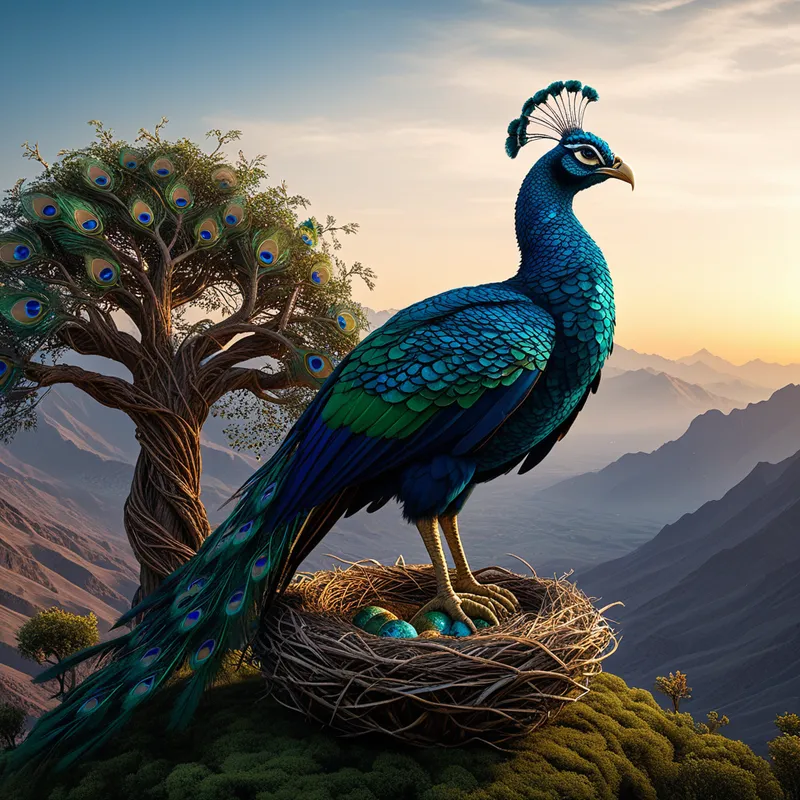
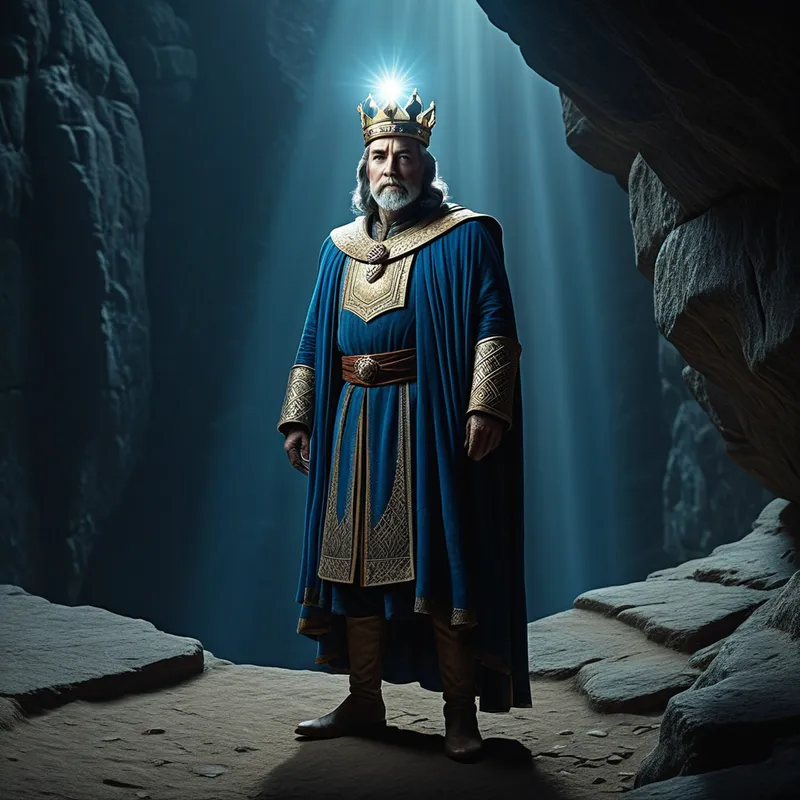
Hear now a tale whispered on the winds that sweep down from the Alborz mountains, a story not of conquest, but of surrender. It begins with a king, a ruler whose power was as vast as his longing. His name is lost to the ages, but his hunger is known to all: a hunger for the ultimate wisdom, for the secret that binds the cosmos. His advisors, sages with beards like winter frost, spoke of a being beyond being—the Simurgh. They said this creature, whose feathers held the colors of all worlds and whose shadow could heal the dying earth, nested in a place that was no place, atop the Gaokerena or upon the peak of Mount Qaf, the axis of the world.
Driven by a fire that no earthly throne could quench, the king embarked on a journey that stripped him of his kingdom. He crossed deserts where the sun was a hammer, forded rivers that sang with forgotten tongues, and climbed slopes where the air grew thin with eternity. His courtiers fell away, his treasures were scattered, until he walked alone, a pilgrim in rags. Finally, he stood before a chasm so deep it seemed to cleave the world’s heart. And there, on the far side, impossibly suspended between heaven and the abyss, was the Nest.
It was not woven of mere twig and straw. It was a tapestry of light and shadow, of living branches from the World Tree, cradling a single, luminous egg. The Simurgh was not there—only its essence, a palpable silence that hummed with knowing. The chasm was unbridgeable. The king’s quest, it seemed, had found its end in futile gazing.
Then, a voice that was not a voice, but a knowing in the bone, arose from the Nest itself. The way is not across, but within. The bridge is sacrifice. The king looked at the last thing he possessed: his own sovereign will, his identity as the seeker. He understood. To reach the Nest, he must become the Nest. He must offer not something he had, but something he was.
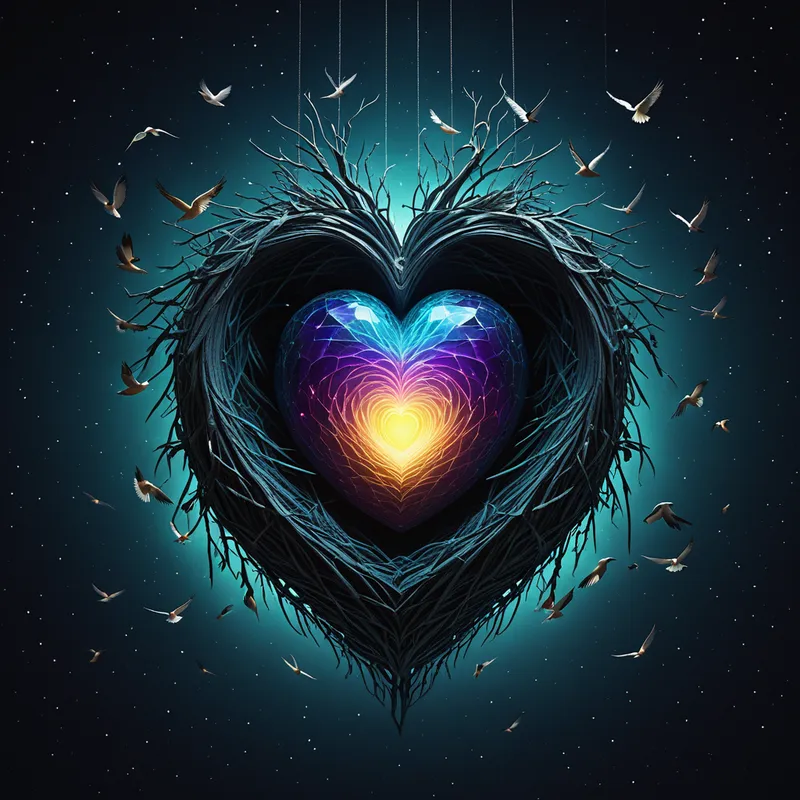
With a cry that was both agony and release, the king did not leap toward the Nest, but into the chasm below it. He fell not as a man, but as an offering. And as he fell, a miraculous inversion occurred. The chasm, the distance, the separation—all were revealed as illusion. His act of ultimate surrender was the crossing. He did not crash upon the rocks, but was gathered, transformed. He found himself within the Nest, not as a king, but as its very center. The luminous egg was now his own heart, and from it, the wisdom of the Simurgh flowed not as knowledge to be held, but as being to be inhabited. King and Nest, seeker and sought, were one. The journey ended where it always began: in the wholeness that was, is, and ever shall be.
Cultural Origins & Context
This profound narrative finds its roots in the rich tapestry of Persian mystical literature, most notably within the epic poetry of Ferdowsi and the transcendent works of Farid ud-Din Attar. In Attar’s masterpiece, Mantiq al-Tayr, the journey of thirty birds (si morgh) to meet the Simurgh becomes the central allegory for the soul’s path to divine unity. The myth of the king and the Nest operates as a concentrated, archetypal kernel of this same truth.
Passed down through oral tradition and refined in the courts of scholars and Sufi lodges (khanqahs), this story served a crucial societal function. In a culture that highly valued kingship and order (Farr), it presented a radical counter-narrative: that true sovereignty comes not from dominion over others, but from the utter surrender of the ego. It was a teaching story for rulers and commoners alike, a reminder that the highest authority is spiritual, accessed only through the dissolution of the separate self.
Symbolic Architecture
The myth’s power lies in its flawless symbolic architecture. The Simurgh represents the ultimate Self, the complete, unified psyche that encompasses both conscious and unconscious realms. Its Nest is the sanctuary of this wholeness, the state of integrated being. The king is the ego-consciousness, the ruling principle of the personal psyche that believes it must acquire wisdom and power from an external source.
The chasm is not a space to be crossed, but the illusion of separation itself—the gulf between the ego and the Self.
The journey is the classic nekyia, the descent where all worldly attributes are stripped away. The critical turn is the realization that the ego cannot take possession of the Self; it must be sacrificed to it. The king’s leap is the ego’s voluntary death, the relinquishment of control and identity. The miraculous inversion—where falling becomes ascending, where the seeker becomes the sanctuary—symbolizes the psychic law that one must lose oneself to find oneself. The egg is the latent potential for this new, born-again consciousness, which hatches not into a separate entity, but into the realization of primordial unity.

The Dreamer’s Resonance
When this myth stirs in the modern dreamer, it often manifests as dreams of impossible quests, unbridgeable gaps, or sacred, out-of-reach objects. You may dream of a radiant home on a distant cliff, a treasure at the bottom of a well you cannot enter, or a wise figure who remains always just beyond sight. The somatic feeling is one of profound yearning mixed with frustration—a deep soul-hunger.
Psychologically, this signals a critical juncture in the individuation process. The conscious mind (the dream-ego, the king) has identified a goal—greater psychological wholeness, purpose, or authenticity (the Nest). It has undertaken significant effort (the journey). But it has reached a limit where striving itself becomes the obstacle. The dream presents the chasm to illustrate that the current mode of operation—grasping, seeking, achieving—is now the problem. The psyche is preparing the dreamer for a necessary sacrifice of attitude, a letting go of how one believes transformation must occur. It is the prelude to a breakdown of the old ego-structure to make room for a new, more integrated consciousness.
Alchemical Translation
The alchemical process mirrored here is the nigredo giving way to the albedo, but through a singular, definitive act. The king’s worldly journey is the separatio and mortificatio—the separation from attachments and the death of the old identity. The chasm is the crucible. The leap is the supreme act of solutio, where the solid, kingly ego dissolves into the waters of the unconscious.
The goal of the work is not to possess the philosopher’s stone, but to realize you are the vessel in which the transmutation occurs.
For the modern individual, this translates to those moments when relentless self-improvement, therapy, or spiritual seeking hit a wall. The alchemical instruction is to stop trying to fix or attain. It is to consciously offer up the very identity of “the seeker” or “the wounded one” or “the achiever” to the larger, unknown psyche. This could mean surrendering a long-held narrative of victimhood, abandoning a rigid life goal that has become a cage, or simply stopping the inner commentary and control. The “Nest” is realized not as a future state to be reached, but as the present ground of being that was always here, once the illusion of the separate, striving ego (the king) is relinquished into the chasm of the unknown. The result is not enlightenment as a trophy, but wholeness as a lived reality—the king become the Nest, the individual Self resting in the cosmic Self.
Associated Symbols
Explore related symbols from the CaleaDream lexicon: