
The Silver Branch Myth Meaning & Symbolism
A sacred branch of silver apple blossoms that sings, calling a mortal from this world to the Otherworld, initiating a journey of transformation.
The Tale of The Silver Branch
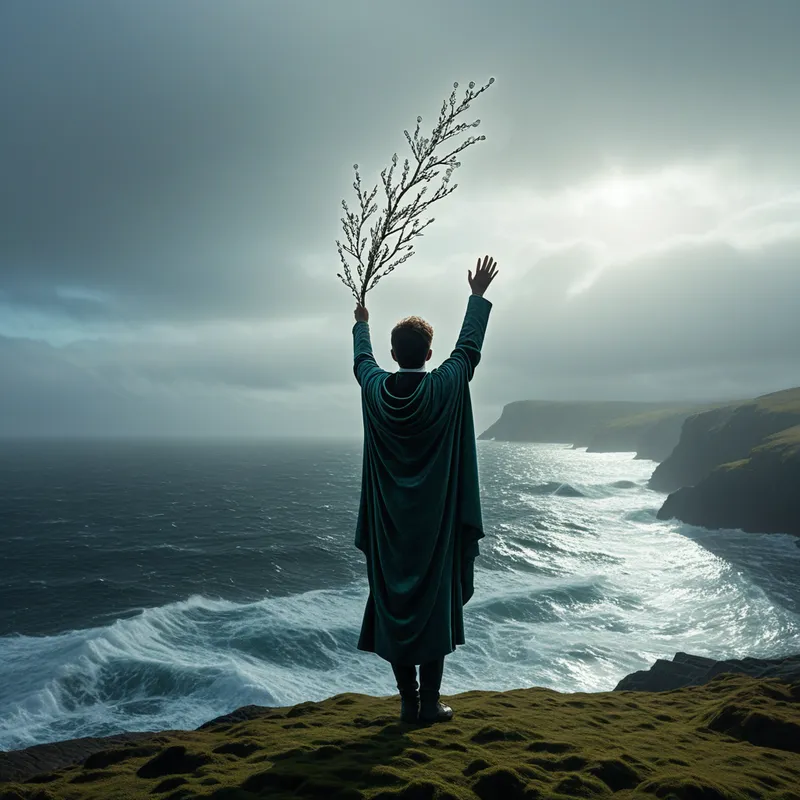
Listen, and let the mists of the western sea gather in your mind. The wind does not blow here; it whispers of a world just beyond the edge of sight. On a headland where the grey stone meets the grey sea, a man stands. He is not a king, nor a famed warrior, but a soul restless with a longing he cannot name. His name is Bran mac Febal.
The air grows thick, heavy with the scent of apple blossom out of season. A sound begins, not from the earth or the sky, but from the space between them. It is a music that bypasses the ear to vibrate in the marrow of his bones—a melody of such piercing sweetness and sorrow that his heart clenches like a fist. He turns.
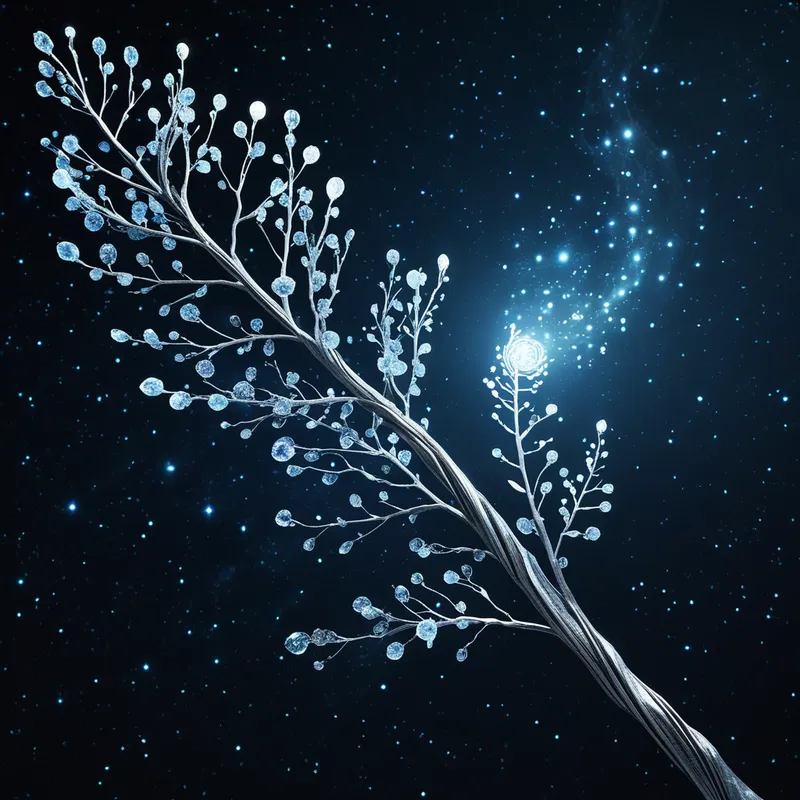
Through the veils of mist, a figure approaches. Not walking, but gliding, as if the ground itself parts in reverence. It is a woman, but her form is of a light that does not burn the eyes. In her hand, she holds a branch. Not of wood, but of living silver, and from it bloom flowers of a white so pure it casts its own light. And it sings. The branch itself is the source of the music, each blossom a note in an eternal song.
She speaks, and her voice is the echo of the music. “I come from Tír na nÓg, the Land of the Young. I bring the Silver Branch. Its song is the call of that land. It is for you, Bran mac Febal. Your waking life is but a dream. The true world awaits across the wine-dark sea.”
Bran looks from her eyes, which hold constellations, to the branch, whose song now feels like a hook in his soul, pulling him home to a home he has never known. All doubt, all fear of the mortal realm—his possessions, his name, his very life—falls away like a discarded cloak. The call is not an invitation; it is a remembering.
He follows her to the shore. There, where only waves should be, rests a boat. It is wrought of bronze and fíanaigecht, and it gleams with no reflection of this sun. He steps in. The woman raises the Silver Branch, and as its song swells, the boat moves of its own will, sliding into the deep water. The shores of Ireland recede, not into distance, but into memory. Ahead is not a horizon, but an opening—a tear in the fabric of the world, glowing with an inner light. Bran does not look back. The Silver Branch sings, and he is gone, carried not toward a place, but into a state of being, leaving the world of struggle for the world of essence.
Cultural Origins & Context
The myth of the Silver Branch is not a single, codified story but a potent motif woven through the tapestry of early Irish literature, most notably in the voyage tale Immram Brain. These tales were the province of the filid, the poet-seers who functioned as custodians of history, law, and the sacred. They were not mere entertainers; they were mediators between the community and the invisible world.
The myth served a crucial societal function in a culture that perceived reality as layered. The Middle World of human existence was flanked by the Sídhe realms of the gods and ancestors. The Silver Branch was the ultimate symbol of legitimate contact between these spheres. Its appearance signaled that a journey was not a trespass but a divine summons. It validated the experiences of seers and provided a mythological framework for understanding profound psychic events—the call to adventure, the onset of inspiration, or the deep longing for something beyond material life. It was a narrative anchor in a cosmos that was inherently magical and interconnected.
Symbolic Architecture
At its core, the Silver Branch is an object of paradox. It is a branch—connected to the World Tree, symbol of life, growth, and connection—yet it is made of silver, a metal of the moon, intuition, and the soul. It bears apple blossoms, symbols of immortality and sacred knowledge, yet it is plucked, representing a gift severed from its source to initiate a new cycle.
The Silver Branch is not an object to be possessed, but a frequency to be attuned to. Its song is the sound of the soul’s own forgotten language.
Psychologically, the branch represents the irresistible call of the Self. This is not the ego’s ambition, but the totality of the psyche summoning the conscious personality to a greater destiny. The mortal realm, for all its tangibility, becomes the “dream” when this call sounds. The figure bearing the branch is the anima/animus, the psychopomp who guides the ego to the depths. Bran’s immediate, unquestioning departure signifies a crucial psychological truth: when the Self calls, all egoic negotiations must cease. The journey is non-negotiable.
The Dreamer’s Resonance
When this mythic pattern stirs in the modern unconscious, it rarely manifests as a literal silver branch. Instead, the dreamer experiences the quality of the call. It may be a dream of hearing a sublime piece of music that induces overwhelming nostalgia and grief upon waking. It could be a recurring image of a door, gate, or shoreline that glows with inviting yet terrifying light. Often, there is a guide—an unknown yet deeply familiar figure who silently gestures toward a threshold.
Somatically, the dreamer might report a feeling of being “pulled” in the chest or a profound, aching longing (hiraeth) with no obvious cause. Psychologically, this signals that a deep process of reorientation has begun. The conscious attitude has become too narrow, too identified with the “headland” of personal history and daily concerns. The unconscious is now applying pressure, using the symbol of the Silver Branch to break the ego’s identification with the provisional life. The conflict is between the comfort of the known world and the terrifying allure of the unknown Self.

Alchemical Translation
The journey of Bran models the alchemical process of nigredo and albedo in the service of individuation. The first, crucial step is the severing. The Silver Branch is, by definition, cut from its tree. So too must the individual be cut from the tree of collective norms, family expectations, and personal history to begin the true work.
The voyage across the sea is not an escape from life, but a descent into the life beneath life. One drowns in the personal unconscious to be reborn in the collective.
Bran’s abandonment of the shore is the mortificatio—the symbolic death of the old ego-state. The boat journey on the “wine-dark sea” is the navigation of the unconscious, where the guiding light is not logic, but the enduring song of the branch—the faint, persistent voice of the Self. The destination, Tír na nÓg, is not a geographic location but the psychic state of wholeness, where opposites (young/old, mortal/immortal) are reconciled.
For the modern individual, the “Silver Branch moment” occurs when a vocation, a crisis, a love, or a loss strikes with the force of a divine summons, rendering previous goals meaningless. The work is to have the courage of Bran: to stop trying to interpret the call with the old mind, and instead to step into the boat—to commit to the therapy, the creative act, the spiritual practice, the life change—guided only by the haunting, beautiful melody of what one is ultimately meant to become. The branch sings. The only question is whether one will follow.
Associated Symbols
Explore related symbols from the CaleaDream lexicon: