The Silkworm Cocoon Myth Meaning & Symbolism
A celestial goddess descends, marries a mortal, and sacrifices her divine form to gift humanity silk, weaving a myth of love, loss, and sacred transformation.
The Tale of The Silkworm Cocoon
Listen, and hear the whisper of the mulberry leaves. In the time when [the earth](/myths/the-earth “Myth from Hindu culture.”/) was young and the heavens hung close enough to touch, there lived a man. He was a farmer, kind and lonely, tending his fields under the watchful eye of his aging father. One day, as dusk painted [the sky](/myths/the-sky “Myth from Persian culture.”/) in hues of sorrow, the old man vanished. The son searched for days, his heart a hollow drum, until his path led him to the foot of a great, ancient mulberry tree.
There, beneath its generous boughs, he found not his father, but a sight that stole his breath. A white horse, its coat like polished moonlight, stood guard. And from the tree’s highest branch, hung a cocoon—not of any earthly worm, but a vessel of luminous, pearlescent silk, shimmering with an [inner light](/myths/inner-light “Myth from Buddhist culture.”/). As the man reached out in wonder, the cocoon began to unravel. Not into chaos, but into a dance. The silk threads spun themselves into the air, weaving and coalescing until they formed the figure of a woman.
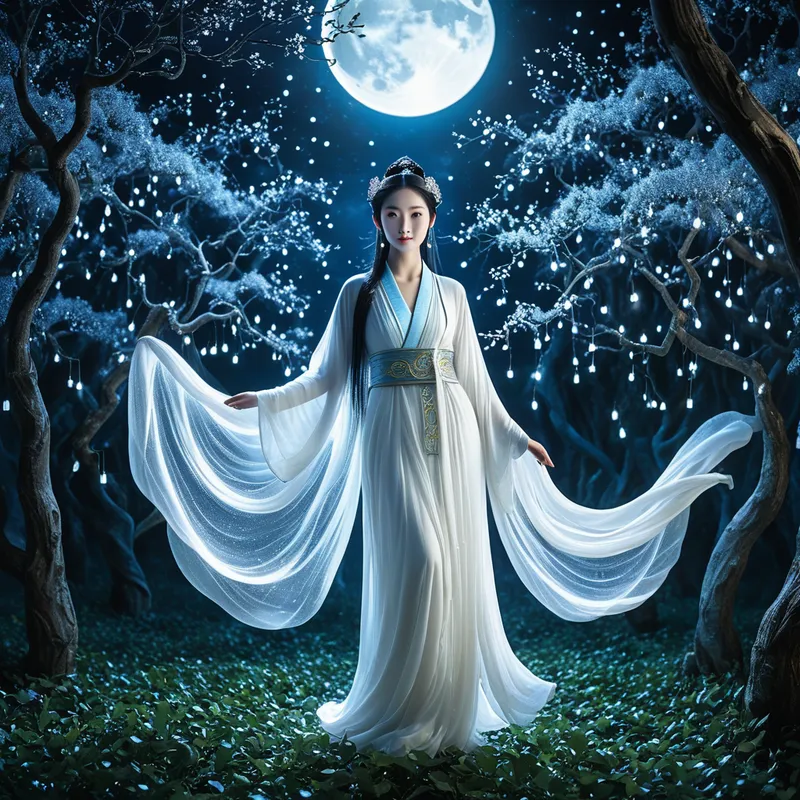
She was [Leizu](/myths/leizu “Myth from Chinese culture.”/), a daughter of the [Jade Emperor](/myths/jade-emperor “Myth from Chinese culture.”/). Her eyes held the patience of centuries, and her presence filled the grove with a serene, celestial warmth. She had seen the man’s filial devotion, his pure heart echoing in the silent spaces between the stars. Love, profound and destined, bloomed between the mortal and the divine. She descended from her silken throne, sent the loyal white horse back to the heavens as a messenger, and stayed. She became his wife, bringing to his humble home not gold, but a deeper magic.
For years, they lived in simple harmony. Yet, Leizu carried a silent sorrow. She watched her mortal husband toil, saw the coarse hemp and animal skins that clothed their people, and remembered the effortless grace of her celestial silks. A deep, nurturing impulse stirred within her—a divine compassion for mortal struggle. One evening, as they sat beneath that same mulberry tree, she took his hands in hers. Her touch was like cool silk. “My love,” she said, her voice the sound of wind through ripe grain, “I must give you a gift. But to give it, I must change.”
Before he could speak, she began to glow. Her form, so solid and beloved, softened at the edges. She smiled, a look of peaceful resolve, and walked to the mulberry tree. As she embraced its trunk, her body dissolved into a cascade of shimmering, white threads. They flowed from her like a river of moonlight, weaving around her, over her, creating a perfect, ovate cocoon that hung where she had stood. The man wept, his tears watering the roots of the tree. From within the silent cocoon, a new sound emerged—a soft, rustling knowledge. When the time was right, he carefully harvested the cocoon. Placing it in warm [water](/myths/water “Myth from Chinese culture.”/), he found he could gently unwind a single, endless, miraculous thread. The gift was complete. The secret of silk, born from celestial sacrifice, was now in mortal hands.

Cultural Origins & Context
This myth, central to the origin of sericulture, is most famously associated with Xiling Shi. It is not a single, canonical text but a living oral tradition that crystallized during the early dynastic periods, likely as a foundational narrative for the [Yellow Emperor](/myths/yellow-emperor “Myth from Chinese culture.”/)’s reign. It was told by elders, by weavers at their looms, and by mothers to daughters, functioning as a sacred charter for one of China’s most vital technological and economic arts.
The story served multiple societal functions: it sanctified the labor-intensive practice of silk production, linking it directly to the divine and the imperial lineage. It provided an etiological explanation for the mysterious process of sericulture—why silkworms eat mulberry leaves, why they spin cocoons, and how the thread is obtained. More profoundly, it embedded a core cultural value: that civilization’s greatest advancements (like silk) are not mere inventions, but gifts born from a nexus of divine compassion, sacrificial love, and human reverence.
Symbolic Architecture
The myth’s power lies in its layered [symbolism](/symbols/symbolism “Symbol: The use of symbols to represent ideas or qualities, often conveying deeper meanings beyond literal interpretation. In dreams, it’s the language of the unconscious.”/), a psychological [blueprint](/symbols/blueprint “Symbol: A blueprint represents the foundational plan or design for something, often symbolizing potential, structure, and the mapping of one’s inner self or future.”/) written in the [language](/symbols/language “Symbol: Language symbolizes communication, understanding, and the complexities of expressing thoughts and emotions.”/) of [nature](/symbols/nature “Symbol: Nature symbolizes growth, connectivity, and the primal forces of existence.”/) and divinity.
The [Silkworm](/symbols/silkworm “Symbol: The silkworm represents the idea of creativity, labor, and the intricate processes of transformation.”/) [Goddess](/symbols/goddess “Symbol: The goddess symbolizes feminine power, divinity, and the nurturing aspects of life, embodying creation and wisdom.”/) represents the archetypal Great [Mother](/symbols/mother “Symbol: The symbol of ‘Mother’ represents nurturing, protection, and the foundational aspect of one’s emotional being, often associated with comfort and unconditional love.”/) in her most creative and self-sacrificing [aspect](/symbols/aspect “Symbol: A distinct feature, quality, or perspective of something, often representing a partial view of a larger whole.”/). She is the materia prima of [heaven](/symbols/heaven “Symbol: A symbolic journey toward ultimate fulfillment, spiritual transcendence, or connection with the divine, often representing life’s highest aspirations.”/), descending to nourish and clothe the [material](/symbols/material “Symbol: Material signifies the tangible aspects of life, often representing physical resources, desires, and the physical world’s influence on our existence.”/) world. Her transformation is not a [death](/symbols/death “Symbol: Symbolizes transformation, endings, and new beginnings; often associated with fear of the unknown.”/), but a [metamorphosis](/symbols/metamorphosis “Symbol: A profound, often irreversible transformation of form, identity, or state, representing a complete journey from one condition to another.”/) into a new state of being-as-resource.
The [Cocoon](/symbols/cocoon “Symbol: Represents potential, protection, and the process of transformation.”/) is the central, multivalent [symbol](/symbols/symbol “Symbol: A symbol can represent an idea, concept, or belief, serving as a powerful tool for communication and understanding.”/). It is a [womb](/symbols/womb “Symbol: A symbol of origin, potential, and profound transformation, representing the beginning of life’s journey and the unconscious source of creation.”/) and a tomb, a sanctuary and a [prison](/symbols/prison “Symbol: Prison in dreams typically represents feelings of restriction, confinement, or a lack of freedom in one’s life or mind.”/). It represents a necessary, liminal [space](/symbols/space “Symbol: Dreaming of ‘Space’ often symbolizes the vastness of potential, personal freedom, or feelings of isolation and exploration in one’s life.”/) of [dissolution](/symbols/dissolution “Symbol: The process of breaking down, dispersing, or losing form, often representing transformation, release, or the end of a state of being.”/) and potential. The goddess enters it voluntarily, enacting a sacred suicide of her previous form to midwife a new [reality](/symbols/reality “Symbol: Reality signifies the state of existence and perception, often reflecting one’s understanding of truth and life experiences.”/).
The cocoon is the crucible where identity is willingly unmade so that essence may be rewoven into a new thread of connection.
The [Silk](/symbols/silk “Symbol: A luxurious natural fiber representing refinement, sensuality, and transformation from humble origins to exquisite beauty.”/) Thread is the distilled gift—[consciousness](/symbols/consciousness “Symbol: Consciousness represents the state of awareness and perception, encompassing thoughts, feelings, and experiences.”/), culture, [connection](/symbols/connection “Symbol: Connection symbolizes relationships, communication, and bonds among individuals.”/) itself. It is the tangible result of inner [alchemy](/symbols/alchemy “Symbol: A transformative process of purification and creation, often symbolizing personal or spiritual evolution through difficult stages.”/): the transformation of raw, divine substance (the goddess) into a strong, beautiful, and useful [filament](/symbols/filament “Symbol: A thin thread-like structure representing connection, fragility, illumination, and the transmission of energy or ideas.”/) that can connect, adorn, and elevate.
The Mulberry [Tree](/symbols/tree “Symbol: In dreams, the tree often symbolizes growth, stability, and the interconnectedness of life.”/) is the [Axis](/symbols/axis “Symbol: A central line or principle around which things revolve, representing stability, orientation, and the fundamental structure of reality or consciousness.”/) Mundi. It is where heaven and [earth](/symbols/earth “Symbol: The symbol of Earth often represents grounding, stability, and the physical realm, embodying a connection to nature and the innate support it provides.”/) meet, where the [father](/symbols/father “Symbol: The father figure in dreams often symbolizes authority, protection, guidance, and the quest for approval or validation.”/) is lost and the goddess is found. It roots the entire [drama](/symbols/drama “Symbol: Drama signifies narratives, emotional expression, and the exploration of human experiences.”/) in the [fertile soil](/symbols/fertile-soil “Symbol: Fertile soil symbolizes potential, growth, and nurturing, representing the foundation for new beginnings and creativity.”/) of the natural world, making the divine gift inseparable from earthly cycles.
The Dreamer’s Resonance
When this myth stirs in the modern unconscious, it often surfaces in dreams of profound personal transformation. To dream of being inside a cocoon, or of weaving one, signals a somatic and psychological process of encapsulation. The [psyche](/myths/psyche “Myth from Greek culture.”/) is initiating a protective withdrawal from the outer world. This is not regression, but a necessary retreat for deep inner work.
Dreams of unraveling a cocoon, or of finding a luminous thread within it, point to the stage of integration. The dreamer is ready to carefully, gently, draw forth the new insight, talent, or aspect of self that has been forming in solitude. The feeling-tone is crucial: anxiety suggests a fear of this emerging self, while awe or calm indicates a readiness to receive the gift.
Conversely, dreaming of a cocoon that feels like a prison, or of silk that tangles and binds, reveals a resistance to this alchemical process. [The ego](/myths/the-ego “Myth from Jungian culture.”/) clings to an old form, terrified of the dissolution required to spin its new thread. The body may respond with sensations of constriction, tightness in the chest, or a longing for breath—the somatic echo of the cocoon’s walls.
Alchemical Translation
For the individual on the path of individuation, the [Silkworm Cocoon](/myths/silkworm-cocoon “Myth from Chinese culture.”/) myth is a master narrative of psychic transmutation. It models the complete cycle of inner development.
First, there is the Descent of the Divine—the call from [the Self](/myths/the-self “Myth from Jungian culture.”/). This is that inexplicable inspiration, the “celestial” idea or feeling that enters our mundane life (the farmer’s world), often following a period of loss or searching. We fall in love with this new potential.
Then comes the Sacrificial Encapsulation. This is the hardest phase. The nurturing, creative energy (the inner Goddess) must voluntarily submit to being deconstructed. In human terms, this is the sacrifice of a comfortable identity, a cherished self-image, or outdated life structures to serve a greater inner purpose. We must enter our own cocoon of therapy, solitude, artistic practice, or deep reflection.
Individuation demands we become both the weaver and the thread, the sacrificer and the gift.
Within the cocoon, Dissolution and Re-weaving occurs. Old complexes and patterns break down. It is a dark, formless, yet fertile time where the essential substance of the psyche is prepared.
Finally, there is the Unwinding of the Thread—the conscious integration. This is the careful, patient work of drawing this newly formed essence out into [the world](/myths/the-world “Myth from Tarot culture.”/). It becomes our “silk”: our unique creative output, our healed way of relating, our authentic voice. The myth assures us that the gift, once fully received and unwound, forever changes our relationship to the world, clothing our existence in a grace that originated in a sacred, self-offered transformation. We are left, like the farmer, with both the beauty of the gift and the memory of the love that spun it, tasked with weaving it into the fabric of our lives.
Associated Symbols
Explore related symbols from the CaleaDream lexicon: