The Silk Ribbon Dance Myth Meaning & Symbolism
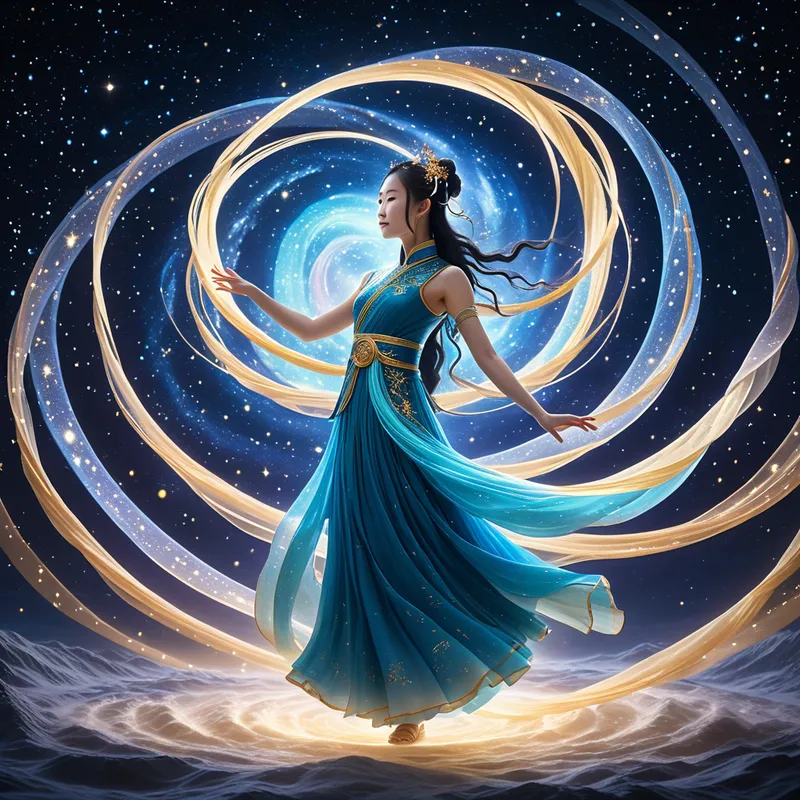
A celestial goddess weaves the cosmos from chaos with her dance, her silk ribbons becoming the rivers and stars, teaching the art of transforming emotion into order.
The Tale of The Silk Ribbon Dance
In the time before time, there was only the Hundun—a formless, silent egg of mist and potential. No sky pressed down, no earth pushed up. There was only the great, breathless waiting. Then, a vibration began, a hum felt rather than heard, deep within the heart of the chaos. It was the stirring of Feilian, she who was born of the longing for form itself.
She awoke not with a cry, but with a sigh that became the first wind. Finding herself adrift in the endless grey, a profound melancholy settled upon her—not a sadness of despair, but the deep, creative sorrow of solitude. This sorrow gathered in her sleeves, heavy and dense. With a gesture born of pure instinct, she swept her arms through the void. From her billowing sleeves, lengths of silk—not mere cloth, but the very substance of her feeling—began to unfurl. They were the color of dawn’s first blush, of deep river jade, of twilight indigo.
And so, she began to dance. It was not a dance of joy, but one of necessity, a moving meditation to give shape to the shapelessness within and without. Her steps were slow at first, tracing hesitant circles in the mist. With each turn, each sweep of her arm, the ribbons flew further. They did not fall; they poured, like liquid light. The melancholy in them transformed as it moved; the heavy threads became flowing rivers, carving their patient paths through the haze. The sharper, flicking motions of her wrists sent threads skyward, where they caught on nothing and yet held fast, becoming the shimmering veins of the Tianhe.
The dance grew in intensity. The formless chaos began to resist, coiling and pushing back against the imposition of order. Feilian’s dance became a struggle, a beautiful, silent battle. She spun, her ribbons wrapping around pockets of stubborn mist, compressing them into the first mountains. A powerful, downward strike of her ribbon-tipped hand parted the heavy vapors, and the clear air of the sky rushed to fill the space above, while the denser energies settled to form the earth below. Her breath, synchronized with her movement, became the shifting winds and the seasons’ turn.
Finally, spent and serene, she brought her dance to a close. The last flick of a ribbon tied the sky to the earth at the distant horizon. Where her feet had touched the new-formed ground, the first flowers bloomed. She stood at the center of her creation, the silks now still, having become the world itself—its waterways, its starry paths, the very fabric of reality. The silence was gone, replaced by the soft symphony of a world beginning: the whisper of water, the sigh of wind through nascent valleys. The dance was over, but its pattern was now the pattern of all things.
Cultural Origins & Context
The myth of the Silk Ribbon Dance is woven from the deep cultural looms of Ru (Confucian) cosmology and Daoist naturalism. It is not a single, canonical text from a tome like the Shan Hai Jing, but rather a living oral tradition, often recounted by village elders, Daoist practitioners, and masters of classical dance and weaving. Its primary societal function was etiological—explaining the origin of the world’s beauty and order—and pedagogical, serving as a foundational narrative for arts like silk weaving, ribbon dancing (Cai Dai Wu), and calligraphy, where the flowing line is paramount.
The myth embodies the core Chinese cosmological principle of Yinyang emerging from Hundun. It translates an abstract philosophical concept into a somatic, emotional story. The goddess Feilian is less a sovereign deity issuing commands and more an artisan or midwife to the cosmos. The story was often told during festivals celebrating craft and harvest, reinforcing the idea that human creativity—in dance, fabric, and art—is a microcosmic reflection of the divine, creative act that birthed the universe. It grounds cosmic genesis in a profoundly relatable, feminine, and artistic act.
Symbolic Architecture
The myth’s power lies in its elegant symbolic architecture, where every element is a vessel of profound meaning.
-
The Silk Ribbons: These are the central symbol. They are not tools, but extensions of the self—specifically, of the dancer’s emotional and psychic energy (Qi). They represent raw, unformed feeling (the initial melancholy) that, through disciplined movement (the dance), is transformed into the structures of the world. The ribbon is the line of fate, the river of time, the connective tissue between spirit and matter, and the artistic expression itself.
-
Feilian, The Dancer: She is the archetypal Creator. Her dance is not frivolous performance; it is ritual action. She represents consciousness itself awakening within the unconscious (Hundun) and, through engagement and struggle, giving it form and meaning. She is the psyche that must move through its own inner chaos to create a livable, beautiful inner world.
-
The Dance: The dance is the process of individuation in motion. It is the alchemy of experience. The initial, heavy sorrow is not discarded but used as the raw material. The dance models how we must engage with our own inner chaos—our confusion, grief, or passion—not by suppressing it, but by moving with it, shaping it through the discipline of awareness.
The psyche does not conquer chaos; it dances with it, and from that intimate, moving engagement, a world is born.
The Dreamer’s Resonance
When this myth stirs in the modern unconscious, it often surfaces in dreams of swirling fabrics, being entangled in or weaving vast tapestries, or performing a slow, deliberate dance in empty, misty spaces. To dream of the Silk Ribbon Dance is to be in a potent state of psychic gestation. The dreamer is the dancer, and the ribbons are their own emotional and psychic contents seeking form.
Somatically, this can correlate with a feeling of being “full” but confused—a pressure of unexpressed creativity, unprocessed emotion, or a looming life transition that feels chaotic. The dream is an indicator that the primal, creative Self is attempting to initiate a process of ordering. The struggle in the dance mirrors the dreamer’s internal resistance to this demanding, beautiful work. It is a call to engage, to move, to begin the process of giving articulate shape to the formless potentials and pressures within. The dream is the first tremor of the dance.
Alchemical Translation
For the individual, the myth of the Silk Ribbon Dance provides a complete model for psychic alchemy—the transmutation of base, chaotic experience into the gold of conscious, lived reality.
-
Confronting the Hundun: This is the initial stage of any crisis, depression, or creative block—the feeling of being lost in a fog of undifferentiated possibility or pain. The myth teaches that this is not a void, but a womb. It is the necessary raw material.
-
Embracing the Sorrow/Material: Feilian does not reject her melancholy; she allows it to fill her sleeves. Psychologically, this is the critical step of acknowledging and accepting one’s emotional state without judgment, seeing it as the very substance from which something new will be made.
-
The Discipline of the Dance: This is the active work of therapy, journaling, artistic practice, or mindful reflection. It is the conscious, often difficult effort to “move” the material—to articulate the feeling, to trace its contours, to follow its flow. Each act of expression—a sentence written, a conversation had, a brushstroke made—is a step in the dance, sending a ribbon out into the inner void to define a new boundary, a new pathway.
-
Creation of the Inner Cosmos: The resolution is not the elimination of chaos, but the establishment of a dynamic, beautiful order within it. The rivers are the deep, flowing currents of one’s values and passions. The stars are the guiding lights of insight and memory. The mountains are the enduring structures of identity and belief. The dance never truly ends; the psyche, now ordered, continues its subtle, lifelong movement of maintenance and creation.
Individuation is the art of spinning the silk of one’s own experience into the tapestry of a coherent soul. The dance is lifelong, and the ribbons are what we make of our days.
Associated Symbols
Explore related symbols from the CaleaDream lexicon: