The Sibylline Books Myth Meaning & Symbolism
An ancient prophetess offers nine books of fate to a king, who scorns her. She burns them, forcing him to buy the last three at the original price.
The Tale of The Sibylline Books
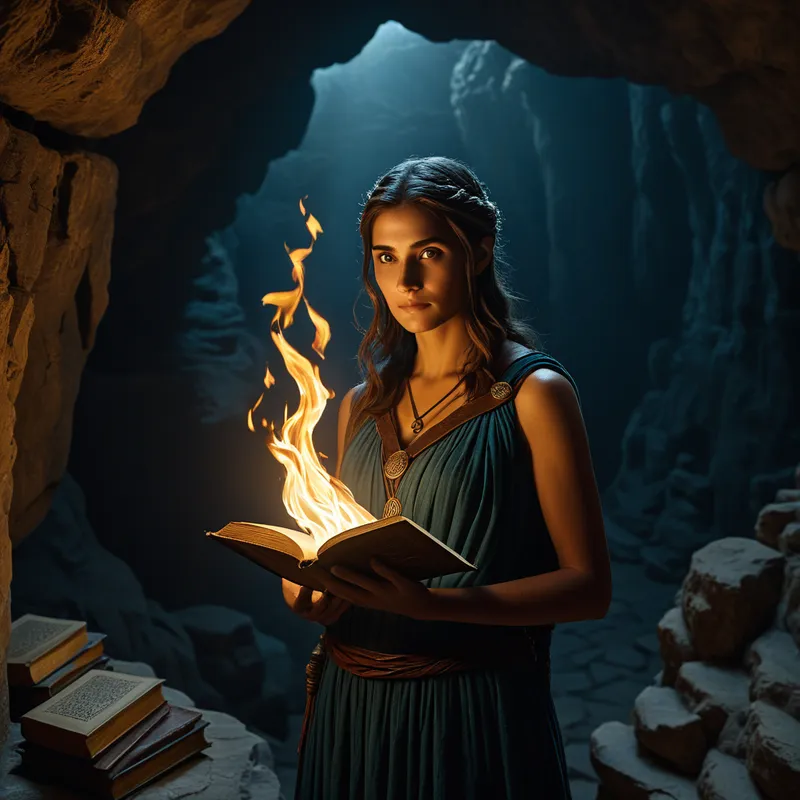
Listen, and hear the rustle of fate’s pages. In the days when gods walked close to [the earth](/myths/the-earth “Myth from Hindu culture.”/) and kings ruled by their whim, there lived a woman touched by Apollo himself. She was the Sibyl of Cumae, a prophetess whose voice was not her own. It was [the wind](/myths/the-wind “Myth from Various culture.”/) through caverns, the hiss of sacred snakes, the echo of the god’s own mind. She dwelled in a cavern where the air smelled of damp stone, [sulfur](/myths/sulfur “Myth from Alchemical culture.”/), and the sweet, cloying scent of bay leaves crushed underfoot.
One day, a visitor came to her threshold. Not a humble supplicant, but Tarquinius Superbus, a king whose pride was as vast as his realm. He came with the weight of Rome upon his shoulders, seeking an anchor for its future. The Sibyl emerged from the shadows, her form seeming both young and immeasurably old. In her hands, she held nine books. They were not like other books; their leather bindings seemed to pulse with a faint, [inner light](/myths/inner-light “Myth from Buddhist culture.”/), and the [papyrus](/myths/papyrus “Myth from Egyptian culture.”/) within crackled with a static energy.
“Hail, King of Rome,” her voice echoed, a chorus of whispers. “I bring you the destiny of your city. Within these nine volumes lies every twist of fate, every coming war and plague, every ritual to appease the gods in times of direst need. They are the future, written in the present.”
Tarquinius, a practical man of power and gold, eyed the strange collection. “Name your price, seer.”
The Sibyl’s eyes, pools of reflected torchlight, fixed upon him. “Three hundred pieces of gold.”
The king laughed, a sharp, dismissive sound that rang against [the cave](/myths/the-cave “Myth from Platonic culture.”/) walls. “Three hundred? For the ramblings of a cave-dweller? You ask for a fortune for mere paper and ink. The price is absurd.”
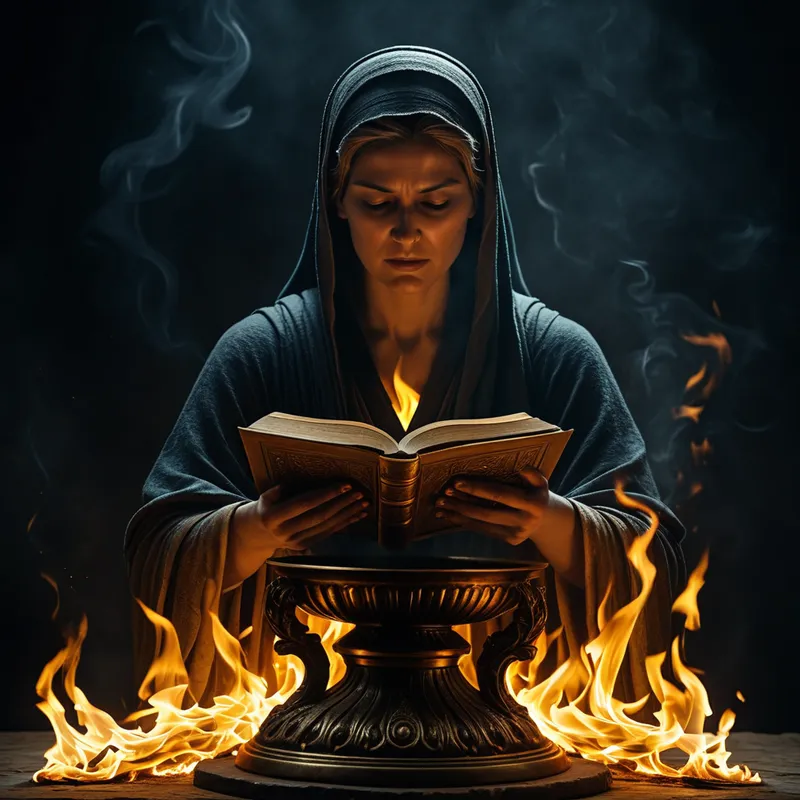
The air in the cavern grew cold. The Sibyl did not argue. She did not plead. Without a word, she turned and walked to a bronze brazier where a fire eternally burned. She took three of the sacred books and, with a gesture of terrible finality, cast them into the flames. The pages did not merely burn; they erupted in a flash of silver light and a sound like a sighing wind, before crumbling to ash.
She turned back to the stunned king, her face impassive. “The wisdom of three books is lost to you forever. The price for the remaining six is unchanged: three hundred pieces of gold.”
Tarquinius stared, his arrogance now mixed with a dawning, cold dread. He scoffed again, louder this time, to mask his unease. “You are mad! You destroy your own wares and keep the price the same? I will not pay it.”
Again, silence. Again, the slow turn. Three more books followed the first into the holy fire, their destruction accompanied by a low, mournful hum that vibrated in the teeth of all who heard it.
Now only three books remained in her hands. The Sibyl’s voice, when she spoke, was flat, devoid of all emotion, and thus more terrifying than any shout. “The choice is final, King of Rome. Three books. Three hundred gold pieces. This is the last offer. Refuse, and the knowledge within these last will follow the others into [the void](/myths/the-void “Myth from Buddhist culture.”/), and your city will face its darkest hours blind and unprepared.”
All pride drained from Tarquinius. He saw not a madwoman, but an instrument of a will far greater than his own. In the ashes of the six books, he saw the ashes of Rome’s future. With trembling hands, heavy with the weight of his folly, he paid the full, original price. The Sibyl gave him the three surviving books—a fractured, partial map of destiny, purchased at the cost of the whole. These would become the Sibylline Books, guarded in [the temple](/myths/the-temple “Myth from Jewish culture.”/) of Jupiter Capitolinus, consulted only in moments of profound crisis, a perpetual reminder of the catastrophic cost of scorned wisdom.
Cultural Origins & Context
The myth of the Sibylline Books sits at a fascinating crossroads between Greek and Roman tradition. The figure of the Sibyl is fundamentally Greek—an ecstatic prophetess, often associated with specific locales like Delphi or Cumae. Her prophecy was not a calm prediction but a raw, divine possession, a mania (madness) bestowed by Apollo. The story of her sale to Tarquinius, however, is a Roman framing device. It served a crucial societal function: to provide a divine and awe-inspiring origin story for a very real and politically vital Roman institution.
The actual Sibylline Books were a collection of Greek hexameter verses, carefully guarded by a special priesthood. They were not used for everyday divination but were consulted only by senatorial decree during existential threats like plague, famine, or military disaster. The myth thus legitimized this state apparatus by rooting it in a dramatic, divine encounter. It explained why the collection was incomplete (because of royal arrogance) and why it was so precious and costly (because its price was literally paid in lost wisdom). The tale was passed down by historians like Livy and the scholar Varro, cementing it as a foundational parable about the relationship between secular power and sacred knowledge.
Symbolic Architecture
At its [heart](/symbols/heart “Symbol: The heart symbolizes love, emotion, and the core of one’s existence, representing deep connections with others and self.”/), this myth is not about [prophecy](/symbols/prophecy “Symbol: A foretelling of future events, often through divine or supernatural means, representing destiny, fate, and hidden knowledge.”/), but about valuation. It explores the profound gap between [the market](/myths/the-market “Myth from Various culture.”/) price of a [thing](/myths/thing “Myth from Norse culture.”/) and its true, often ineffable, worth. The [Sibyl](/symbols/sibyl “Symbol: A prophetic priestess in ancient Greek and Roman mythology who delivered divine oracles, often through ecstatic trance, representing hidden knowledge and fate.”/) represents the autonomous, non-[human](/symbols/human “Symbol: The symbol of a human represents individuality, complexity of emotions, and social relationships.”/) voice of the unconscious or [the Self](/myths/the-self “Myth from Jungian culture.”/)—it does not negotiate. It presents its demand, the cost of integrating a [piece](/symbols/piece “Symbol: A ‘piece’ in dreams often symbolizes a fragment of the self or a situation that requires integration, reflection, or understanding.”/) of transcendent [knowledge](/symbols/knowledge “Symbol: Knowledge symbolizes learning, understanding, and wisdom, embodying the acquisition of information and enlightenment.”/) into the conscious [realm](/symbols/realm “Symbol: The symbol of ‘Realm’ often signifies the boundaries of one’s consciousness, experiences, or emotional states, suggesting aspects of reality that are either explored or ignored.”/) (the [kingdom](/symbols/kingdom “Symbol: A kingdom symbolizes authority, belonging, and a sense of identity within a larger context or community.”/)).
The unconscious does not bargain. It states its price. To haggle is to invite the burning of your own soul’s library.
The nine books symbolize the complete, archetypal knowledge of the [psyche](/myths/psyche “Myth from Greek culture.”/)—the totality of potential destinies and patterns. Tarquinius, the embodiment of the conscious ego—pragmatic, prideful, and transactional—attempts to apply his worldly [logic](/symbols/logic “Symbol: The principle of reasoning and rational thought, often representing order, structure, and intellectual clarity in dreams.”/) to the numinous. His refusal is not just stinginess; it is a fundamental failure to recognize the [nature](/symbols/nature “Symbol: Nature symbolizes growth, connectivity, and the primal forces of existence.”/) of what is being offered. The burning of the books is the inevitable consequence. Knowledge that is rejected, scorned, or devalued by the conscious mind does not simply wait on the [shelf](/symbols/shelf “Symbol: A shelf in dreams often represents organization, categorization, and the management of thoughts, memories, and priorities.”/). It retreats, disintegrates, or turns destructive. The three remaining books represent the fragmented, [crisis](/symbols/crisis “Symbol: A crisis symbolizes turmoil, urgent challenges, and the need for immediate resolution or change.”/)-driven [relationship](/symbols/relationship “Symbol: A representation of connections we have with others in our lives, often reflecting our emotional state.”/) most people have with their deeper selves. We only listen to the inner Sibyl when we are desperate, after much of our potential wholeness has been sacrificed to our own arrogance.
The Dreamer’s Resonance
When this myth patterns a modern dream, it often manifests as a profound somatic anxiety around missed opportunity or willful ignorance. The dreamer might be in a library where books turn to dust as they reach for them, or they are offered a crucial key or map by a mysterious figure only to dismiss it as worthless and watch it vanish. The psychological process is one of confronting a rejected insight.
The body may feel heavy, burdened by the “cost” that was avoided but now manifests as depression or stagnation—the ashes of the burned books settling in the psyche. Alternatively, there can be a frantic, searching energy, a desperate attempt to reconstruct what was lost from fragments. This dream pattern signals that the conscious attitude is being called to account. It is a stark, symbolic reminder that the psyche’s offerings are non-negotiable. To scorn the inner guide, the intuitive flash, or the call to a deeper life path is to actively destroy parts of one’s own potential future.

Alchemical Translation
The alchemical process modeled here is the mortificatio—the necessary death or destruction that precedes transformation. Tarquinius’s ego must be humiliated and broken (the burning of the six books) before it can become a vessel fit to receive even a portion of the sacred. His payment of the full price for [the remnant](/myths/the-remnant “Myth from Biblical culture.”/) is the first true act of humility, the beginning of his individuation.
The treasure is always guarded by a dragon, and the dragon is our own scorn. We slay it not with a sword, but with surrendered gold.
For the modern individual, the myth instructs a brutal but vital lesson: the cost of self-knowledge is fixed and absolute. You cannot have it on your own terms. The “bargaining” ego—which wants growth without sacrifice, insight without discomfort, wholeness without surrendering its pride—must witness the burning of its own possibilities. The three books that remain are the core, non-negotiable truths we are finally forced to accept. Their integration is never clean or complete; they are a fragmented guide for navigating crises. The alchemical gold is not in possessing perfect knowledge, but in the humbled posture of [the ego](/myths/the-ego “Myth from Jungian culture.”/) that now guards the fragmented scrolls with reverence, knowing the terrible price of their acquisition and the even more terrible cost of their loss. The work becomes one of tending the fragment, interpreting it with care, and living in awe of the vast, burned library that shadows it—a constant reminder of the wholeness that arrogance forfeits.
Associated Symbols
Explore related symbols from the CaleaDream lexicon: