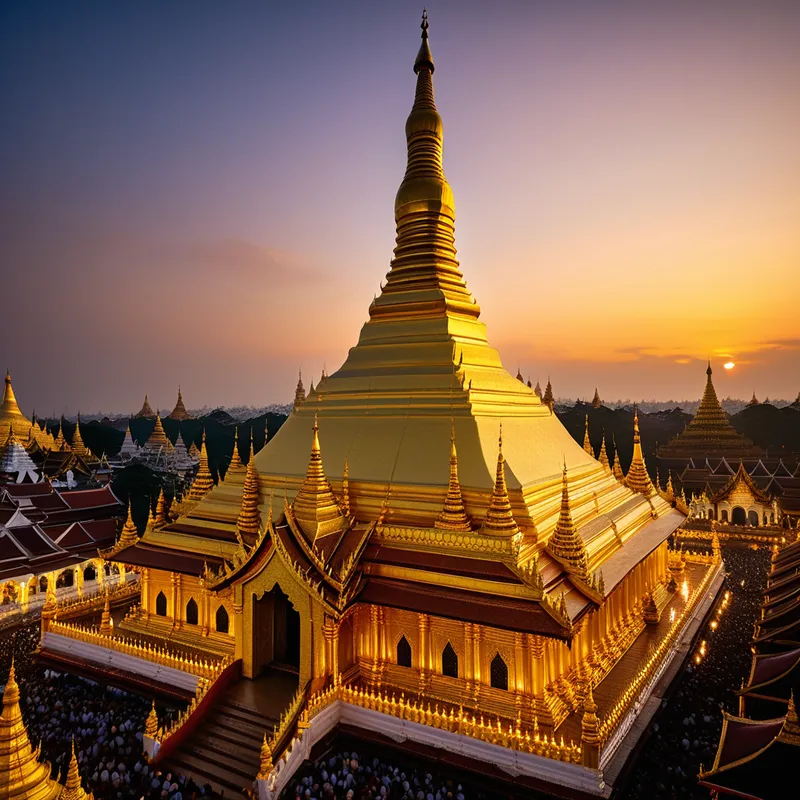
The Shwedagon Pagoda Myth Meaning & Symbolism
A myth of two merchant brothers receiving sacred relics from the Buddha, enshrined in a golden pagoda that anchors the spiritual axis of the world.
The Tale of The Shwedagon Pagoda
Listen, and hear the tale of the golden mountain that anchors [the world](/myths/the-world “Myth from Tarot culture.”/).
In a time when [the earth](/myths/the-earth “Myth from Hindu culture.”/) was younger and [the veil](/myths/the-veil “Myth from Various culture.”/) between realms was thin, two merchant brothers, Taphussa and Bhallika, journeyed from the distant land of Okkalapa. Their carts were heavy with goods, but their hearts were heavier with a nameless longing. Their path crossed that of a being of supreme peace, the Buddha, sitting in radiant stillness beneath [the Bodhi tree](/myths/the-bodhi-tree “Myth from Buddhist culture.”/). The air itself hummed with a profound silence that was not empty, but full. The light around him was not of the sun, but seemed to emanate from the very fabric of reality.
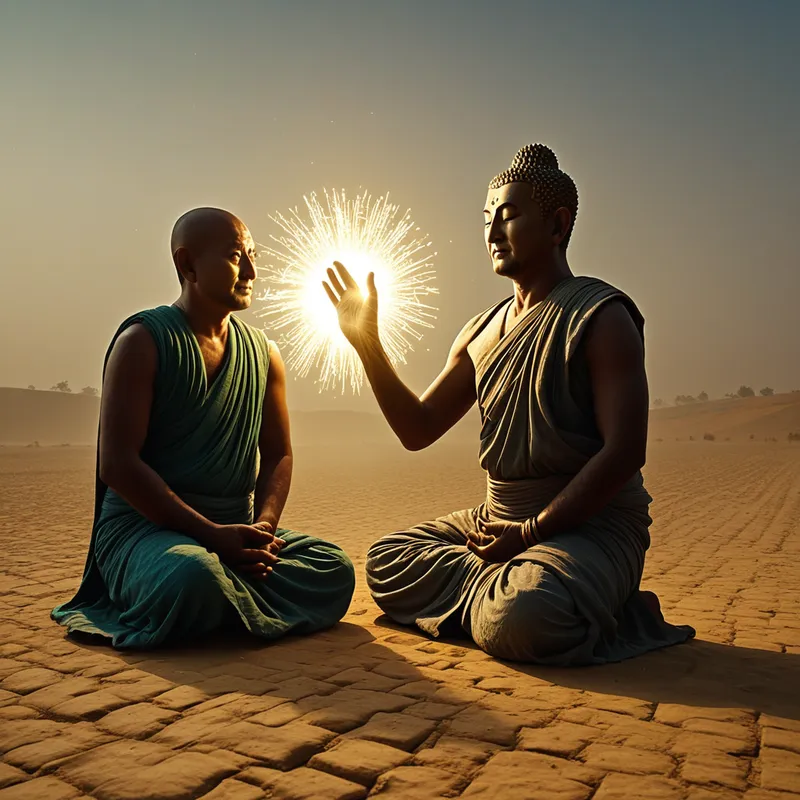
Overcome by a devotion that felt older than their bones, the brothers offered him their simple food—honey cakes. In return, [the Buddha](/myths/the-buddha “Myth from Buddhist culture.”/) gifted them not with gold or jewels, but with eight hairs from his own head. These were no ordinary strands. To hold them was to feel the weight of infinite compassion and the sharp clarity of ultimate truth. They shimmered with a soft, internal light, warm to the touch. A voice, not heard with ears but known in the heart, instructed them: these relics must be enshrined in their homeland, on the hill of Singuttara.
The brothers returned across mountains and seas, the sacred hairs cradled in a golden casket that seemed to grow lighter with each step, as if eager for its home. Yet Singuttara hill was no ordinary place. It was already a sacred axis, a spiritual pinnacle where the relics of the three previous Buddhas of this world-cycle—Kakusandha, Konagamana, and Kassapa—already lay buried, guarded by ancient nats and dragons of the earth. The hill rumbled with a deep, terrestrial power. [The sky](/myths/the-sky “Myth from Persian culture.”/) darkened as the guardian nats manifested, their forms shifting between human and elemental, demanding to know who dared add to this supreme repository.
The king of Okkalapa, Sihasura, intervened. With the wisdom of a ruler and the piety of a devotee, he opened the hill. A blinding light erupted as the casket was placed. The relics of the past Buddhas rose miraculously from the earth to greet the new, creating a pillar of light that pierced the clouds. From this luminous axis, the first golden pagoda was built, not by human hands alone, but by the concerted will of kings, nats, and devas. It grew, layer upon golden layer, not as a monument to a man, but as a beacon of the Dhamma itself, a permanent, shining testament to the possibility of awakening, planted like a golden seed in the heart of the world.
Cultural Origins & Context
This origin myth of the Shwedagon Pagoda is enshrined in the Mahavamsa and local Burmese chronicles. It functions not merely as a foundation story for Myanmar’s most sacred site, but as a cosmological charter. The tale synthesizes pre-Buddhist animist reverence for local spirits (nats) and sacred geography with the transcendent universalism of Buddhism. The hill of Singuttara is consecrated by this narrative, transforming it from a potent local spirit abode into the axis mundi for the entire Buddhist dispensation.
Passed down by monks, chroniclers, and generations of devotees, the myth served to legitimize kingship (through King Sihasura’s pious role), integrate indigenous beliefs into the Buddhist fold, and provide a tangible, geographical heart for the faith. It answers a profound human need: to locate the infinite within the finite, to have a place where heaven’s promise physically touches the earth. The story is recited not as dry history, but as an act of devotion, reinforcing the pagoda’s status as a living entity, a direct conduit to the time of the Buddha.
Symbolic Architecture
The myth’s core is an act of profound enshrinement. The eight hairs are not merely biological relics; they are vessels of the [Buddha](/symbols/buddha “Symbol: The image of Buddha embodies spiritual enlightenment, peace, and a quest for inner truth.”/)’s awakened mind, his metta and panna, made tangible. Their [journey](/symbols/journey “Symbol: A journey in dreams typically signifies adventure, growth, or a significant life transition.”/) from India to Myanmar maps the journey of the Dhamma itself—transmitted, received, and ultimately rooted in a new land.
The pagoda is not a tomb for the dead, but a womb for the living truth. It protects the fragile, hair-thin connection to enlightenment within the unyielding, golden mountain of worldly form.
The [hill](/symbols/hill “Symbol: A hill represents challenges, progress, or obstacles in life’s journey, often symbolizing effort and perspective.”/), Singuttara, symbolizes the layered [psyche](/myths/psyche “Myth from Greek culture.”/). The relics of past Buddhas buried within represent the deep, archetypal strata of wisdom inherent in the [cosmos](/symbols/cosmos “Symbol: The entire universe as an ordered, harmonious system, often representing the totality of existence, spiritual connection, and the unknown.”/), awaiting activation. The conflict with the nats is the necessary negotiation between the new, transformative [consciousness](/symbols/consciousness “Symbol: Consciousness represents the state of awareness and perception, encompassing thoughts, feelings, and experiences.”/) (Buddhism) and the established, autochthonous patterns of the land and the [psyche](/myths/psyche “Myth from Greek culture.”/) (the indigenous spirits). The [resolution](/symbols/resolution “Symbol: In arts and music, resolution refers to the movement from dissonance to consonance, creating a sense of completion, release, or finality in a composition.”/)—their harmonious cooperation—models [integration](/symbols/integration “Symbol: The process of unifying disparate parts of the self or experience into a cohesive whole, often representing psychological wholeness or resolution of internal conflict.”/), not conquest. The resulting [pagoda](/symbols/pagoda “Symbol: A Pagoda symbolizes spiritual enlightenment, cultural heritage, and the reaching of higher consciousness, often serving as a meditation or worship space.”/) is a [mandala](/symbols/mandala “Symbol: A sacred geometric circle representing wholeness, the cosmos, and the journey toward spiritual integration.”/) in three dimensions: a concentric, ascending [structure](/symbols/structure “Symbol: Structure in dreams often symbolizes stability, organization, and the framework of one’s life, reflecting how one perceives their environment and personal life.”/) that diagrams the [path](/symbols/path “Symbol: The ‘path’ symbolizes a journey, choices, and the direction one’s life is taking, often representing individual growth and exploration.”/) from earthly suffering ([samsara](/myths/samsara “Myth from Buddhist culture.”/)) at its base to the unconditioned, luminous point of Nibbana at its [spire](/symbols/spire “Symbol: A tall, tapering structure pointing skyward, symbolizing aspiration, spiritual connection, and reaching beyond earthly limits.”/).
The Dreamer’s Resonance
To dream of the Shwedagon, or of its mythic components, is to encounter the psyche’s own imperative to enshrine what is most sacred and fragile. Dreaming of receiving a sacred, glowing object (like the hairs) suggests [the ego](/myths/the-ego “Myth from Jungian culture.”/) has been graced by a content from [the Self](/myths/the-self “Myth from Jungian culture.”/)—a core insight, a profound feeling, or a nascent talent that feels both intimately personal and transpersonal. It is a gift that carries the obligation of preservation.
Dreaming of a conflict at a sacred hill or mountain represents the inner resistance when trying to integrate this new content. The “nats” of the dream may appear as familiar anxieties, old identities, or family complexes that guard their territory fiercely. The somatic feeling is often one of pressure, a rumbling in the chest or gut—the weight of the new pressing against the structure of the old. The dream’s resolution, building the enshrinement, points to a successful act of psychic architecture: creating an inner, inviolable space where this sacred content can reside, be honored, and from which it can radiate meaning.
Alchemical Translation
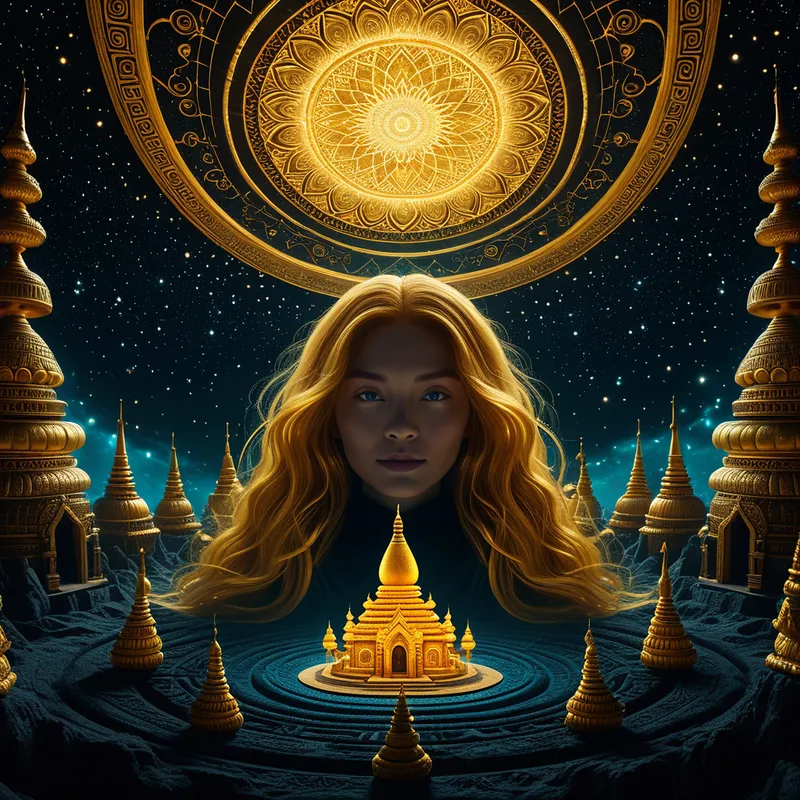
The alchemical process modeled here is fixation: the volatilized spirit (the Buddha’s teaching, the ephemeral hairs) must be fixed into a permanent, incorruptible form (the golden pagoda). For the modern individual, this is the process of making inner experience substantively real in one’s life.
The journey begins with the “merchant brothers”—the pragmatic, worldly parts of the psyche that nonetheless feel a spiritual hunger. Their offering of simple nourishment (the honey cakes) is the initial, humble act of devotion or attention that opens the door to grace. Receiving the relics is the moment of numinous insight or emotional truth. The critical phase is the return and the conflict. One cannot simply possess such a gift; one must build a life around it.
Individuation requires not just revelation, but institution. The golden pagoda is the psyche’s permanent establishment, built layer by conscious layer, where the fleeting glimpse of the Self becomes the enduring axis of one’s world.
This means creating daily practices, ethical structures, and relationships that “enshrine” and protect that core truth. It involves negotiating with one’s inner “nats”—the powerful, often unconscious complexes and instincts—not to eliminate them, but to enlist them as guardians of this new center. The finished “pagoda” is the individuated personality: a complex, layered, beautiful structure centered on and oriented by that which is most sacred within, allowing it to shine forth as a beacon and a refuge, both for oneself and for the world.
Associated Symbols
Explore related symbols from the CaleaDream lexicon: