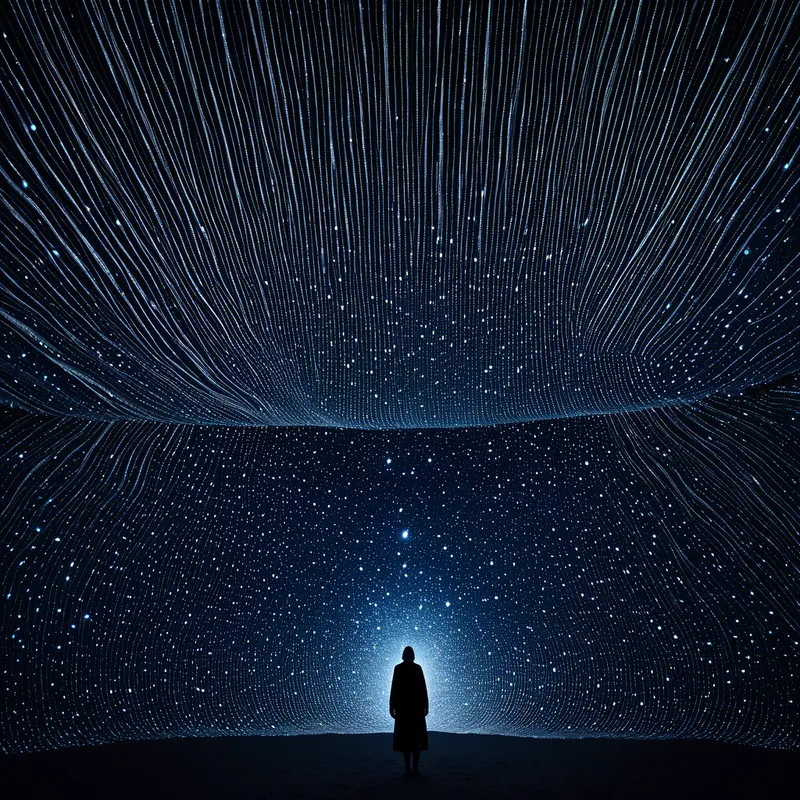
The Shroud / Veil Myth Meaning & Symbolism
An ancient motif of a divine fabric separating worlds, its lifting or tearing reveals ultimate reality, demanding courage from those who witness.
The Tale of The Shroud / Veil
Listen. Before the first name was spoken, before the first story was carved in stone, there was a breath held between two worlds. The gods, in their first act of creation, did not make [the earth](/myths/the-earth “Myth from Hindu culture.”/) or [the sky](/myths/the-sky “Myth from Persian culture.”/) first. They wove a cloth. They took threads from the silence before dawn and strands from [the void](/myths/the-void “Myth from Buddhist culture.”/) between stars, and with hands that knew no fatigue, they spun the Shroud.
It hung, vast and without seam, in [the womb](/myths/the-womb “Myth from Various culture.”/) of existence. On one side blazed the unmediated reality—the raw, singing truth of all things, a light so pure it was both form and formlessness, thought and feeling fused into one searing presence. To gaze upon it directly was to cease to be a separate self; it was annihilation into ecstasy. On the other side lay potential—the quiet, dark clay of what-could-be, waiting for distinction, for story, for time.
And into this clay, the gods breathed us. We awoke in a twilight, a world of beautiful, softened edges. The light that reached us was filtered through the magnificent Veil, casting long shadows that became mountains and gentle glows that became rivers. We knew the warmth of the sun, but not its consuming fire. We knew the mystery of the night, but not its absolute depth. [The Veil](/myths/the-veil “Myth from Various culture.”/) gave us the gift of separation, the space to become. We built hearths and kingdoms, composed songs of longing, and told tales of a glory just beyond [the horizon](/myths/the-horizon “Myth from Various culture.”/), sensed in the golden hour of dusk.
But the weave was not perfect. In places, worn thin by the pressure of the infinite or torn by the grief of a god, whispers of the other side would bleed through. A prophet would stare into a flame and see the dance of raw creation. A lover, in the moment of deepest connection, would feel the barrier tremble. A child, dying, would speak of a beautiful light before their eyes closed. These were the rents in the fabric, moments of terrifying grace.
Then came the one who would not just glimpse, but seek to cross. Driven by a sorrow no earthly solace could mend, or a curiosity that burned brighter than fear, they journeyed to the place where the oldest stories said the Veil met the earth—a forgotten mountain peak, the heart of a silent desert, the still center of a deep lake. There it was, humming with a low, foundational frequency, a wall of shimmering opacity that was neither solid nor air.
The air grew thin. The familiar world—the sound of wind, the feel of stone—began to feel like a dream itself. With a will forged in desperation and devotion, they reached out. The moment their being made contact with the Shroud, the myth splits. In one telling, they find a single, loose thread and pull, and the entire tapestry of perceived reality begins to unravel silently. In another, a voice from both sides speaks a syllable that resonates in their bones, and the Veil parts like a curtain. In yet another, they simply step forward, and where there was barrier, there is suddenly threshold.
What happens next is never described in the language of sight or sound. It is an unraveling of [the self](/myths/the-self “Myth from Jungian culture.”/), a flood of knowing that is also a dissolution. The hero does not return with a map of the beyond. They return, if they return at all, with eyes that see [the world](/myths/the-world “Myth from Tarot culture.”/) and the light behind it simultaneously, forever after a stranger living in a once-familiar land.
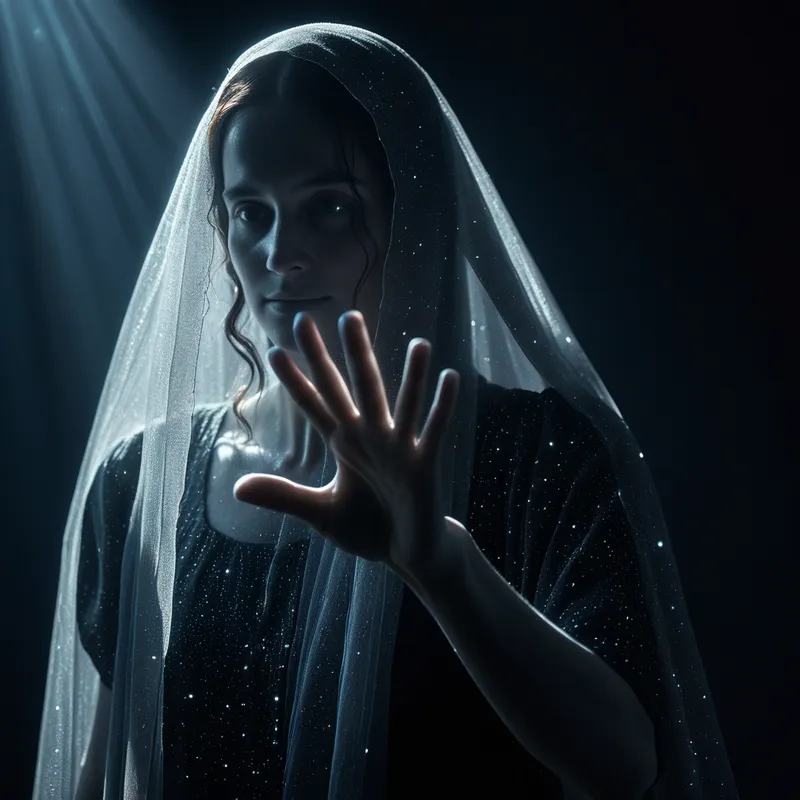
Cultural Origins & Context
The motif of the Shroud or Veil is not the property of a single culture but a primordial pattern etched into the human [psyche](/myths/psyche “Myth from Greek culture.”/), appearing in myriad forms across time and geography. It is the paroket in the Hebrew tradition, the veil before [the Holy of Holies](/myths/the-holy-of-holies “Myth from Biblical culture.”/) that separated the people from the manifest presence of Yahweh, rent in two at a moment of cosmic significance. It is the Bifröst, [the rainbow bridge](/myths/the-rainbow-bridge “Myth from Global/Universal culture.”/), a vibrant but fragile connector and separator. It is the maya of Hindu philosophy, the divine illusion that constitutes the phenomenal world, veiling the ultimate reality of Brahman.
This myth was never just a fireside tale; it was the foundational metaphysics of entire civilizations. It was passed down by priests explaining the architecture of temples, by shamans describing their visionary journeys, and by philosophers pondering the nature of perception. Its societal function was dual: it provided a sacred rationale for the limits of human experience (why we cannot see the gods, why death is a mystery), and it established the ultimate goal of spiritual endeavor—to ethically prepare oneself for the potential lifting of the Veil, whether through ritual, meditation, or righteous living.
Symbolic Architecture
At its core, the [Shroud](/symbols/shroud “Symbol: A cloth covering a corpse, symbolizing death, transition, concealment, and the unknown journey beyond life.”/) represents the very [architecture](/symbols/architecture “Symbol: Architecture in dreams often signifies structure, stability, and the framing of personal identity or life’s journey.”/) of [consciousness](/symbols/consciousness “Symbol: Consciousness represents the state of awareness and perception, encompassing thoughts, feelings, and experiences.”/). It is the psychological [boundary](/symbols/boundary “Symbol: A conceptual or physical limit defining separation, protection, or identity between entities, spaces, or states of being.”/) that allows for the individual ego to exist. Without a filter between the unconscious (the raw, formless [reality](/symbols/reality “Symbol: Reality signifies the state of existence and perception, often reflecting one’s understanding of truth and life experiences.”/)) and the conscious mind, there is no coherent [identity](/symbols/identity “Symbol: Identity represents the sense of self, encompassing personal beliefs, cultural background, and social roles.”/), only psychotic [inundation](/symbols/inundation “Symbol: A flood or overwhelming deluge, often representing emotional overwhelm, cleansing, or uncontrollable forces.”/).
The Veil is not a lie, but a necessary condition for the story of the self to be written.
The filtered world we inhabit—the world of names, forms, and time—is the [realm](/symbols/realm “Symbol: The symbol of ‘Realm’ often signifies the boundaries of one’s consciousness, experiences, or emotional states, suggesting aspects of reality that are either explored or ignored.”/) of [the ego](/myths/the-ego “Myth from Jungian culture.”/). The unfiltered reality on the other side is the Self, the totality of the psyche, both personal and collective. The [hero](/symbols/hero “Symbol: A hero embodies strength, courage, and the ability to overcome significant challenges.”/)’s [journey](/symbols/journey “Symbol: A journey in dreams typically signifies adventure, growth, or a significant life transition.”/) to the [Veil](/symbols/veil “Symbol: A veil typically symbolizes concealment, protection, and transformation, representing both mystery and femininity across cultures.”/) is [the ego](/myths/the-ego “Myth from Jungian culture.”/)’s [journey](/symbols/journey “Symbol: A journey in dreams typically signifies adventure, growth, or a significant life transition.”/) toward its own [source](/symbols/source “Symbol: The origin point of something, often representing beginnings, nourishment, or the fundamental cause behind phenomena.”/) and its own potential annihilation. The tearing represents a catastrophic or grace-filled [moment](/symbols/moment “Symbol: The symbol of a ‘moment’ embodies the significance of transient experiences that encapsulate emotional depth or pivotal transformations in life.”/) of [insight](/symbols/insight “Symbol: A sudden, deep understanding of a complex situation or truth, often arriving unexpectedly and illuminating hidden connections.”/) where the complexes and personas that [structure](/symbols/structure “Symbol: Structure in dreams often symbolizes stability, organization, and the framework of one’s life, reflecting how one perceives their environment and personal life.”/) ordinary [life](/symbols/life “Symbol: The symbol of ‘Life’ represents a journey of growth, interconnectedness, and existential meaning, encompassing both the joys and challenges that define human experience.”/) are seen through, revealing the broader, more mysterious ground of being. The myth warns that this is not merely an acquisition of [knowledge](/symbols/knowledge “Symbol: Knowledge symbolizes learning, understanding, and wisdom, embodying the acquisition of information and enlightenment.”/), but a [death](/symbols/death “Symbol: Symbolizes transformation, endings, and new beginnings; often associated with fear of the unknown.”/)-and-[rebirth](/symbols/rebirth “Symbol: A profound transformation where old aspects of self or life die, making way for new beginnings, growth, and renewal.”/) of the very knower.
The Dreamer’s Resonance
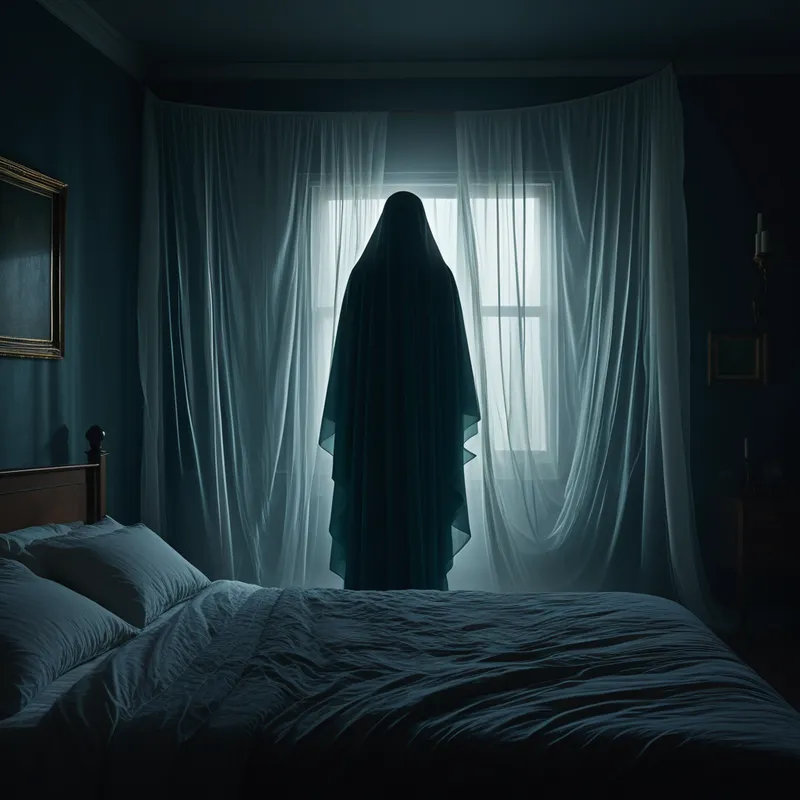
When this myth stirs in the modern unconscious, it often manifests in dreams of thresholds and permeable barriers. To dream of a thin curtain in a familiar room, behind which a profound but unseen presence waits, signals a psyche ripe for a revelation. To dream of tearing a fabric and being flooded with blinding light or overwhelming sound reflects an imminent psychological breakthrough—perhaps the sudden, involuntary insight that shatters a long-held self-image or a core belief.
The somatic experience is key. Dreamers often report a feeling of immense pressure, vibration, or a hum in these dreams, mirroring the mythic description of the Veil’s presence. This is the body sensing the approach of the numinous, the Self pressing against the boundaries of conscious awareness. The process is one of initiation: the old psychic structure is becoming transparent, unable to contain the emerging wholeness. The dreamer is not learning something new, but remembering something ancient about their own nature, and the psyche uses the ancient symbol of the Shroud to stage this drama.
Alchemical Translation
For the individual on the path of individuation, the myth of the Shroud models the final, most terrifying phase of the work: the sublimatio and [solutio](/myths/solutio “Myth from Alchemical culture.”/). Having integrated the personal shadow (the contents of [the personal unconscious](/myths/the-personal-unconscious “Myth from Jungian Psychology culture.”/)), the seeker now approaches the barrier to the transpersonal. The alchemical operation is the lifting of the Veil that hides the mysterium coniunctionis, [the sacred marriage](/myths/the-sacred-marriage “Myth from Various culture.”/) of opposites within the psyche.
This is not an intellectual exercise but an existential surrender. The modern hero’s journey to the Veil might be a profound meditation retreat, a crushing life crisis that obliterates all former identities, or the sustained practice of art or analysis that slowly wears the fabric thin. The goal is not to permanently live in the unmediated light—that is inflation, psychosis, or enlightenment beyond human concern. The goal is the return.
The triumph is not in escaping the world of form, but in seeing it, for the first time, as both Veil and Revelation simultaneously.
The integrated individual lives in [reference](/myths/reference “Myth from Global/Universal culture.”/) to the other side. They carry the knowledge of the porous boundary within them. Their perception is alchemized; they see the sacred in the ordinary, the infinite in the finite. The world is no longer merely a place of separation, but a living tapestry where every thread, every shadow, and every beam of light is recognized as part of the great and holy Shroud, forever trembling with the breath of the real. They become, in essence, a walking threshold—a human who knows they are woven from the very stuff of the Veil, and therefore, can never be truly separated from the light it both conceals and reveals.
Associated Symbols
Explore related symbols from the CaleaDream lexicon: