The shore where Odysseus is wa Myth Meaning & Symbolism
A hero stranded on a timeless shore, caught between the sea's call and the land's silence, embodying the soul's eternal pause before homecoming.
The Tale of The shore where Odysseus is wa
Listen. There is a place the maps do not know, a breath held between the roar and the silence. This is the shore where Odysseus is wa.
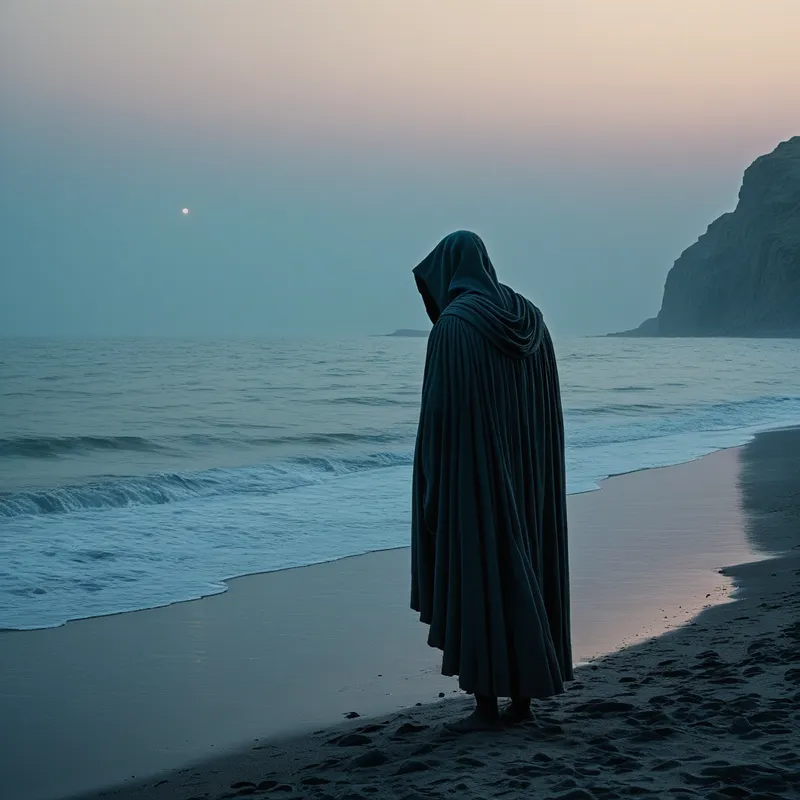
He is not shipwrecked. His vessel, the last faithful splinter of his twenty-year war, is drawn up on the grey sand, a hollow ribcage. The sea behind him is a flat, leaden plain, empty of sirens and storms. The land before him is a line of dark pines, still and scentless. He stands in the space between them, a man carved from salt and memory.
He has outrun Charybdis and outwitted Scylla. He has left the perfume of Calypso’s island and the laughter of the Lotus-Eaters in his wake. Poseidon’s wrath has spent itself, a storm dissipated into this eerie calm. Ithaca is over that horizon. Penelope’s loom is there. Telemachus, now a man, waits. The journey’s end is a fact, a geographical certainty.
Yet, his foot does not move. The sand, cool and firm, grips his heel. He looks at his hands—the hands that strung the great bow, that clung to the mast while the song of oblivion washed over him. They hang empty. The wind carries no scent of home, only the damp, metallic breath of the unresolved. The waves do not crash; they sigh onto the beach and withdraw, like the turning of a page in a book he has not finished reading. He is here, at the absolute edge of return, and he is… waiting. Not for a sign, not for a god’s pardon. He is waiting for the man who left Troy to arrive here, to be whole enough to take the final step. The shore is not a barrier, but a mirror. And in its grey, timeless light, the great hero, the cunning metis-bearer, finds himself a stranger, suspended in the quietest, most profound conflict of all: the moment after the struggle, before the embrace.
Cultural Origins & Context
This is not a myth from a single scroll or epic cycle, but a haunting refrain that echoes through the world’s story-hoard. It is the coda to Homer’s Odyssey that was never written, the space between the verses. It emerges from the universal human experience of the almost. We find its echoes in the Buddhist concept of Bardo, a transitional plane where consciousness lingers before moving on. We hear it in the blues refrain of the traveler who’s “been all around the world, just to get back home,” only to pause on the porch step.
It was passed down not by bards in halls, but in the quiet moments of individuals: the soldier home from war staring at his front door from the car, the immigrant whose dream is realized yet feels oddly distant, the survivor after the crisis is past. Its societal function is not to teach virtue or explain nature, but to name and sanctify the psychological limbo that official narratives of triumph and return often omit. It gives shape to the unspoken “and then what?” that follows every great trial.
Symbolic Architecture
The shore is the ultimate symbol of liminality. It is the threshold made manifest, a geographical representation of a psychic state. The sea represents the unconscious, the chaotic realm of trials, monsters, and deep memory. The land represents consciousness, order, identity, and the known world—home.
Odysseus on that shore is the ego caught between the unconscious and the conscious, having navigated the depths but not yet integrated the journey into the self who must re-enter daily life.
His waiting is not passive; it is the most critical, active pause. It is the psyche’s necessary digestion of trauma, transformation, and loss. Each monster he faced, each loss he endured, is a piece of his soul he has not yet brought ashore. To step forward as the man who left would be a betrayal of the man the sea forged. To remain forever is to become a ghost. The conflict is the integration itself. The hero represents the part of us that achieves the goal, but the exile represents the part that is irrevocably changed by the path.

The Dreamer’s Resonance
When this myth surfaces in modern dreams, it rarely appears as Odysseus. It manifests as dreaming of arriving at the airport for a long-awaited trip, but your passport has blank pages. Or you finally reach the summit of a mountain, but the view is obscured by a familiar, interior fog. You stand at the altar, or receive the diploma, or open the door to the new house, and a profound, somatic stillness descends—a feeling of “I am here, but I am not here.”
This dream pattern signals a profound psychological process: the somatic and psychic recalibration after a major life passage. The nervous system, having been in a prolonged state of striving, survival, or adaptation, does not know how to register the cessation of the struggle. The dream is the psyche’s theater, staging this suspension so the dreamer can consciously witness their own liminal state. It is the soul’s way of saying, “The battle is over, but the warrior has not yet disarmed. Honor this pause.”

Alchemical Translation
The alchemical process mirrored here is the rubedo, the reddening, which follows the albedo. The blinding trials (the nigredo) are past. The purification is complete. But the final stage—the embodiment of the transformed spirit into a living, breathing, engaged life—requires this solemn pause on the shore.
The triumph is not in reaching Ithaca; it is in the full arrival of the one who reaches it. The alchemical gold is not the goal, but the consciousness that carries the journey within it.
For the modern individual, this models the crucial, often neglected phase of individuation after a breakthrough. We seek therapy and confront a shadow (the journey), we achieve a career milestone (surviving the monsters), but the psychic transmutation is not finished until we allow ourselves to stand on that internal shore. We must let the old identity—the relentless seeker, the wounded victim, the triumphant hero—dissolve in the salt air. We must wait, not for external permission, but for the internal alignment where the exiled parts of ourselves catch up. Only then can we step forward, not as a returning conqueror, but as a whole human, carrying the sea in our bones and the quiet of the shore in our heart, finally ready to be home.
Associated Symbols
Explore related symbols from the CaleaDream lexicon: