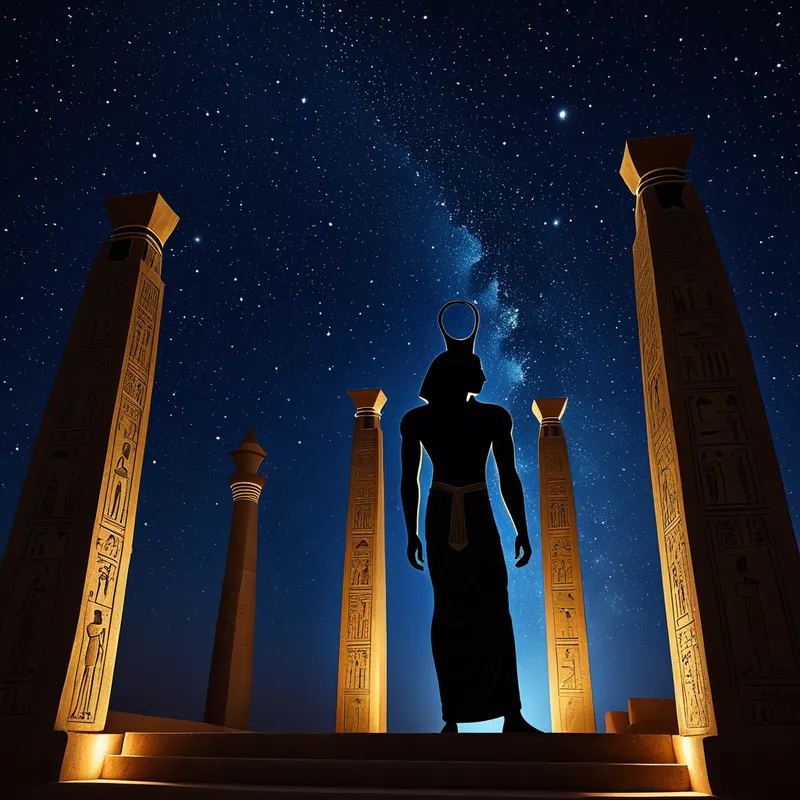
The Sheut Myth Meaning & Symbolism
The story of the Sheut, the shadow soul, a profound Egyptian myth of duality, integrity, and the sacred journey to reclaim the hidden self.
The Tale of The Sheut
Hear now, beneath the unblinking eye of Ra, a tale not of gods and monsters, but of [the self](/myths/the-self “Myth from Jungian culture.”/) and its silent twin. It begins not in [the Duat](/myths/the-duat “Myth from Egyptian culture.”/), the land of the dead, but in the very breath of life, in the noonday sun of the living world.
Consider a nobleman, a servant of the Maat, walking the polished halls of his villa. The sun, fierce and direct, pours through the colonnade. He watches his form, crisp and dark, painted upon the bright stone. It is a companion he has never considered, this flat, silent mimic. But on this day, as the heat shimmers and [the world](/myths/the-world “Myth from Tarot culture.”/) holds its breath, he sees it stir.
It does not move with him. It lingers, a half-beat behind. When he raises a hand to call a servant, [the shadow](/myths/the-shadow “Myth from Jungian culture.”/)-hand stretches, fingers elongating into tendrils that caress the hieroglyphs of his lineage. A coldness, dry as desert night, touches his spine. He turns quickly, but there is nothing—only his own form, and the shadow, now obediently at his feet. Yet he felt it. A presence. A separate intention.
That night, by the flickering light of an oil lamp, the truth reveals itself. His shadow climbs the wall, no longer bound to the flame’s caprice. It takes the shape of a man—his shape, but fuller, more substantial. It has the set of his jaw, the curve of his shoulder, but also the weight of every unspoken thought, every suppressed anger, every joy stifled for decorum. It is him, but it is more him. It is the Sheut.
Terror turns to a profound loneliness. He is halved. The part of him that knows his secret hungers, his private griefs, his raw and unfiltered will, has stepped into the world. It walks the edges of his estate, a silent witness to his public life. It stands at the foot of his bed as he sleeps, a guardian of truths he cannot face awake. He is a man haunted by his own essence.
The journey to reclaim it is not a quest across lands, but a descent into the courtyard of his own soul. He must approach this dark twin not as a demon to be banished, but as a lost brother. He sits in the moonlit garden and speaks, not with his mouth, but with his heart. He confesses his fears to the empty air where the Sheut often lingers. He acknowledges the rage he buried at [the market](/myths/the-market “Myth from Various culture.”/), the desire he denied, the tear he did not shed.
And slowly, the Sheut draws near. It does not speak in words, but in sensations—a warmth where there should be cold, a pressure on the shoulder, a vivid memory rising unbidden. One dawn, as the first light of Ra paints the eastern sky, the man stands and faces the wall where his shadow is cast long and deep. He does not look at his own body, but directly into the dark silhouette. He bows his head.
And the shadow bows back.
When he raises his eyes, the duality is gone. He feels a weight return, not of burden, but of completion. The air is still. The sun climbs. His shadow follows him, once more a faithful, flattened companion. But now, he knows. It is not a slave. It is the keeper of his true name.
Cultural Origins & Context
The concept of the Sheut was not a myth told around fires in a single narrative, but a fundamental pillar of the Egyptian metaphysical system, woven into the very fabric of their understanding of personhood. It was a doctrinal truth preserved in the sacred texts of the Coffin Texts and the [Pyramid Texts](/myths/pyramid-texts “Myth from Egyptian culture.”/), and later, the Book of the Dead.
This was not popular folklore, but priestly knowledge. The Sheut was one of the five integral parts of the soul: the Khat, the Ka, the Ba, the Ren, and the Sheut. Its societal function was profound. It served as a constant, ethical mirror. Since the Sheut witnessed everything, one could not hide one’s actions from one’s own soul. It was a built-in mechanism for conscience and accountability, long before judgment by [Osiris](/myths/osiris “Myth from Global/Universal culture.”/) in the Hall of Maat. To lose or damage one’s Sheut was to become spiritually incomplete, vulnerable in life and fractured in death.
Symbolic Architecture
The Sheut is the original [archetype](/symbols/archetype “Symbol: A universal, primordial pattern or prototype in the collective unconscious that shapes human experience, behavior, and creative expression.”/) of the psychological [Shadow](/symbols/shadow “Symbol: The ‘shadow’ embodies the unconscious, repressed aspects of the self and often represents fears or hidden emotions.”/). It is not evil, but other—the repository of all that the conscious ego cannot or will not acknowledge.
The shadow is not the opposite of the self, but its depth. To fear it is to fear the ground upon which one stands.
Symbolically, it represents authenticity over [image](/symbols/image “Symbol: An image represents perception, memories, and the visual narratives we create in our minds.”/). The nobleman in the tale lives by [the code](/symbols/the-code “Symbol: A system of rules or hidden structure governing behavior, communication, or reality. Often represents order, secrets, or unspoken social agreements.”/) of Maat and social propriety (his Ba and Ka in [harmony](/symbols/harmony “Symbol: A state of balance, agreement, and pleasing combination of elements, often associated with musical consonance and visual or social unity.”/)), but his Sheut holds the unvarnished [truth](/symbols/truth “Symbol: Truth represents authenticity, honesty, and the quest for knowledge beyond mere appearances.”/) of his experience. Its rebellion—stepping away—symbolizes the [psyche](/myths/psyche “Myth from Greek culture.”/)’s natural move toward wholeness when the conscious [attitude](/symbols/attitude “Symbol: Attitude symbolizes one’s mental state, perception, and posture towards life, influencing emotions and actions significantly.”/) becomes too one-sided, too rigidly “good” or “civilized.” The Sheut insists on being seen because wholeness is a divine imperative in Egyptian thought. The [resolution](/symbols/resolution “Symbol: In arts and music, resolution refers to the movement from dissonance to consonance, creating a sense of completion, release, or finality in a composition.”/) is not conquest, but recognition and [integration](/symbols/integration “Symbol: The process of unifying disparate parts of the self or experience into a cohesive whole, often representing psychological wholeness or resolution of internal conflict.”/). The bow is a sacred contract between the conscious [identity](/symbols/identity “Symbol: Identity represents the sense of self, encompassing personal beliefs, cultural background, and social roles.”/) and the unconscious [truth](/symbols/truth “Symbol: Truth represents authenticity, honesty, and the quest for knowledge beyond mere appearances.”/).
The Dreamer’s Resonance
When this myth stirs in the modern dreamer, it announces a critical phase of shadow work. Dreams of being followed by a persistent, often ominous figure; of a doppelgänger or twin; of one’s own reflection acting independently—these are the Sheut knocking at the gate of awareness.
The psychological process is one of differentiation. [The ego](/myths/the-ego “Myth from Jungian culture.”/) is being forced to confront aspects of itself it has disowned. This can feel somatic: a weight, a chill, a sense of being watched. Emotionally, it may bring up shame, rage, or latent power that feels alien. The dream is not a warning of an external threat, but an invitation. The Sheut-dream says: “This, too, is you. The ambition you call ruthless, the sensitivity you call weak, the wildness you call inappropriate—it is part of your totality. To deny it is to live as a ghost, haunted by your own substance.”

Alchemical Translation
The myth of the Sheut provides a flawless map for the alchemical stage of [Nigredo](/myths/nigredo “Myth from Alchemical culture.”/)—the blackening, the confrontation with the primal matter of the soul—and its progression toward Albedo, the whitening or purification through understanding.
The initial separation of the shadow is the necessary first step in individuation. The ego must first perceive the Shadow as a distinct entity before it can relate to it. The nobleman’s fear and loneliness mirror our own when we first glimpse our repressed contents. The “work” is the slow, courageous turning toward that darkness, the internal dialogue (confession in the garden). This is the alchemical [solutio](/myths/solutio “Myth from Alchemical culture.”/)—dissolving the rigid ego defenses in the waters of honest self-reflection.
Integration is not adding something new, but remembering something ancient that was always there.
The final bow is the coniunctio oppositorum, [the sacred marriage](/myths/the-sacred-marriage “Myth from Various culture.”/) of opposites. The conscious ego and the unconscious shadow acknowledge each other as essential partners. The psychic energy once spent on repression is liberated. The individual is no longer a flat, two-dimensional [persona](/myths/persona “Myth from Greek culture.”/) cast by the sun of social expectation, but a full, three-dimensional being, capable of both light and depth. They become truly grounded, for they have made peace with the ground of their own being. In reclaiming the Sheut, one does not become “darker,” but more real, more complete, and paradoxically, more capable of genuine light, for it is a light that acknowledges and contains its own source of darkness.
Associated Symbols
Explore related symbols from the CaleaDream lexicon: