
The Shadow Archetype Myth Meaning & Symbolism
The tale of the dark twin, a forgotten self born of our rejected parts, whose confrontation is the first step toward true wholeness.
The Tale of The Shadow Archetype
In the beginning, there was One. A being of light and potential, walking in the garden of its own becoming. But with every step upon the soft earth, with every choice made in the dappled sunlight, a strange [thing](/myths/thing “Myth from Norse culture.”/) occurred. A piece of itself, deemed too sharp, too hungry, too fearful, or too wild, would detach and fall silently behind, sinking into the fertile soil like a discarded seed.
The being, whom we shall call the Ego, did not look back. It sought the heights, the pure ideals, the [persona](/myths/persona “Myth from Greek culture.”/) of polished stone it wished to become. It gathered virtues like flowers and wore them as a crown. Yet, with each passing season, the trail of discarded seeds grew longer. And in the dark, rich humus of the unconscious, they did not die. They took root.
They grew together, these cast-off parts—the unspoken rage, the forbidden desire, the shameful weakness, the brilliant but unacceptable thought. They twined and fused in the subterranean dark, fed by neglect. And from this compost of the denied self, a form began to stir. It was a twin, born not of love but of avoidance; a Self fashioned from everything [the Ego](/myths/the-ego “Myth from Jungian culture.”/) refused to be. This was [the Shadow](/myths/the-shadow “Myth from Jungian culture.”/), and it grew strong in its exile.
For a time, the Ego walked in its sunlit world, feeling the strange, persistent tug of something at its heels. It would catch a glimpse in a still pool—not its own proud face, but a scowling, hungry one staring back. It would hear its own voice in [the wind](/myths/the-wind “Myth from Various culture.”/), but twisted into a cruel laugh or a desperate sob. The Shadow was no longer buried. It was following.
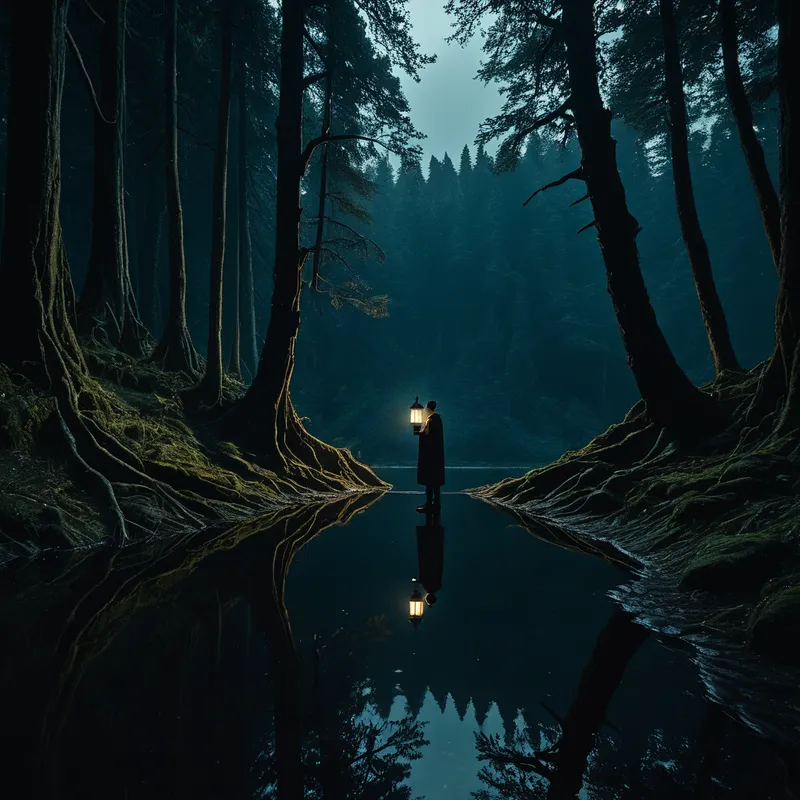
The confrontation came not in a grand arena, but in a forgotten glen at twilight. The Ego, weary from its lofty pursuits, turned a corner in the path and there it stood: its own shape, but wrought in darkness and raw, untamed emotion. “You,” hissed the Ego. “You are everything I have cast out. You are not me.”
The Shadow’s voice was like the grinding of stones deep in [the earth](/myths/the-earth “Myth from Hindu culture.”/). “I am more you than [the mask](/myths/the-mask “Myth from Various culture.”/) you wear. You made me. You fed me with your denial. I am your strength you called aggression, your passion you called lust, your clarity you called cruelty. Without me, you are but a half-light, a phantom of your true potential.”
A battle ensued, but it was not of claw and sword. It was a battle of recognition. The Ego fought with the weapons of reason and righteousness, but each blow seemed to pass through the Shadow, only making it denser. The Shadow fought with raw emotional truth—waves of shame, spikes of envy, the chilling touch of long-forgotten grief. The Ego began to falter. Its polished stone persona cracked.
Exhausted, bleeding not blood but psychic energy, the Ego fell. The Shadow loomed over it, a culmination of every feared thing. And in that moment of utter defeat, the Ego did the one thing it had never done: it looked. Truly looked. Not at a monster, but at a reflection. In the Shadow’s dark eyes, it saw not alien hatred, but its own rejected sorrow. In its clenched fists, it saw its own unused power. The fight left them both. The glen was silent.
The Ego, broken open, whispered the words that ended the exile: “I see you.”
And the Shadow, no longer a pursuer but a lost brother, replied, “At last.”
They did not merge into one bland being. Nor did they part. The Ego rose, forever changed, its lightness now tempered by a knowing darkness. The Shadow walked beside it, no longer a formless terror but a defined presence, its raw energies now available, not autonomous. Together, they walked on, a whole being stepping into [the world](/myths/the-world “Myth from Tarot culture.”/) for the first time. The path ahead was no longer just sunlit or shadowed, but beautifully, terribly real.
Cultural Origins & Context
This is not a myth carved on temple walls or sung in ancient epics. Its culture is the consulting room, the personal journal, and the silent recesses of the modern mind. The “Jungian” culture is a scholarly and therapeutic tradition founded by Swiss psychiatrist Carl Gustav Jung in the early 20th century. The myth of the Shadow was not passed down by bards, but observed and documented by Jung and his successors as a recurring, living pattern in the dreams, fantasies, and neuroses of their patients.
Its societal function is profoundly personal yet universally relevant. In a Western world increasingly focused on conscious ideals, positive thinking, and social personas, the myth serves as a crucial counter-narrative. It is a warning against one-sidedness and a guide for navigating the inner civil war that results from psychological repression. The tellers of this myth are therapists, artists, and anyone courageous enough to turn their gaze inward. Its transmission is through analysis, creative expression, and the hard-won wisdom of personal crisis, making it a foundational story of modern depth psychology.
Symbolic Architecture
The [Shadow](/symbols/shadow “Symbol: The ‘shadow’ embodies the unconscious, repressed aspects of the self and often represents fears or hidden emotions.”/) represents the entirety of the unconscious [personality](/symbols/personality “Symbol: Personality in dreams often symbolizes the traits and characteristics of the dreamer, reflecting how they perceive themselves and how they believe they are perceived by others.”/)—all those traits, desires, and impulses that the conscious Ego cannot, or will not, acknowledge as its own. It is not inherently evil, but it is undifferentiated; it contains inferior, primitive, and awkward aspects alongside valuable, vital energies that were simply deemed unacceptable by [family](/symbols/family “Symbol: The symbol of ‘family’ represents foundational relationships and emotional connections that shape an individual’s identity and personal development.”/), society, or the individual’s own ideal self-[image](/symbols/image “Symbol: An image represents perception, memories, and the visual narratives we create in our minds.”/).
The Shadow is the door to the treasure house of the authentic self, but it is guarded by the dragon of everything we fear we might be.
The Ego’s [journey](/symbols/journey “Symbol: A journey in dreams typically signifies adventure, growth, or a significant life transition.”/) is the [drama](/symbols/drama “Symbol: Drama signifies narratives, emotional expression, and the exploration of human experiences.”/) of [consciousness](/symbols/consciousness “Symbol: Consciousness represents the state of awareness and perception, encompassing thoughts, feelings, and experiences.”/) itself, initially identifying solely with a bright, acceptable self-image (the [Persona](/symbols/persona “Symbol: The social mask or outward identity one presents to the world, often concealing the true self.”/)). The confrontation is the inevitable, often painful, [moment](/symbols/moment “Symbol: The symbol of a ‘moment’ embodies the significance of transient experiences that encapsulate emotional depth or pivotal transformations in life.”/) when the repressed returns. The battle symbolizes the [resistance](/symbols/resistance “Symbol: An object or tool representing opposition, struggle, or the act of pushing back against external forces or internal changes.”/) of the conscious mind to acknowledging its own completeness. The [resolution](/symbols/resolution “Symbol: In arts and music, resolution refers to the movement from dissonance to consonance, creating a sense of completion, release, or finality in a composition.”/)—seeing and naming the Shadow—is the act of recognition, which is the first and most critical step in the process of Individuation. The resulting partnership is not a state of perfection, but of dynamic wholeness, where conscious will is informed by unconscious [depth](/symbols/depth “Symbol: Represents profound layers of consciousness, hidden truths, or the unknown aspects of existence, often symbolizing introspection and existential exploration.”/).
The Dreamer’s Resonance
When this myth stirs in the modern dreamer, it announces a psychological crisis of integrity. Dreams of being chased by a dark figure, of a [sinister](/myths/sinister “Myth from Roman culture.”/) twin, of a threatening intruder in the house (the [psyche](/myths/psyche “Myth from Greek culture.”/)), or of a wild, neglected animal are classic Shadow motifs. The somatic experience upon waking is often one of dread, anxiety, or uncanny fascination.
This is the psyche’s autonomous attempt at course-correction. The dream is not a prophecy of doom, but an invitation—or a demand—for dialogue. The psychological process is one of [projection](/myths/projection “Myth from Alchemical culture.”/) withdrawal. The dreamer is often at a point where they can no longer comfortably attribute their own disliked qualities to others (e.g., “He is so arrogant,” “She is so manipulative”). The unconscious, through the dream, is forcing these disowned parts back onto the dreamer’s lap, initiating a necessary, if uncomfortable, phase of self-confrontation. The emotional charge of the dream is the measure of energy bound up in the repression, now seeking release and integration.

Alchemical Translation
The myth of the Shadow is the [prima materia](/myths/prima-materia “Myth from Alchemical culture.”/) of the alchemical work of Individuation. In psychological alchemy, the base metal of the fragmented personality must be broken down to its essential components before the gold of the Self can be formed.
[The first stage](/myths/the-first-stage “Myth from Alchemical culture.”/), [Nigredo](/myths/nigredo “Myth from Alchemical culture.”/) (the blackening), is perfectly mirrored in the confrontation in the dark glen. It is the descent, the depression, the encounter with the dark, chaotic, and “poisonous” aspects of oneself. This is not a mistake, but a necessary death of the naive Ego-identity. The battle represents the [separatio](/myths/separatio “Myth from Alchemical culture.”/)—the conscious differentiation of “I” from “That which I have called Not-I.”
To integrate the Shadow is not to become shadow, but to allow its substance to weight the spirit, granting it reality and traction in the world.
The resolution—“I see you”—is the beginning of coniunctio ([the sacred marriage](/myths/the-sacred-marriage “Myth from Various culture.”/)). Here, the conscious mind (Ego) does not conquer the unconscious (Shadow), nor is it conquered. They enter into a relationship. The raw power of the Shadow—its capacity for instinct, its fierce honesty, its creative darkness—is now available to the Ego, not as a controlling force, but as a resource. The Ego, in turn, provides direction and conscious form to these energies. The transformed individual who walks forward is the embodiment of the Philosopher’s Stone: not a perfect being, but a real one, capable of holding light and dark, good and bad, strength and vulnerability in a living, creative tension. This is the alchemical translation: from the lead of self-ignorance to the gold of self-knowledge.
Associated Symbols
Explore related symbols from the CaleaDream lexicon: