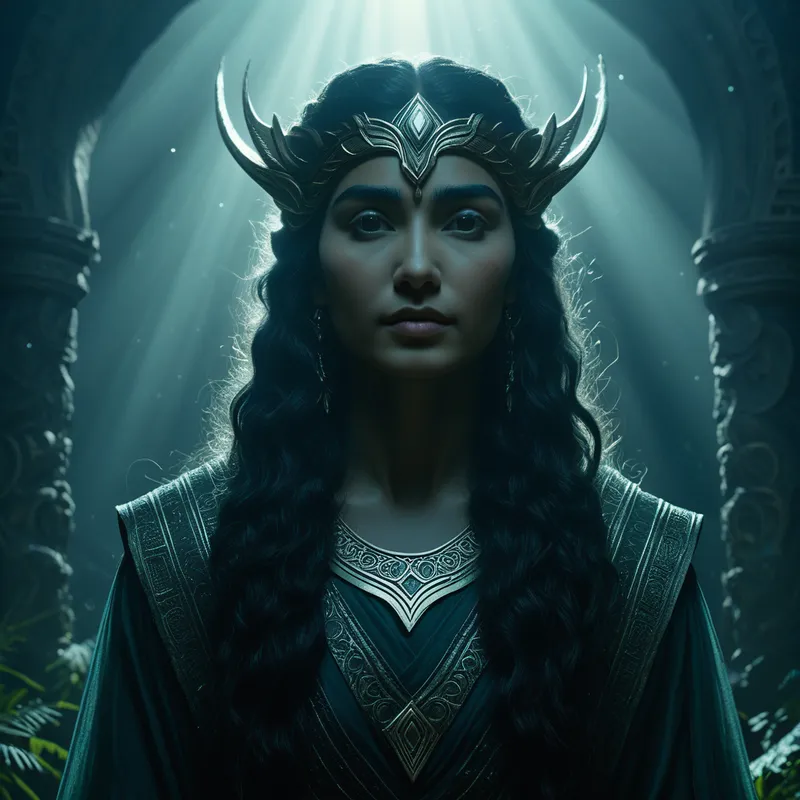
The Seventh Day Rest
The foundational Hebrew myth where God rests after creation, establishing the Sabbath and revealing divine completion and human purpose.
The Tale of The Seventh Day Rest
In the beginning, there was a formless void, a deep and watery darkness over which the Spirit of God hovered like a breath held before a word. Then, [the Word](/myths/the-word “Myth from Biblical culture.”/) was spoken: “Let there be light.” And there was light, not as a mere physical phenomenon, but as the first act of separation, dividing the primal unity into Day and Night. This was the first day.
The second day, God fashioned the dome of [the sky](/myths/the-sky “Myth from Persian culture.”/), separating the waters above from the waters below. On the third day, He commanded the waters under the sky to gather into one place, letting the dry land appear. Earth brought forth vegetation: seed-bearing plants and trees, each according to its kind. [The world](/myths/the-world “Myth from Tarot culture.”/) was given its green, beating heart.
On the fourth day, God set lights in the dome of the sky—the greater light to govern the day, the lesser light to govern the night, and the stars. They were not deities, as the surrounding nations believed, but markers, signs for seasons, for days and years, servants of the order now being established.
The fifth day saw the waters swarm with living creatures, and birds fly above [the earth](/myths/the-earth “Myth from Hindu culture.”/) across the dome of the sky. God blessed them, saying, “Be fruitful and multiply.” The silent depths and the empty airs were filled with motion and sound.
On the sixth day, the earth brought forth living creatures of every kind: livestock, creatures that move along the ground, wild animals. And then, God said, “Let us make humankind in our image, according to our likeness.” From the dust of the ground, God formed adam, the human, and breathed into its nostrils the breath of life. To this image-bearer, God gave dominion over the fish, the birds, the cattle, and all the earth. God saw all that had been made, and behold, it was very good. Evening came, and morning came—the sixth day.
Then, the cosmos held its breath. The heavens and the earth were finished in all their vast array. On the seventh day, God finished the work which had been done. And on the seventh day, God rested from all the work.
But this rest was not exhaustion; it was completion. It was not an absence of activity, but the presence of a different quality of being. God blessed the seventh day and sanctified it, setting it apart from the rhythmic procession of the other six. In that hallowed pause, the Creator ceased from the work of making, to simply be with what had been made. The universe, now a living, breathing entity, was left to hum with its own God-given life, under the gaze of a God who was no longer shaping, but appreciating. The foundational rhythm was set: six for doing, one for being. Work, and then [Sabbath](/myths/sabbath “Myth from Judeo-Christian culture.”/).
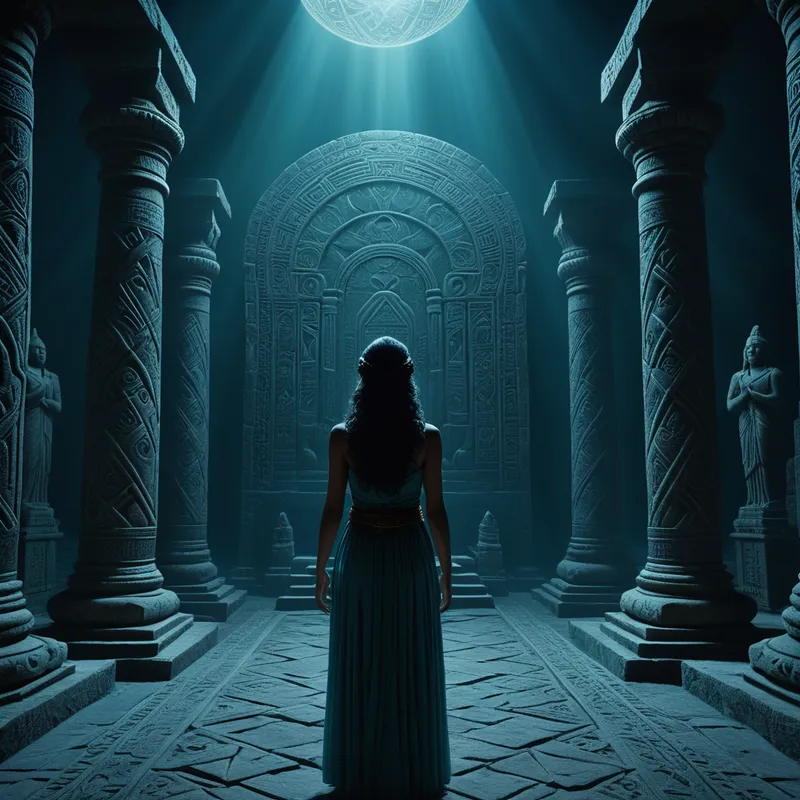
Cultural Origins & Context
This narrative forms the majestic prologue to [the Torah](/myths/the-torah “Myth from Jewish culture.”/), the foundational text of Hebrew identity. It is not a scientific treatise but a theological and cosmological argument, composed during a period of national reflection, likely during or after the Babylonian Exile (6th [century](/myths/century “Myth from Biblical culture.”/) BCE). Its purpose was to ground a displaced people in a vision of reality radically different from that of their captors.
Surrounded by Mesopotamian myths like the [Enuma Elish](/myths/enuma-elish “Myth from Babylonian culture.”/), where creation was a violent, chaotic struggle between warring gods born from primordial sludge, the Hebrew account offered a profound counter-narrative. Here, creation is not an accident of divine conflict but the deliberate, spoken word of a single, sovereign God who brings order (tov) out of [chaos](/myths/chaos “Myth from Greek culture.”/) (tohu wabohu). The sun, moon, and stars are not gods to be feared, but creations to be admired. Most strikingly, humanity is not an afterthought or a slave to feed lazy deities, but the pinnacle of creation, fashioned in the divine image (tzelem Elohim) and entrusted with stewardship.
The myth’s emphasis on the seventh day directly establishes [the Sabbath](/myths/the-sabbath “Myth from Abrahamic culture.”/) (from the Hebrew shavat, “to cease”), which became the central pillar of Hebrew ritual life. It was a social and theological revolution—a day of rest for all, including slaves and animals, mirroring the divine pattern. This rhythm was a living protest against the tyranny of endless production and a weekly remembrance that human worth is not in what they produce, but in whose image they bear.
Symbolic Architecture
The myth’s power lies in its symbolic [architecture](/symbols/architecture “Symbol: Architecture in dreams often signifies structure, stability, and the framing of personal identity or life’s journey.”/), where every element is a loaded concept in a divine [grammar](/symbols/grammar “Symbol: Grammar represents the underlying structure and rules that govern communication, order, and meaning-making in life.”/).
The seven-day [structure](/symbols/structure “Symbol: Structure in dreams often symbolizes stability, organization, and the framework of one’s life, reflecting how one perceives their environment and personal life.”/) is itself a primary [symbol](/symbols/symbol “Symbol: A symbol can represent an idea, concept, or belief, serving as a powerful tool for communication and understanding.”/). Seven in the ancient Near East represented completeness, perfection. The creation narrative builds to this perfect [number](/symbols/number “Symbol: Numbers in dreams often symbolize meaning, balance, and the quest for understanding in the dreamer’s life, reflecting their mental state or concerns.”/), framing all of [reality](/symbols/reality “Symbol: Reality signifies the state of existence and perception, often reflecting one’s understanding of truth and life experiences.”/) within a sacred cycle. The work culminates not in another act of making, but in an act of cessation, suggesting that true completion (shalom, wholeness) includes rest.
The “[image](/symbols/image “Symbol: An image represents perception, memories, and the visual narratives we create in our minds.”/) of God” (tzelem Elohim) is the myth’s most profound anthropological [insight](/symbols/insight “Symbol: A sudden, deep understanding of a complex situation or truth, often arriving unexpectedly and illuminating hidden connections.”/). It is not a physical likeness but a functional and relational one. To be [human](/symbols/human “Symbol: The symbol of a human represents individuality, complexity of emotions, and social relationships.”/) is to carry a divine imprint—the [capacity](/symbols/capacity “Symbol: A measure of one’s potential, limits, or ability to contain, process, or achieve something, often reflecting self-assessment or external demands.”/) for reason, moral agency, creativity, and [relationship](/symbols/relationship “Symbol: A representation of connections we have with others in our lives, often reflecting our emotional state.”/). This bestowed not a license for domination, but a vocation of responsible care, a kingship modeled on the [Creator](/symbols/creator “Symbol: A figure representing ultimate origin, divine power, or profound authorship. Often embodies the source of existence, innovation, or personal destiny.”/)’s own benevolent order.
The Sabbath rest is the temple in time. Where other cultures built ziggurats to reach the divine, the Hebrews were given a day to inhabit the divine perspective—to view the world not as a project to be completed, but as a gift to be received.
The repeated refrain “And God saw that it was good” culminates in “very good.” This evaluative gaze is crucial. Creation is declared intrinsically valuable before humanity even enters the scene. The human [role](/symbols/role “Symbol: The concept of ‘role’ in dreams often reflects one’s identity or how individuals perceive their place within various social structures.”/) is not to confer value through use, but to recognize and uphold the value already declared by God.
The Dreamer’s Resonance
For the individual [psyche](/myths/psyche “Myth from Greek culture.”/), this myth maps the journey from chaos to order, and crucially, from striving to being. The “formless void” resonates with our own internal states of confusion, potential, or depression—the tohu wabohu of the soul. The sequential days of separation and formation mirror the psychological work of differentiation: establishing boundaries (light from dark), building internal structure (sky from sea), cultivating inner life (vegetation), setting guiding principles (lights in the sky), engaging with the emotional depths and inspirations (sea and air creatures), and finally, integrating our instinctual nature (land animals) to prepare for the birth of the conscious ego, the “image-bearer.”
The seventh day is the myth’s gift to the burdened modern soul. In a culture that idolizes endless productivity, the Sabbath principle insists that our worth is not identical to our output. It is the sacred pause where [the ego](/myths/the-ego “Myth from Jungian culture.”/), the “human” who has been given dominion, ceases its labors of self-construction and management. In this rest, we reconnect with the foundational truth that we are first and foremost creatures, beloved and “very good” simply because we exist, not for what we achieve. It is the weekly healing of the primal wound of “not enough.”
Alchemical Translation
In the alchemy of the soul, this myth describes the opus contra naturam—the work against the fallen nature of endless, anxious striving. The six days represent the labor of consciousness: the difficult, necessary work of bringing order to inner chaos, of refining the base materials of instinct and experience into a coherent self.
The seventh day is the stage of [coniunctio](/myths/coniunctio “Myth from Alchemical culture.”/), [the sacred marriage](/myths/the-sacred-marriage “Myth from Various culture.”/), but here it is the marriage of the human soul with its own sanctified existence. It is the moment when [the alchemist](/myths/the-alchemist “Myth from Various culture.”/) stops stirring the furnace and allows the transformation to be complete, to behold the philosopher’s stone not as a goal to be grasped, but as a reality to be inhabited.
The rest of God is the space where creation is allowed to be itself, fully independent yet fully held. Psychologically, this is the state where the conscious self stops interfering with the deeper Self, allowing the psyche’s innate wholeness to simply be.
This alchemical process transforms time itself. [Chronos](/myths/chronos “Myth from Greek culture.”/), sequential, quantitative time, is sanctified into [Kairos](/myths/kairos “Myth from Global/Universal culture.”/)—the qualitative, opportune, and holy time. The Sabbath is the weekly infusion of Kairos into Chronos, a reminder that our deepest identity is found not in the linear march of achievements, but in the eternal present of divine acceptance.
Associated Symbols
Explore related symbols from the CaleaDream lexicon:
- Rest — The sacred cessation from labor, representing completion, sanctity, and the space where being takes precedence over doing.
- Order — The divine principle brought forth from chaos, establishing harmony, boundary, and the foundational structure of reality.
- Circle — The symbol of completion, wholeness, and the eternal cycle embodied in the seven-day unit that returns to its sacred origin.
- Temple — Not merely a physical space, but the sanctified time of the Sabbath, a dwelling place for the divine presence in the rhythm of life.
- Divine — The transcendent source of all being, whose nature is reflected in acts of creation, declaration of goodness, and the gift of rest.
- Light — The first-born of creation, representing consciousness, differentiation, and the divine word that pierces primordial darkness.
- Earth — The fertile ground of potential, the material realm formed and declared good, from which life and humanity are drawn.
- Human — The image-bearer, the creature fashioned from dust and divine breath, holding the tension between earthly origin and transcendent vocation.
- Seed — The latent potential within creation, carrying the command to be fruitful, representing the generative power blessed by God.
- Sky — The dome of separation, the realm of the celestial markers that govern time and symbolize the overarching divine order.
- Gift — The fundamental nature of creation and the Sabbath, both presented not as earned rewards but as bestowed blessings to be received.
- Rhythm — The foundational pattern of work and rest, activity and reflection, which structures cosmic and human life according to the divine prototype.