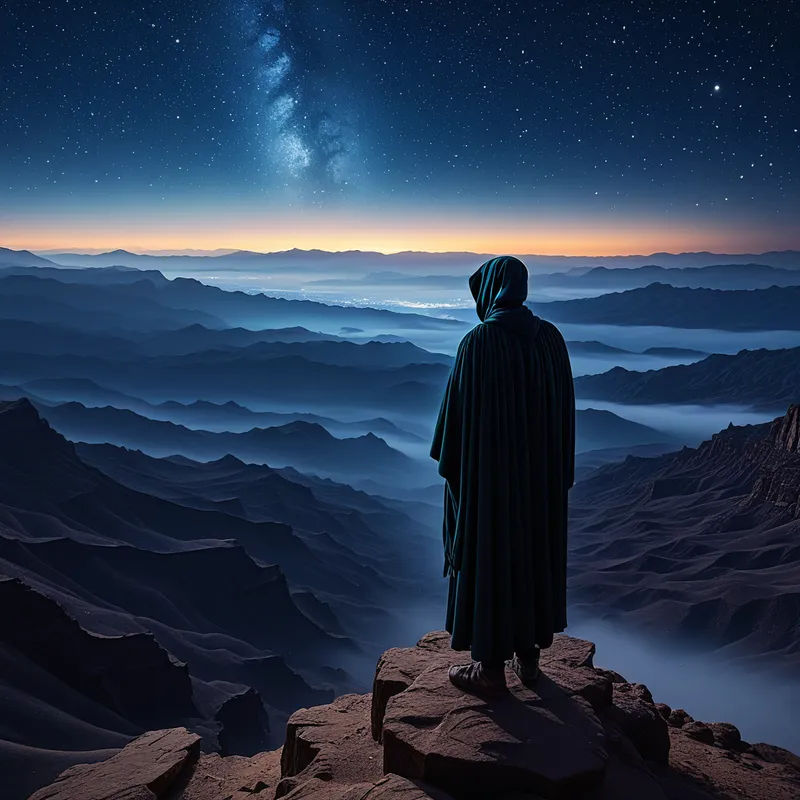
The Seven Valleys of the Quest Myth Meaning & Symbolism
A mystic map of the soul's journey through seven spiritual valleys, from the first cry of search to the final annihilation in divine love.
The Tale of The Seven Valleys of the Quest
Listen, and let the silence between the words speak. This is not a story of a hero, but of a soul. It begins not with a roar, but with a sigh—a sigh that cracks the heart open like a dry seed in the first rain.
There was a traveler, known to none, not even to themselves. They awoke one day in a world of dust, every color muted, every sound an echo. A thirst awoke in them, a longing with no name. It was a pain sharper than any blade, this ache for a home they had never seen. Driven by this invisible fire, they left the marketplace of familiar things and stepped onto a path that vanished behind their feet.
The first land they entered was the Valley of the Quest. Here, the wind carried whispers of a lost king. The traveler burned every possession, every certainty, as fuel for their lantern. They asked every stone, every stranger, “Where is the Beloved?” They learned that to seek is to be consumed by seeking.
Wearied but purified, they stumbled into the Valley of Love. Here, the air itself was flame. Logic turned to ash. The traveler saw the face of the Beloved in the flash of a bird’s wing, in the cruelty of a thorn. Love was not comfort; it was a madness that scorched away all that was not itself. They wept tears that sizzled on the sand.
From that crucible, they were cast into the Valley of Knowledge. A cold, clear light now shone. They saw the hidden architecture of creation—how the spider’s web held the same pattern as the spinning galaxies. They understood the language of leaves and stars. Yet, this knowledge was a towering mountain, and from its peak, they saw only how far they had yet to go. A great loneliness descended.
This loneliness was the gateway to the Valley of Detachment. In this vast, wind-scoured plain, every want, every name, every memory was stripped away. The traveler became a hollow reed. They desired nothing, not even union. In this utter poverty, they found a freedom more vast than any sky.
Then, without moving, they arrived at the Valley of Unity. The veil tore. The traveler saw the single Sun reflected in a million dew drops—in the eye of a hawk, in a pool of blood, in their own tear. The seeker, the seeking, and the Sought were one melody. The world was a mirror, and in every fragment shone the whole Face.
But the mirror itself must dissolve. In the Valley of Bewilderment, all maps turned to water. Every truth they had grasped evaporated. They were lost in a sublime confusion, a holy astonishment where knowing was impossible. Here, the mind drowned in an ocean of awe.
And from that ocean, they were gathered into the final, silent embrace: the Valley of True Poverty and Absolute Nothingness. The drop fell into the sea. The traveler was not. Only the Beloved remained, abiding in Itself. There was no story left to tell, no traveler to tell it. Only the eternal, soundless “I Am.”

Cultural Origins & Context
This allegorical journey is most famously articulated in The Seven Valleys (حَفت وادی), a mystical treatise penned in the mid-19th century by Baháʼu’lláh. While composed within a specific scriptural context, its structure and imagery are deeply rooted in the classical Persian Sufi poetic tradition, particularly the works of Farid ud-Din Attar and Jalāl ad-Dīn Rūmī. The “valley” (vádí) is a central metaphor in this literature, representing stages (maqámát) on the path (ṭaríqah) to God.
The myth was not told around campfires but in the contemplative spaces of khánqáhs and in the illuminated margins of poetry. It functioned as a spiritual cartography—a map for the heart, not the feet. Its societal function was initiatory and therapeutic; it provided a language for the ineffable struggles of the inner life, validating the pain of longing, the darkness of doubt, and the ecstasy of glimpses beyond the self. It taught that the goal was not to acquire, but to be annihilated and reconstituted in divine reality (Ḥaqíqah).
Symbolic Architecture
The myth’s power lies in its symbolic [architecture](/symbols/architecture “Symbol: Architecture in dreams often signifies structure, stability, and the framing of personal identity or life’s journey.”/), which charts the [death](/symbols/death “Symbol: Symbolizes transformation, endings, and new beginnings; often associated with fear of the unknown.”/) and [rebirth](/symbols/rebirth “Symbol: A profound transformation where old aspects of self or life die, making way for new beginnings, growth, and renewal.”/) of the ego. The [traveler](/symbols/traveler “Symbol: A person on a journey, representing movement, transition, and the search for new experiences or self-discovery.”/) is not a person but the [human](/symbols/human “Symbol: The symbol of a human represents individuality, complexity of emotions, and social relationships.”/) [soul](/symbols/soul “Symbol: The soul represents the essence of a person, encompassing their spirit, identity, and connection to the universe.”/) (nafs) in its raw, seeking essence. The valleys are not places but states of [consciousness](/symbols/consciousness “Symbol: Consciousness represents the state of awareness and perception, encompassing thoughts, feelings, and experiences.”/).
The journey begins in the poverty of having a question and ends in the richness of becoming the Answer.
The [Valley](/symbols/valley “Symbol: A valley often symbolizes a period of transition or a place of respite between two extremes.”/) of the [Quest](/symbols/quest “Symbol: A quest symbolizes a journey or search for purpose, fulfillment, or knowledge, often representing life’s challenges and adventures.”/) symbolizes the initial activation of conscious [awareness](/symbols/awareness “Symbol: Conscious perception of self, surroundings, or internal states. Often signifies awakening, insight, or heightened sensitivity.”/), the divine discontent that shatters complacency. The [Valley](/symbols/valley “Symbol: A valley often symbolizes a period of transition or a place of respite between two extremes.”/) of Love represents the total, often destructive, reorientation of the psyche from egoic desire to a transcendent Object. Here, love is an alchemical fire. The [Valley](/symbols/valley “Symbol: A valley often symbolizes a period of transition or a place of respite between two extremes.”/) of [Knowledge](/symbols/knowledge “Symbol: Knowledge symbolizes learning, understanding, and wisdom, embodying the acquisition of information and enlightenment.”/) is not intellectual but intuitive—a unitive seeing that paradoxically highlights [separation](/symbols/separation “Symbol: A spiritual or mythic division between realms, states of being, or consciousness, often marking a transition or loss of connection.”/). The ensuing [Valley](/symbols/valley “Symbol: A valley often symbolizes a period of transition or a place of respite between two extremes.”/) of [Detachment](/symbols/detachment “Symbol: A psychological or emotional separation from oneself, others, or reality, often indicating a need for self-protection, perspective, or spiritual growth.”/) is the crucial “dark [night](/symbols/night “Symbol: Night often symbolizes the unconscious, mystery, and the unknown, representing the realm of dreams and intuition.”/),” where all projections and attachments to spiritual experience itself are incinerated.
The [climax](/symbols/climax “Symbol: The peak moment in a narrative or musical composition, representing resolution, transformation, or ultimate expression.”/) in the Valley of Unity and Bewilderment symbolizes the collapse of the subject-object [dichotomy](/symbols/dichotomy “Symbol: A division into two contrasting parts, often representing opposing forces, choices, or perspectives within artistic or musical expression.”/). The final Valley of True [Poverty](/symbols/poverty “Symbol: A state of lacking material resources or essential needs, often symbolizing feelings of inadequacy, vulnerability, or spiritual emptiness in dreams.”/) is the psychological state of faná, where the individual self is experienced as nonexistent, followed by baqá, abiding in the divine consciousness.
To traverse the seventh valley is to realize you were never the traveler; you were the path, the destination, and the journey itself.
The Dreamer’s Resonance
When this myth stirs in the modern unconscious, it rarely appears as a linear narrative. Instead, dreams present its archetypal textures. One may dream of endlessly climbing a mountain that turns into a mirror (Mirror), or of searching for a key (Key) in a series of identical, empty rooms (Cave). The somatic feeling is often one of profound longing, coupled with exhaustion and awe.
Dreams of the early valleys might feature urgent Quests, being lost in a trackless Forest, or following a faint, distant Star. Dreams resonant with the later stages may involve dissolving into a vast Ocean, witnessing the shattering of a sacred Circle, or experiencing oneself as a Drop of rain merging with a sea. These are dreams of psychic death and rebirth, where the dream ego undergoes necessary dissolution.
Alchemical Translation
Psychologically, the Seven Valleys model the process of individuation—the journey toward wholeness by integrating the conscious ego with the contents of the unconscious. The initial “Quest” is the ego’s acknowledgment of a lack, a summons from the Self. The “Love” stage is the passionate, often painful, engagement with the inner other—the Shadow and the Anima/Animus. The “Knowledge” gained is insight into one’s own complexes and the archetypal patterns governing one’s life.
The critical “Detachment” is the alchemical nigredo—the letting go of identification with persona, achievements, and even one’s own self-concept. This feels like a barren valley, a psychic annihilation. From this ashes arises the “Unity” of albedo, where one perceives the interconnectedness of all inner parts. The “Bewilderment” is the encounter with the numinous totality of the Self, which always shatters previous understanding.
The alchemical gold is not a perfected ego, but an ego transparent to the Self, a vessel through which the totality of the psyche can flow.
The final “Poverty” is the stable attainment of this state, where the ego becomes a faithful servant to the greater totality, no longer claiming ownership of the journey. For the modern individual, this translates not to monastic withdrawal, but to living in the world with a center of gravity that is no longer the fragile, needy self, but the deep, abiding ground of being.
Associated Symbols
Explore related symbols from the CaleaDream lexicon:
- Valley — The central landscape of the myth, representing both a challenging stage of spiritual aridity and a protected, formative passage toward transformation.
- Quest — The animating force of the entire journey, the sacred longing that compels the soul to leave the familiar and embark on its perilous, essential search.
- Fire — The purifying and destructive element of divine love that burns away illusion, attachment, and the ego in the Valley of Love.
- Ocean — The symbol of the infinite divine reality into which the individual soul ultimately merges, losing its separate existence in the Valley of True Poverty.
- Mirror — Represents the stage of Unity, where all creation is seen as a reflection of the Beloved, and the seeker recognizes the divine face in all things, including themselves.
- Key — The insight, grace, or moment of surrender that unlocks the passage from one valley to the next, often found only after great struggle.
- Light — The gnosis or divine illumination that dawns in the Valley of Knowledge, revealing the hidden connections and sacred patterns of existence.
- Journey — The fundamental archetype enacted, representing the soul’s linear progression through time and its simultaneous spiral into the depths of its own being.
- Door — The threshold between each valley, symbolizing the irreversible transitions and initiations that mark each death and rebirth of the self.
- Shadow — The traveler’s own unconscious depths that must be encountered and integrated, especially in the bewildering darkness of the middle valleys.
- Star — The distant, guiding ideal—the Beloved—that provides direction and hope through the long nights of search and detachment.
- Drop — The individual soul, whose destiny is to realize its essential unity with the divine Ocean, culminating in the final annihilation.