The Seven Seals Myth Meaning & Symbolism
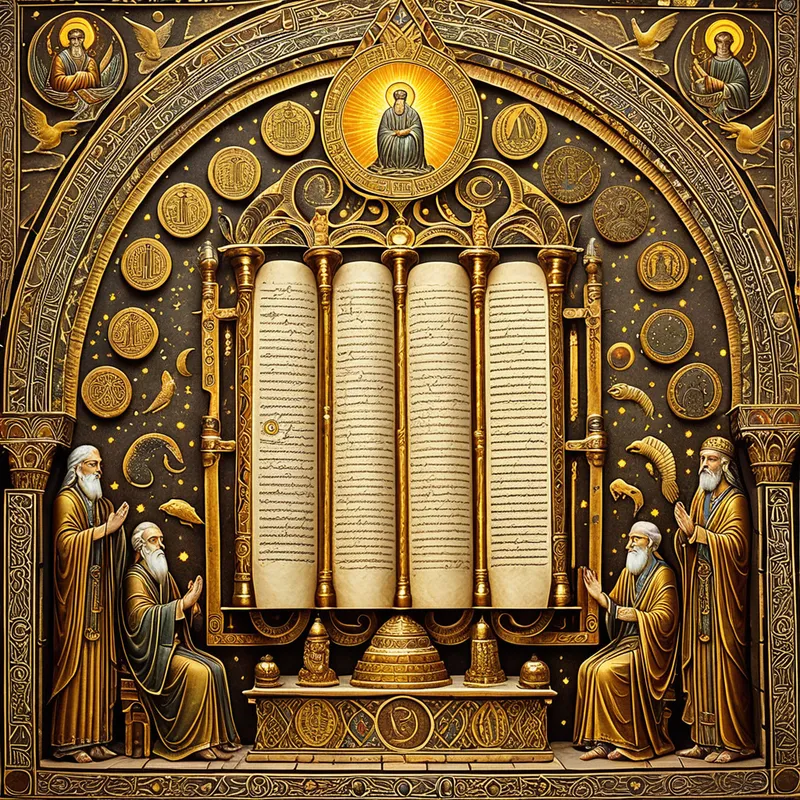
A cosmic scroll, sealed with seven seals, holds the fate of creation. Only the worthy Lamb can open them, unleashing judgment, tribulation, and ultimate renewal.
The Tale of The Seven Seals
Hear now of the vision granted in the Spirit’s grip, on the isle called Patmos, where the sea whispers secrets to the stone. In the Lord’s Day, a voice like a trumpet spoke, and the veil was torn. I was taken up, and behold, a door stood open in heaven.
And there, a throne. And He who sat upon it was like jasper and carnelian, and a rainbow like an emerald encircled the throne. Around it, twenty-four thrones, and upon them, twenty-four elders in white garments, with crowns of gold. From the throne came flashes of lightning, and rumblings, and peals of thunder. Before the throne, seven torches of fire, which are the seven spirits of God, and a sea of glass, like crystal.
In the right hand of Him who sat on the throne, I saw a scroll. A scroll written within and on the back, sealed with seven seals. A mighty angel proclaimed with a loud voice, “Who is worthy to open the scroll and break its seals?” And no one in heaven or on earth or under the earth was able to open the scroll or to look into it. I wept bitterly, for no one was found worthy.
Then one of the elders said to me, “Weep not; behold, the Lion of the tribe of Judah, the Root of David, has conquered, so that he can open the scroll and its seven seals.”
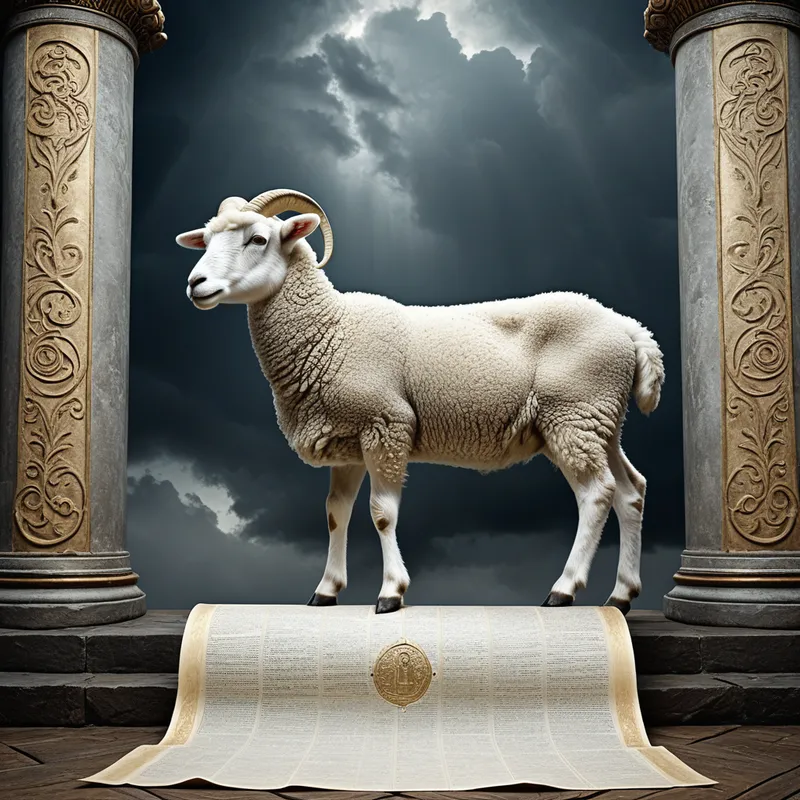
And I saw, between the throne and the four living creatures and among the elders, a Lamb standing, as though it had been slain. It had seven horns and seven eyes, which are the seven spirits of God sent out into all the earth. He went and took the scroll from the right hand of Him who was seated on the throne. When he had taken the scroll, the four living creatures and the twenty-four elders fell down before the Lamb. The air grew thick with incense, which is the prayers of the saints, and they sang a new song.
Then the Lamb began to open the seals, one by one.
With the breaking of the first, a sound like thunder, and one of the living creatures cried, “Come!” I looked, and behold, a white horse! Its rider held a bow, and a crown was given to him, and he came out conquering, and to conquer.
The second seal broke with a crack like splitting stone. A second horse, fiery red, plunged forth. Its rider was permitted to take peace from the earth, so that people should slay one another, and he was given a great sword.
At the third seal’s rupture, a sound of tearing parchment. Behold, a black horse! Its rider held a pair of scales in his hand. A voice cried from among the living creatures, “A quart of wheat for a denarius, and three quarts of barley for a denarius, and do not harm the oil and wine!”
The fourth seal shattered, and a pale horse lurched into being. Its rider’s name was Death, and Hades followed close behind. They were given authority over a fourth of the earth, to kill with sword and with famine and with pestilence and by wild beasts.
The fifth seal broke, and I saw under the altar the souls of those slain for the word of God. They cried out, “How long, O Sovereign Lord, holy and true, until you judge?” White robes were given to each, and they were told to rest a little longer.
The sixth seal opened with a cataclysm. A great earthquake; the sun turned black as sackcloth, the full moon became like blood. The stars fell to earth as figs shaken by a gale. The sky vanished like a scroll being rolled up. Every mountain and island was moved. The kings and the great ones hid in caves, calling to the rocks, “Fall on us and hide us from the face of him who is seated on the throne, and from the wrath of the Lamb!”
Then there was silence in heaven for about half an hour.
Cultural Origins & Context
This myth originates from the Book of Revelation, also called the Apocalypse of John. Composed near the end of the 1st century CE, it is a text born of persecution, exile, and profound crisis. Its author, a Christian prophet named John, writes from the island of Patmos, a Roman penal colony. The text is an apocalypse, a literary form familiar to Jewish and early Christian communities, used to make sense of suffering and affirm divine sovereignty in times of extreme oppression, in this case, under the Roman Empire.
The myth of the Seven Seals was not a story told around a fire for entertainment. It was a coded, potent narrative shared among clandestine communities. It functioned as resistance literature, assuring the faithful that their persecutors—symbolized by the beast and the harlot—were not ultimate powers. The true narrative of history was held in God’s scroll, and its unfolding, though terrifying, was moving toward a divine conclusion: the New Jerusalem. It was a myth of hope for the hopeless, a cosmic map for those who felt the world was ending. It was passed down as sacred scripture, its vivid, symbolic language designed to be pondered, interpreted, and internalized as a guide for endurance and faith.
Symbolic Architecture
The scroll represents the complete, hidden narrative of divine purpose—the book of fate, the secret law of the cosmos, the full story of creation from its origin to its consummation. It is sealed because its totality is incomprehensible to a fragmented consciousness.
The sealed scroll is the unconscious totality of the Self, the complete story of who we are, which our conscious ego cannot bear to read all at once.
The Lamb who was slain is the paradox at the heart of the myth. Worthiness is not found in unblemished power, but in transformative suffering that has been integrated. The Lamb’s wounds are its authority. Psychologically, this represents the part of the psyche that has endured profound trauma or moral conflict and, by integrating it, gains the key to deeper layers of the self.
The breaking of each seal is not a random punishment but a necessary revelation. The Four Horsemen represent archetypal forces of historical and psychological reality: the drive to conquer (white horse), the outbreak of conflict (red horse), the scarcity and economic anxiety that fracture society (black horse), and the inevitable decay and mortality that haunt all life (pale horse). These are not external demons but the foundational, often destructive, energies that structure human existence when they operate autonomously, without conscious relation.
The fifth seal reveals the cry of the martyred soul-fragments within us—the suppressed ideals, loves, and truths we have “killed” for expediency. Their demand for justice is the psyche’s demand for wholeness. The sixth seal is the ego’s apocalyptic reaction when these suppressed contents and archetypal forces finally break into awareness: the familiar world (the sky, the mountains) dissolves.
The Dreamer’s Resonance
When this myth stirs in modern dreams, it seldom appears as biblical pageantry. Instead, one may dream of a crucial document locked in a vault, a series of impassable doors, or a sequence of complex locks on a personal diary. The somatic feeling is one of immense pressure and anticipation in the chest—the “sealed” heart. To dream of breaking or finding a seal often coincides with a life transition so profound it feels apocalyptic: the end of a career, the death of a loved one, a psychological breakdown, or the terrifying approach of a long-avoided truth.
The horses may manifest as overwhelming emotional states: a sudden, conquering ambition (white horse), a burst of rage or passion that shatters relationships (red horse), a gnawing anxiety about resources or self-worth (black horse), or a chilling encounter with mortality, illness, or depression (pale horse). The dreamer is not merely witnessing an external apocalypse but experiencing the necessary, if violent, unsealing of their own inner world. The process is one of catastrophic individuation, where the old, too-small self must be shattered for the more complete narrative—the scroll of the Self—to be read.

Alchemical Translation
The alchemical process modeled here is the opus contra naturam—the work against nature—which is, in truth, the work of conscious transformation against the grain of unconscious compulsion. The base metal of the psyche is our identified ego, living in a sealed, partial reality. The sealed scroll is the prima materia, the unknown, chaotic totality of the psyche containing both poison and medicine.
The Lamb is the alchemical lapis, the stone that is no stone, the agent of transformation that is itself transformed. Its power lies in its wound, symbolizing the conscious integration of suffering, which alone can dissolve the seals of defense and denial.
Breaking each seal is a stage of the nigredo, the blackening. The horsemen are the corrosive acids of the soul—the necessary confrontations with our inner conqueror, inner warrior, inner miser, and inner corpse. This is a descent into the shadow. The cry of the souls under the altar (the fifth seal) is the mortificatio, the killing of the old, innocent identity. The great earthquake of the sixth seal is the solutio, the dissolution of all fixed forms.
The silence in heaven that follows is the critical albedo, the whitening. It is the pregnant void, the moment of utter receptivity after the ego’s world has ended. Here, in the stillness, the scroll—now open—can finally be read. Its contents lead to the seventh seal, which contains the seven trumpets and the seven bowls, deeper cycles of purification. The ultimate goal is not destruction but revelation: the descent of the New Jerusalem, the symbol of the rubedo or golden stage—the fully realized, conscious Self, a city of transparent gold where God and the Lamb are the temple. The psyche becomes a coherent, luminous whole, where every archetypal force is acknowledged and integrated, and the once-sealed narrative of one’s life is finally lived in full consciousness.
Associated Symbols
Explore related symbols from the CaleaDream lexicon: