The Seven Rishis Myth Meaning & Symbolism
The myth of the seven primordial sages who anchor cosmic order, embodying the eternal principles of consciousness and the architecture of reality.
The Tale of The Seven Rishis
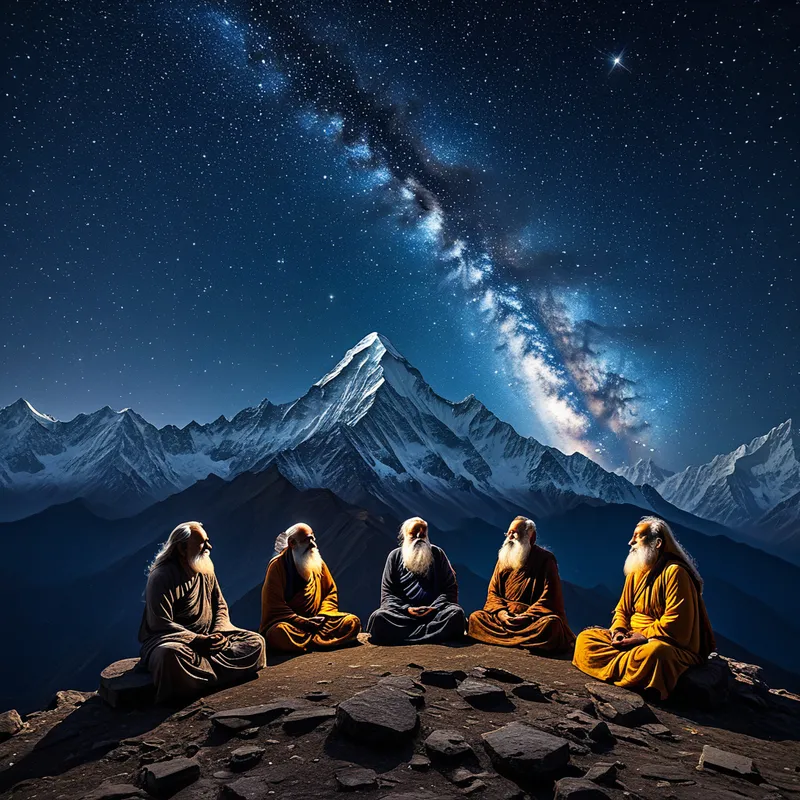
Listen. Before the first name was spoken, before the first river found its course, there was a breath held in the infinite dark. From that breath, from the unformed thought of Brahma, seven flames were kindled. Not fires of destruction, but of pure, unwavering knowing. They were the first minds to awaken in the newborn cosmos, the Saptarishi.
They did not walk; they manifested. Upon the highest, most silent peak where the air is thin as a prayer, they took their seats. Their bodies were not of flesh and blood, but of [tapas](/myths/tapas “Myth from Hindu culture.”/)—the fierce heat of concentration. Their hair was matted with cosmic dust, their eyes were closed, yet they saw everything. They saw the swirling potential of the [Kalpa](/myths/kalpa “Myth from Buddhist culture.”/), the great inhalation and exhalation of existence. Their meditation was not an escape, but an anchor. They were the axis around which the wheel of creation would first turn.
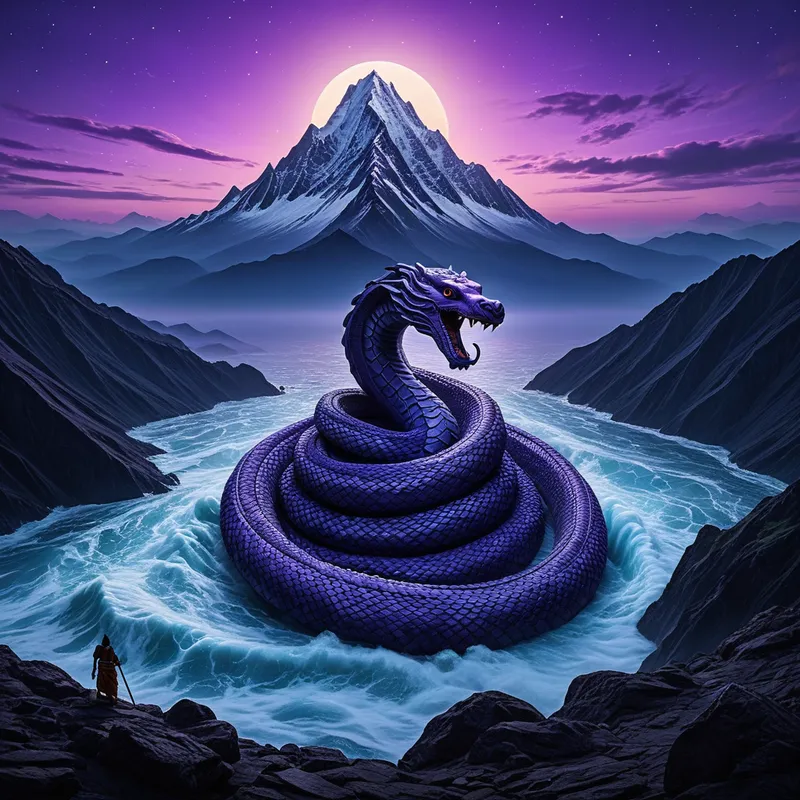
[The world](/myths/the-world “Myth from Tarot culture.”/) was young and fluid, a realm of churning elements and warring impulses. When the Devas and the Asuras, forces of order and chaos, sought to churn [the ocean of milk](/myths/the-ocean-of-milk “Myth from Hindu culture.”/) for the nectar of immortality, they needed a pivot. A foundation that would not shudder or sink. They chose Mount Mandara. But as they pulled the great serpent Vasuki, wrapped around the mountain, [the world](/myths/the-world “Myth from Tarot culture.”/) groaned under the strain. The axis began to slip, threatening to plunge all back into formless void.
It was then the Seven stirred. Not with a shout, but with a collective, silent intent. From their meditative post, they extended their consciousness—a net of luminous stability. They held the mountain firm. They became the unseen foundation, the unwavering witnesses to the titanic struggle, ensuring the churn continued until the treasures, and the poison, of the depths were brought forth. They stabilized reality so that the drama of the gods could unfold.
And when their work in one age was done, they did not die. They withdrew, their forms dissolving into points of brilliant light. [Vishnu](/myths/vishnu “Myth from Hindu culture.”/), who rests upon the serpent of eternity, looked up and breathed them into the vault of the night. There they remain, forever fixed: the Great Bear, Saptarshi [Mandala](/myths/mandala “Myth from Buddhist culture.”/). Seven stars that do not set, that circle the celestial pole, the eternal dharma of [the sky](/myths/the-sky “Myth from Persian culture.”/). They are the silent legislators of the cosmos, the eternal return made visible, watching over the long, turning night of the world.
Cultural Origins & Context
The myth of the Saptarishi is not a single story with a beginning and end, but a foundational stratum of Hindu cosmology, woven into the fabric of the Vedas, elaborated in the Puranas, and encoded in the night sky. Their names—Marichi, Atri, Angiras, Pulaha, Kratu, Pulastya, and Vashistha—are recited in rituals and lineages, for they are the primordial progenitors, the Prajapatis (lords of creation), from whom all human gotras (lineages) are said to descend.
They functioned as the ultimate cultural anchors. Passed down through generations by brahmin priests and village storytellers alike, they represented the unbroken chain of knowledge (shruti and smriti) from the dawn of time. They were the archetypal sages whose penance (tapas) generated the spiritual power that structured moral and cosmic law (Dharma). In a society deeply connected to astronomical cycles, their embodiment as the ever-present, non-setting constellation provided a literal fixed point in the heavens—a celestial mandala guiding navigation, marking seasons, and symbolizing the eternal, cyclical nature of time (Yuga).
Symbolic Architecture
The Seven Rishis are not merely ancient wise men; they are a profound symbolic [architecture](/symbols/architecture “Symbol: Architecture in dreams often signifies structure, stability, and the framing of personal identity or life’s journey.”/) for [consciousness](/symbols/consciousness “Symbol: Consciousness represents the state of awareness and perception, encompassing thoughts, feelings, and experiences.”/) itself. They represent the first crystallization of pure [awareness](/symbols/awareness “Symbol: Conscious perception of self, surroundings, or internal states. Often signifies awakening, insight, or heightened sensitivity.”/) from the undifferentiated mind of the [creator](/symbols/creator “Symbol: A figure representing ultimate origin, divine power, or profound authorship. Often embodies the source of existence, innovation, or personal destiny.”/). They are the foundational patterns of thought, the archetypal laws, and the inherent structures that make [perception](/symbols/perception “Symbol: The process of becoming aware of something through the senses. In dreams, it often represents how one interprets reality or internal states.”/) and order possible.
They are the seven pillars of the house of the world, not built by hand, but perceived by the soul.
Psychologically, they map onto the irreducible, ordering principles of the [psyche](/myths/psyche “Myth from Greek culture.”/). In various traditions, the [number](/symbols/number “Symbol: Numbers in dreams often symbolize meaning, balance, and the quest for understanding in the dreamer’s life, reflecting their mental state or concerns.”/) seven points to completeness: the seven notes of the scale, the seven colors of the [spectrum](/symbols/spectrum “Symbol: A continuum of possibilities, representing diversity, transition, and the full range of existence from one extreme to another.”/), the seven classical planets. [The Rishis](/myths/the-rishis “Myth from Hindu culture.”/) symbolize the inherent, often latent, [framework](/symbols/framework “Symbol: Represents the underlying structure of one’s identity, emotions, or life. It signifies the mental or emotional scaffolding that supports or confines the self.”/) within our own minds that seeks to bring coherence to the [chaos](/symbols/chaos “Symbol: In Arts & Music, chaos represents raw creative potential, uncontrolled expression, and the breakdown of order to forge new artistic forms.”/) of experience. They are the internal sages—discernment, patience, [insight](/symbols/insight “Symbol: A sudden, deep understanding of a complex situation or truth, often arriving unexpectedly and illuminating hidden connections.”/), perseverance, [intuition](/symbols/intuition “Symbol: The immediate, non-rational understanding of truth or insight, often described as a ‘gut feeling’ or inner knowing that bypasses conscious reasoning.”/), [memory](/symbols/memory “Symbol: Memory symbolizes the past, lessons learned, and the narratives we construct about our identities.”/), and silence—that must be “seated” and stabilized within us for our personal world to hold together.
Their [role](/symbols/role “Symbol: The concept of ‘role’ in dreams often reflects one’s identity or how individuals perceive their place within various social structures.”/) in the Churning of the [Ocean](/symbols/ocean “Symbol: The ocean symbolizes the vastness of the unconscious mind, representing deeper emotions, intuition, and the mysteries of life.”/) is particularly telling. They do not participate in the frantic [action](/symbols/action “Symbol: Action in dreams represents the drive for agency, motivation, and the ability to take control of situations in waking life.”/) of the gods and demons; they enable it by providing silent, immovable [stability](/symbols/stability “Symbol: A state of firmness, balance, and resistance to change, often represented by solid objects, foundations, or steady tools.”/). This symbolizes the necessity of a grounded, witnessing consciousness ([Purusha](/myths/purusha “Myth from Hindu culture.”/)) amidst the turbulent churning of our own desires, fears, and conflicting impulses (the Prakriti). Without this inner [axis](/symbols/axis “Symbol: A central line or principle around which things revolve, representing stability, orientation, and the fundamental structure of reality or consciousness.”/), the psyche collapses into chaos.
The Dreamer’s Resonance
When the pattern of the Seven Rishis stirs in the modern unconscious, it often manifests in dreams of profound structural anxiety or, conversely, sudden integrative peace. One might dream of seven pillars holding up a collapsing ceiling, seven lights in a dark tunnel, seven keys on a ring, or seven figures sitting in a circle around the dreamer’s own sleeping form.
Somatically, this can correlate with a felt sense in the body of needing “spinal” support—a literal and metaphorical need to sit upright, to find one’s center, to stabilize. Psychologically, it signals a process of foundational restructuring. The dreamer is at a point where old, ad-hoc ways of making sense of the world are insufficient. The chaos of life events, emotions, or responsibilities is threatening to overwhelm. The psyche, in its wisdom, is calling up the archetype of the primordial foundation. It is an invitation to cease frantic outward doing and to turn inward to establish a practice of deep, silent witnessing—to find the internal “mountain” that cannot be moved by the churning.

Alchemical Translation
The alchemical journey modeled by the Rishis is not one of heroic conquest, but of profound, immovable centering. It is the work of individuation as the establishment of an inner axis mundi.
The first step is Withdrawal and Ignition. Like the Rishis manifesting from Brahma’s mind, we must withdraw psychic energy from its scattered attachments and kindle the focused flame of attention (tapas). This is the discipline of meditation, introspection, or any practice that collects [the self](/myths/the-self “Myth from Jungian culture.”/).
The core operation is Becoming the Axis. In the midst of life’s inevitable churning—career struggles, relational conflicts, internal doubts—we must learn to be the silent, stabilizing presence. This means not being identified with either the “god” (our spiritual aspirations) or the “demon” (our base impulses) pulling the rope, but being the mountain they both depend upon. It is the cultivation of the observing ego, the seat of consciousness that watches the drama without being swept away by it.
The ultimate alchemy is not turning lead to gold, but turning chaos into cosmos by the sheer power of ordered attention.
The final translation is Celestial Fixation. The Rishis become stars. This symbolizes the permanent integration of these ordering principles into the very structure of the personality. What was once a difficult practice becomes a natural state. One’s consciousness becomes a fixed, guiding light in one’s own psychic sky—a constant, reliable [reference](/myths/reference “Myth from Global/Universal culture.”/) point of wisdom and calm. The personal psyche is now aligned with the cosmic order; the individual’s law (svadharma) resonates with the universal law (Dharma). The seeker becomes a sage, not by knowing all, but by being an unwavering vessel for the light of consciousness itself.
Associated Symbols
Explore related symbols from the CaleaDream lexicon: