
The Serpent in Eden Myth Meaning & Symbolism
A serpent offers forbidden knowledge to humanity's first ancestors, catalyzing a fall from innocence and the dawn of self-aware consciousness.
The Tale of The Serpent in Eden
In the beginning, there was a garden. Not a garden as we know it, of tamed hedges and plotted rows, but a living, breathing world in miniature, where the air itself tasted of honey and the soil pulsed with a deep, green warmth. This was Eden, a realm of unbroken harmony. Here, the first man and woman, Adam and Eve, walked naked and unashamed, knowing neither lack nor longing. They were creatures of pure being, their every need met by the breath of the Lord God, who walked with them in the cool of the day.
At the heart of this garden grew two trees of singular power: [the Tree of Life](/myths/the-tree-of-life “Myth from Kabbalistic culture.”/), and the Tree of the Knowledge of Good and Evil. Of the latter, God had spoken a single, resonant command: “You shall not eat of it, for in the day that you eat of it you shall surely die.” The command hung in the air, not as a threat, but as the fundamental law of their existence, the one boundary in a world of boundless grace.
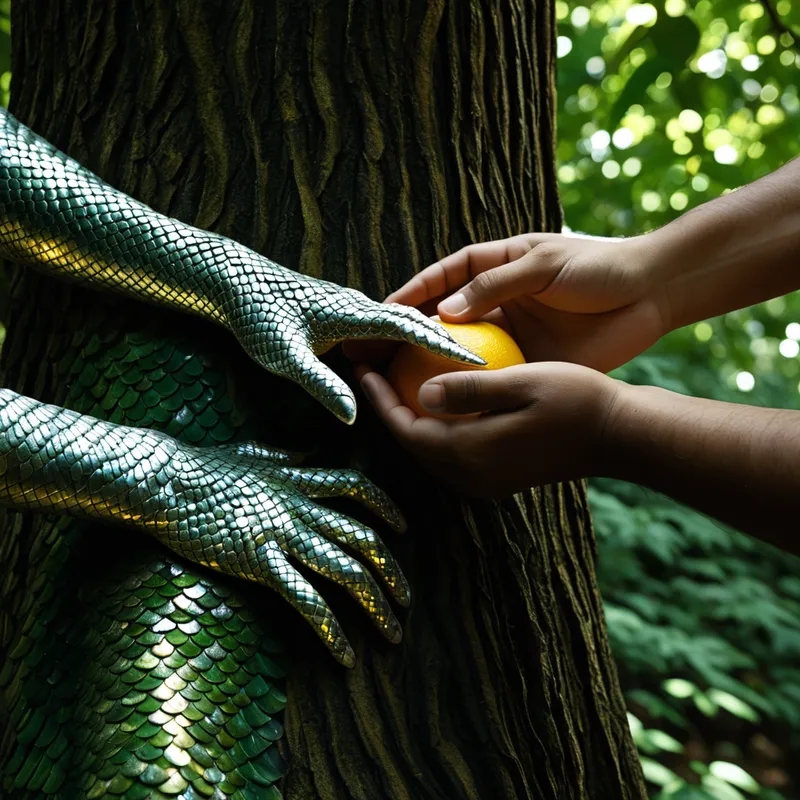
But the garden held another intelligence. More cunning than any other creature the Lord God had made was the Serpent. It did not slither as a mere beast; it moved with a liquid, knowing grace, its scales catching the dappled light like fragments of a shattered mirror. It found the woman by the forbidden tree, its voice a soft, insinuating rustle.
“Did God actually say, ‘You shall not eat of any tree in the garden’?” it began, twisting the absolute into a question of lack. Eve corrected the serpent, repeating the prohibition. Then the serpent spoke the words that would fracture [the world](/myths/the-world “Myth from Tarot culture.”/). “You will not surely die. For God knows that when you eat of it your eyes will be opened, and you will be like God, knowing good and evil.”
The words did not strike her ears; they took root in her soul. She looked at the tree anew. The fruit was not just good for food; it was a delight to the eyes, and it was desirable to make one wise. The boundary became a gateway. She took. She ate. She gave some to her man, who was with her, and he ate.
And in that moment, the unbroken field of their perception shattered into a kaleidoscope of duality. Their eyes were opened, and they knew they were naked. The seamless unity of self and world was gone, replaced by the chasm of a separate self looking out upon an objectified world. They heard the sound of the Lord God walking, and for the first time, they hid—not from a predator, but from the gaze of the Other. The garden was now a place of exposure. The serpent’s promise was true; the warning was also true. They had not died physically, but the death of innocent, unconscious unity was complete. They were cast out, east of Eden, to a world of thorns and sweat, of pain and striving, bearing the terrible, luminous burden of the knowledge they now carried.
Cultural Origins & Context
This foundational narrative is found in the third chapter of the Book of Genesis, the first book of the Tanakh and the Christian Old Testament. Its origins are woven from the threads of ancient Near Eastern mythologies, refined through the unique lens of emerging Israelite monotheism. Unlike the chaotic, battling gods of neighboring Mesopotamian creation epics, the Genesis account presents a sovereign, singular God creating through spoken word. The serpent myth likely functioned as an etiological tale—a story explaining origins. It answered profound, haunting questions for an agrarian, tribal society: Why do we labor? Why do women bear children in pain? Why is there death and suffering? Why do we feel shame?
Passed down orally long before being codified by priestly and wisdom traditions during the Second Temple period, the story served a critical societal function. It established a theological framework for human nature, free will, moral responsibility, and the concept of “[the fall](/myths/the-fall “Myth from Biblical culture.”/)”—a primordial rupture in the relationship between humanity, the divine, and the natural world. It was not merely a story about the past; it was a mirror held up to every individual’s experience of temptation, consequence, and exile from states of naive bliss.
Symbolic Architecture
The [Serpent](/symbols/serpent “Symbol: A powerful symbol of transformation, wisdom, and primal energy, often representing hidden knowledge, healing, or temptation.”/) is the myth’s catalytic [symbol](/symbols/symbol “Symbol: A symbol can represent an idea, concept, or belief, serving as a powerful tool for communication and understanding.”/), dense with layered meaning. It is not a [cartoon](/symbols/cartoon “Symbol: The symbol of a ‘Cartoon’ signifies playfulness, imagination, and the often exaggerated aspects of life, invoking humor and fantasy.”/) devil, but the embodiment of the questioning intellect, the [trickster](/symbols/trickster “Symbol: A boundary-crossing archetype representing chaos, transformation, and the subversion of norms through cunning and humor.”/) who disrupts stagnant unity to force evolution.
The Serpent is the first psychologist, the one who makes the unconscious conscious, regardless of the cost.
It represents [the principle](/symbols/the-principle “Symbol: A fundamental truth, law, or doctrine that serves as a foundation for a system of belief, behavior, or reasoning, often representing moral or ethical standards.”/) of enantiodromia—the [emergence](/symbols/emergence “Symbol: A process of coming into being, rising from obscurity, or breaking through a barrier, often representing birth, transformation, or revelation.”/) of the opposite. In a world of perfect, commanded order, the serpent is the necessary force of [chaos](/symbols/chaos “Symbol: In Arts & Music, chaos represents raw creative potential, uncontrolled expression, and the breakdown of order to forge new artistic forms.”/), curiosity, and [differentiation](/symbols/differentiation “Symbol: The process of distinguishing or separating parts of the self, emotions, or identity from a whole, often marking a developmental or psychological milestone.”/). The “[knowledge](/symbols/knowledge “Symbol: Knowledge symbolizes learning, understanding, and wisdom, embodying the acquisition of information and enlightenment.”/) of good and evil” is not merely ethical [awareness](/symbols/awareness “Symbol: Conscious perception of self, surroundings, or internal states. Often signifies awakening, insight, or heightened sensitivity.”/); it is the [dawn](/symbols/dawn “Symbol: The first light of day, symbolizing new beginnings, hope, and the transition from darkness to illumination.”/) of discriminating [consciousness](/symbols/consciousness “Symbol: Consciousness represents the state of awareness and perception, encompassing thoughts, feelings, and experiences.”/), the [ability](/symbols/ability “Symbol: In dreams, ‘ability’ often denotes a recognition of skills or potential that one possesses, whether acknowledged or suppressed.”/) to judge, to compare, to see oneself as separate. The [fruit](/symbols/fruit “Symbol: Fruit symbolizes abundance, nourishment, and the fruits of one’s labor in dreams.”/) is the symbol of this transformative, often painful, awakening.
The Garden itself symbolizes the original, undifferentiated state of the [psyche](/myths/psyche “Myth from Greek culture.”/)—the unconscious [paradise](/symbols/paradise “Symbol: A perfect, blissful place or state of being, often representing ultimate fulfillment, harmony, and transcendence beyond ordinary reality.”/) of [childhood](/symbols/childhood “Symbol: Dreaming of childhood often symbolizes nostalgia, innocence, and unresolved issues from one’s formative years.”/) or of spiritual naivete where all needs are met but no true [choice](/symbols/choice “Symbol: The concept of choice often embodies decision-making, freedom, and the multitude of paths available in life.”/) exists. The expulsion, therefore, is not merely a [punishment](/symbols/punishment “Symbol: A dream symbol representing consequences for actions, often tied to guilt, societal rules, or internal moral conflicts.”/), but an inevitable [birth](/symbols/birth “Symbol: Birth symbolizes new beginnings, transformation, and the potential for growth and development.”/) into the arduous, creative work of building a conscious self in a world of opposites.
The Dreamer’s Resonance
When this myth stirs in modern dreams, it rarely appears as a literal Biblical scene. Instead, the dreamer encounters its archetypal architecture. Dreaming of a wise, talking animal—especially a snake—that offers a secret or a forbidden object signals a profound invitation from the unconscious. The dreamer is at their own “[Tree of Knowledge](/myths/tree-of-knowledge “Myth from Abrahamic culture.”/).”
The somatic experience is often one of simultaneous dread and fascination, a gripping tension in the chest. Psychologically, this marks a crossroads where a long-held innocence, a comfortable ignorance, or a rigid moral rule is being challenged by a deeper, more complex truth from within. The “fruit” might be a repressed talent, a shadow aspect of the personality, or a painful but necessary insight. To “eat” in the dream is to accept this knowledge, initiating a fall from a previous, simpler identity. The subsequent dream imagery of being exposed, hiding, or navigating a new, harsher landscape reflects [the ego](/myths/the-ego “Myth from Jungian culture.”/)’s adjustment to this newly integrated consciousness.

Alchemical Translation
The myth of Eden is the ultimate alchemical recipe for the creation of the individuated self. The [prima materia](/myths/prima-materia “Myth from Alchemical culture.”/)—the raw, unconscious material—is the innocent, paradisiacal state. The serpent is the agent of transformation, the mercurial spirit that dissolves the stable compound of naive unity.
The Fall is not a moral catastrophe, but the necessary nigredo—the blackening, the despair of separation—that begins all true psychic work.
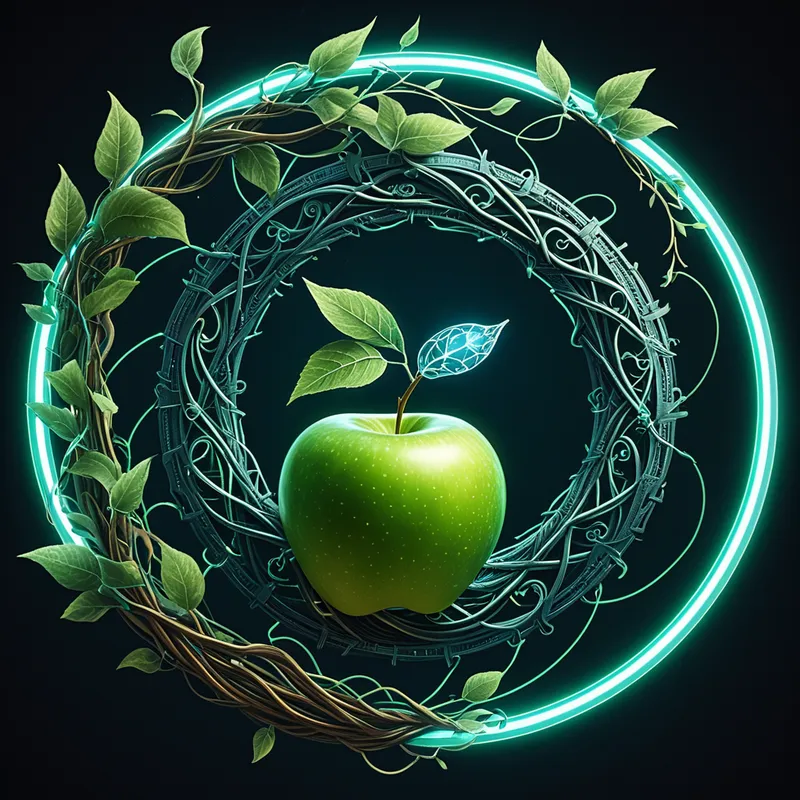
Eating the fruit is the act of consciousness ingestion, the willing engagement with [the shadow](/myths/the-shadow “Myth from Jungian culture.”/) and the opposites. The shame and sewing of fig leaves represent the ego’s first, clumsy attempts at crafting a [persona](/myths/persona “Myth from Greek culture.”/) to cover this new vulnerability. The expulsion into the world “east of Eden” is the beginning of the opus, [the great work](/myths/the-great-work “Myth from Alchemical culture.”/). This is the world of differentiation, conflict, and effort—the very crucible in which the individual is forged. The guarded path back to the [Tree of Life](/myths/tree-of-life “Myth from Kabbalistic culture.”/) is no longer available through a childlike state, but must be earned through the hard-won integration symbolized by the [Ouroboros](/myths/ouroboros “Myth from Global/Universal culture.”/)—the serpent of wisdom that has integrated its own tail, achieving a higher, conscious unity.
Thus, the serpent is both the instigator of the fall and the symbol of the healing wisdom that can only be found on the other side of it. To become truly human, the myth suggests, is not to lament the lost garden, but to undertake the sacred, serpentine journey of knowing.
Associated Symbols
Explore related symbols from the CaleaDream lexicon: