The Second Arrow Myth Meaning & Symbolism
A teaching on how the mind's reaction to pain creates a second, more potent suffering, and the path to liberation from it.
The Tale of The Second Arrow
Listen, and let the silence between the words speak.
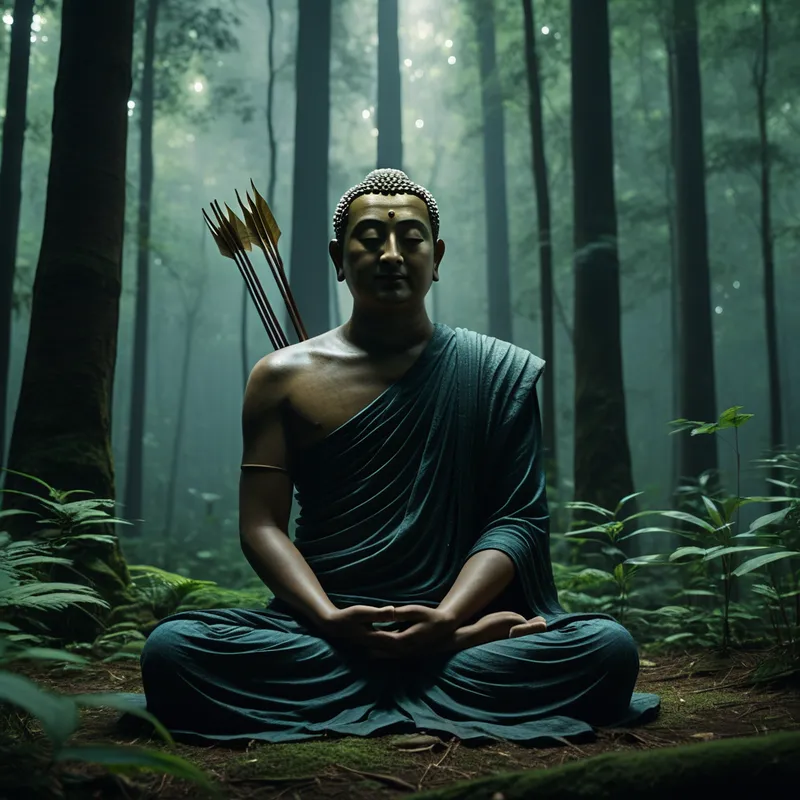
In the deep, dappled shade of the Jeta Grove, a stillness hung in the air, thick as honey. It was a stillness not of absence, but of profound presence. There, upon a simple seat of woven grass, sat the Tathagata. His form was like a mountain—rooted, patient, enduring the slow turn of the sun. A community of monks, their [saffron robes](/myths/saffron-robes “Myth from Hindu/Buddhist culture.”/) like fallen leaves, gathered around him, their faces etched with the unspoken questions of the human heart: the question of pain.
[The Buddha](/myths/the-buddha “Myth from Buddhist culture.”/) did not begin with a discourse. He began with a scene, painted in the air with the quiet certainty of one who has seen the very fabric of reality.
“Suppose, bhikkhus,” his voice was a river, calm and deep, “a man is struck by an arrow.”
The listeners felt the sudden, shocking thwack of impact. They saw the anonymous man—a soldier, perhaps, or a traveler on a dangerous road—jolt as the shaft buried itself in his flesh. The pain was immediate, searing, undeniable. A cry was torn from his lips. This was the First Arrow. It was fate, [karma](/myths/karma “Myth from Hindu culture.”/), the unavoidable circumstance of a body in a world of cause and effect. The arrow was shot by another; its strike was not of his choosing.
“But then,” the Buddha continued, his gaze holding the horror of what came next, “he is struck by a second arrow, in the very same place.”
A collective tension gripped the grove. The image was one of cruel, almost unbearable escalation. The man, already wounded, convulses with a new, sharper agony. Yet the Buddha’s next words changed everything.
“The second arrow,” he said, “is of his own making.”
The scene shifted from a battlefield to the landscape of the mind. The wounded man does not simply feel the fresh puncture of wood and iron. Instead, he is consumed. He rails against the archer, his voice cracking with curses. He laments his misfortune, weaving tales of a life doomed to suffering. He fears the wound will fester, that he will be crippled, that he will die. He burns with resentment for the pain itself, tightening his body against it, which only magnifies the torment. He is shot through not with wood, but with stories—stories of blame, of past regret, of future dread. This is the Second Arrow. Its poison is self-pity, its fletching is fear, and its tip is forged in the fires of resistance.
The Buddha fell silent, letting the parable hang in the fragrant air. The First Arrow brings pain. The Second Arrow creates suffering. And between the strike of the first and the loosing of the second, he implied, lies the entire width of the path to freedom.
Cultural Origins & Context
This teaching is not a myth of gods and monsters, but a psychological parable from the Pali Canon, specifically the Samyutta Nikaya. Its origin is attributed to the historical Buddha, [Siddhartha Gautama](/myths/siddhartha-gautama “Myth from Buddhist culture.”/), in the 5th century BCE. It was transmitted orally for centuries by the [Sangha](/myths/sangha “Myth from Buddhist culture.”/) before being committed to text.
Its societal function was profoundly practical. For monks and lay followers alike, life in ancient India was fraught with physical hardship, disease, and the inevitability of loss. The parable served as a core instructional tool in Dhamma talks, a vivid mental model to diagnose the root of existential distress. It was a tool for deconstruction, shifting the focus from changing an often-unchangeable outer world (the first arrow) to mastering the inner world of response. It democratized liberation, presenting it not as a distant supernatural achievement, but as a moment-to-moment practice of awareness available to anyone, in any circumstance.
Symbolic Architecture
The myth’s power lies in its stark, binary [symbolism](/symbols/symbolism “Symbol: The use of symbols to represent ideas or qualities, often conveying deeper meanings beyond literal interpretation. In dreams, it’s the language of the unconscious.”/). The First [Arrow](/symbols/arrow “Symbol: An arrow often symbolizes direction, purpose, and the pursuit of goals, representing both the journey and the destination.”/) represents dukkha in its most fundamental sense: the inherent unsatisfactoriness, discomfort, and plain physical or emotional pain of embodied existence. It is the initial data of experience—the [loss](/symbols/loss “Symbol: Loss often symbolizes change, grief, and transformation in dreams, representing the emotional or psychological detachment from something or someone significant.”/), the insult, the illness, the failure. It is objective, or at least intersubjective. We might say it belongs to the [realm](/symbols/realm “Symbol: The symbol of ‘Realm’ often signifies the boundaries of one’s consciousness, experiences, or emotional states, suggesting aspects of reality that are either explored or ignored.”/) of fact.
The First Arrow is the given. The Second Arrow is the story we tell about the given.
The Second Arrow is the [architecture](/symbols/architecture “Symbol: Architecture in dreams often signifies structure, stability, and the framing of personal identity or life’s journey.”/) of suffering. It is the entire subsequent psychological edifice: the narrative, the judgment, the emotional [amplification](/symbols/amplification “Symbol: The act of increasing intensity, volume, or magnitude, often through technological or artistic means to enhance impact and reach.”/), the [rumination](/symbols/rumination “Symbol: Repetitive, cyclical thinking patterns that often focus on problems, past events, or anxieties without reaching resolution.”/). It is the voice that says, “This shouldn’t be happening to me,” “This proves I am a failure,” or “This pain will never end.” Symbolically, it represents [the ego](/myths/the-ego “Myth from Jungian culture.”/)’s attempt to resist the flow of [reality](/symbols/reality “Symbol: Reality signifies the state of existence and perception, often reflecting one’s understanding of truth and life experiences.”/), to assert a “self” that is separate from and victimized by experience. The second arrow is the act of identification—“I am in pain” becomes “I am a pained person.”
The true [hero](/symbols/hero “Symbol: A hero embodies strength, courage, and the ability to overcome significant challenges.”/) of the parable is not a figure who avoids the first arrow—an impossibility—but the one who, through mindful [attention](/symbols/attention “Symbol: Attention in dreams signifies focus, awareness, and the priorities in one’s life, often indicating where the dreamer’s energy is invested.”/), sees the second arrow being nocked and chooses not to draw the bow. This is the [birth](/symbols/birth “Symbol: Birth symbolizes new beginnings, transformation, and the potential for growth and development.”/) of true agency.
The Dreamer’s Resonance
In the modern dreamscape, the Second Arrow rarely appears as a literal arrow. Its manifestation is more insidious and somatic. One might dream of a small cut on the hand that begins to weep black oil, spreading corruption up the arm. Or of stubbing a toe, only to have the room transform into a courtroom where a furious prosecutor (who bears the dreamer’s own face) lists every past failure as evidence for why this pain is deserved.
These dreams point to a [psyche](/myths/psyche “Myth from Greek culture.”/) caught in the feedback loop of secondary suffering. The initial wound (the first arrow) might be a recent rejection, a professional setback, or an old childhood memory that has been triggered. The dream process is then dramatizing the mind’s reaction to that trigger—the shame, the catastrophic forecasting, [the self](/myths/the-self “Myth from Jungian culture.”/)-flagellation. The body in the dream often feels heavy, trapped, or poisoned, reflecting the somatic reality of holding onto resentment and fear. Such a dream is not a prophecy of doom, but a stark mirror. It asks the dreamer: “Do you see how you are shooting yourself? Can you feel the bow in your own hands?”

Alchemical Translation
The alchemical process modeled here is the transmutation of raw, reactive pain into conscious, witnessed experience—the turning of leaden suffering into the gold of clarity. Individuation, in this context, is the gradual dis-identification from the archer of the second arrow.
The First Stage ([Nigredo](/myths/nigredo “Myth from Alchemical culture.”/)) is the blackening, the strike of the first arrow. It is the confrontation with the unavoidable shadow: loss, limitation, hurt. This is the necessary [prima materia](/myths/prima-materia “Myth from Alchemical culture.”/), the base reality one must work with.
The Second Stage (Albedo) is the whitening, the moment of separation. This is the critical, mindful pause. It is the development of the “observing ego,” the inner sage who can distinguish between the sensation of pain and the story of suffering. “There is pain,” it notes, rather than, “I am in pain.”
The alchemical fire is not the heat of resistance, but the steady warmth of bare attention.
The Third Stage ([Rubedo](/myths/rubedo “Myth from Alchemical culture.”/)) is the reddening, the integration. Here, the energy once spent on crafting and firing the second arrow—the energy of resistance—is reclaimed. It becomes the vitality of full presence. The first arrow is not eliminated; it may still ache. But it is no longer poisoned by narrative. It becomes simply a part of the field of experience, a sensation that arises and passes, like weather in [the sky](/myths/the-sky “Myth from Persian culture.”/) of awareness. The individual is no longer a target, but the spacious sky itself. In ceasing to wage war against reality, one finds an indestructible peace that exists not in spite of the first arrow, but fundamentally untouched by it. This is the culmination: the liberation from the self-made prison of the second shot.
Associated Symbols
Explore related symbols from the CaleaDream lexicon: