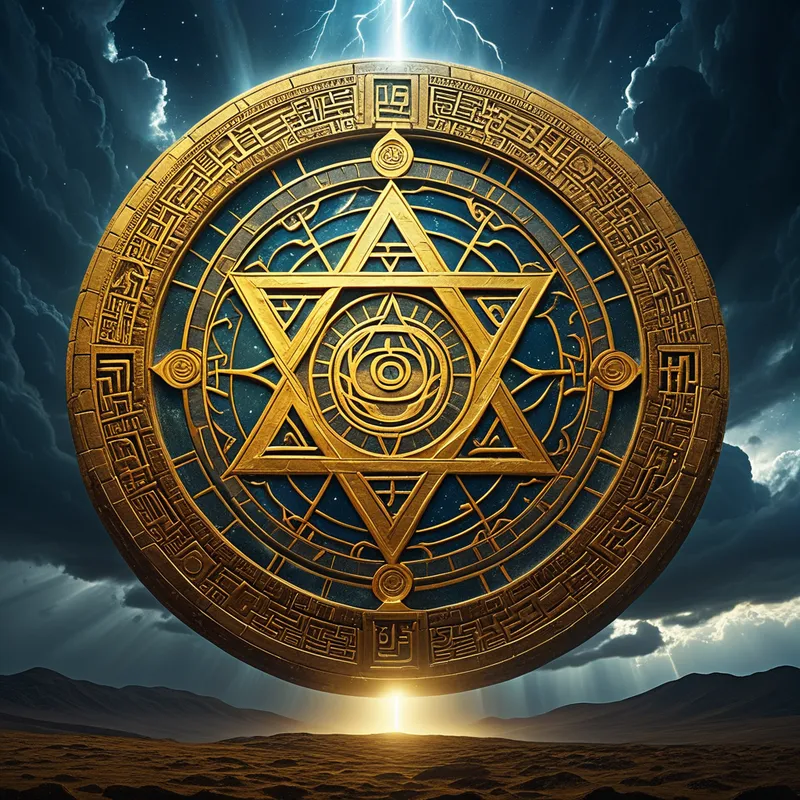
The Seal of God Myth Meaning & Symbolism
A mythic narrative of divine claim, spiritual warfare, and the ultimate protection and identity bestowed upon the faithful soul.
The Tale of The Seal of God
Hear now a tale not of earth and stone, but of spirit and fire. In the last days, when the sun turns black and [the moon](/myths/the-moon “Myth from Tarot culture.”/) to blood, a silence falls upon the heavens—a silence more terrible than any storm. From this silence, four riders are unleashed, and a beast rises from [the abyss](/myths/the-abyss “Myth from Kabbalistic culture.”/), its mouth speaking blasphemies, its number the number of a man.
Upon [the earth](/myths/the-earth “Myth from Hindu culture.”/), a choice is laid bare, stark as a bone against [the sky](/myths/the-sky “Myth from Persian culture.”/). The beast demands worship. It demands that all, small and great, rich and poor, free and slave, receive a mark upon their right hand or their forehead. This mark, this charagma, is the price of bread, the key to [the market](/myths/the-market “Myth from Various culture.”/), the passport in a world gone mad. To refuse is to be cast out, a ghost in the machine of the new age, destined for hunger and the sword.
But high above the thrones of men, in [the temple](/myths/the-temple “Myth from Jewish culture.”/) not made with hands, another decree is issued. An angel ascends from the sunrise, bearing the seal of the living God. His voice is like the crash of waves on eternity’s shore. He cries to the four winds, “Do not harm the earth or [the sea](/myths/the-sea “Myth from Greek culture.”/) or the trees until we put a seal on the foreheads of the servants of our God.”
And so it begins. Not with fanfare, but with a whisper in the soul. One hundred and forty-four thousand, a number beyond counting, a people chosen from every tribe. They are the ones who have not bowed the knee. They are the ones who sing a song no one else can learn. Upon their foreheads, not with ink or laser, but with the breath of the Spirit, is placed the Seal of God.
It is invisible to the eye of the beast, but in the spirit realm, it blazes like a star. It is their name in the Book of Life. It is the divine “Mine” etched against the cacophony of “yours.” The plagues fall, the trumpets sound, the bowls of wrath are poured out, but they pass over the sealed. They stand on a sea of glass mixed with fire, and they are safe. Their conflict is not against flesh and blood, but against principalities, against powers, against the spiritual forces of wickedness in the heavenly places. The seal is their armor, their citizenship, their unbreakable promise in the breaking of [the world](/myths/the-world “Myth from Tarot culture.”/).
Cultural Origins & Context
This mythic tapestry is woven from the threads of the Book of Revelation, attributed to John of Patmos in the late 1st century CE. It emerged from a cultural crucible of persecution, where the fledgling Christian community, a minority within the Roman Empire, faced the immense pressure of emperor worship. To refuse the imperial cult was not merely dissent; it was economic and social suicide, a literal mark of exclusion.
The myth functioned as a powerful narrative of resistance and identity reinforcement. Passed down through clandestine readings and coded art in the catacombs, it served a dual purpose: it was a theodicy, explaining the suffering of the faithful, and a potent piece of apocalyptic propaganda. It assured the community that their invisible, spiritual allegiance to Christ was seen and recorded by God, and that their persecutors, despite all earthly power, were ultimately marked for destruction. The societal function was to create a parallel, superior reality—a heavenly citizenship—that rendered the threats of the earthly empire null and void. It transformed social ostracization into a badge of divine honor.
Symbolic Architecture
At its core, the myth is a profound [drama](/symbols/drama “Symbol: Drama signifies narratives, emotional expression, and the exploration of human experiences.”/) of ownership, [identity](/symbols/identity “Symbol: Identity represents the sense of self, encompassing personal beliefs, cultural background, and social roles.”/), and the battleground of [consciousness](/symbols/consciousness “Symbol: Consciousness represents the state of awareness and perception, encompassing thoughts, feelings, and experiences.”/). The [forehead](/symbols/forehead “Symbol: The forehead often represents intellect, consciousness, and a person’s thoughts or emotions in dreams.”/), the seat of thought and [identity](/symbols/identity “Symbol: Identity represents the sense of self, encompassing personal beliefs, cultural background, and social roles.”/), and the hand, the [instrument](/symbols/instrument “Symbol: An instrument symbolizes creativity, communication, and the means by which one expresses oneself or influences the world.”/) of [action](/symbols/action “Symbol: Action in dreams represents the drive for agency, motivation, and the ability to take control of situations in waking life.”/) and commerce, become the territories of this war.
The ultimate spiritual conflict is not over land or gold, but over the right to inscribe your name upon the human soul.
The [Mark](/symbols/mark “Symbol: A ‘mark’ often symbolizes identity, achievement, or a defining characteristic in dreams.”/) of the [Beast](/symbols/beast “Symbol: The beast often represents primal instincts, fears, and the shadow self in dreams. It symbolizes the untamed aspects of one’s personality that may need acknowledgment or integration.”/) symbolizes total external identification. It is the [psyche](/myths/psyche “Myth from Greek culture.”/) absorbed by the collective, [the ego](/myths/the-ego “Myth from Jungian culture.”/) that sells its sovereignty for [security](/symbols/security “Symbol: Security denotes safety, stability, and protection in one’s personal and emotional life.”/), convenience, and belonging to the prevailing [system](/symbols/system “Symbol: A system represents structure, organization, and interrelated components functioning together, often reflecting personal or social order.”/)—be it ideological, consumerist, or political. It is the unconscious [life](/symbols/life “Symbol: The symbol of ‘Life’ represents a journey of growth, interconnectedness, and existential meaning, encompassing both the joys and challenges that define human experience.”/), where actions (hand) and identity (forehead) are dictated by external [authorities](/symbols/authorities “Symbol: This symbol often represents power, control, and societal structures that dictate behavior and beliefs.”/).
Conversely, the Seal of God represents an internal, divine identification. It is [the Self](/myths/the-self “Myth from Jungian culture.”/), the [archetype](/symbols/archetype “Symbol: A universal, primordial pattern or prototype in the collective unconscious that shapes human experience, behavior, and creative expression.”/) of wholeness, claiming its territory. This seal is not a physical brand but an indelible change in orientation. It signifies the individual who has achieved a consciousness centered not on the ego’s alliances, but on a transcendent, inner [authority](/symbols/authority “Symbol: A symbol representing power structures, rules, and control, often reflecting one’s relationship with societal or personal governance.”/). The sealed ones are those who can discern the voice of the [herd](/symbols/herd “Symbol: Represents collective behavior, social conformity, and group dynamics. Symbolizes both safety in numbers and loss of individuality.”/) from the voice of the [soul](/symbols/soul “Symbol: The soul represents the essence of a person, encompassing their spirit, identity, and connection to the universe.”/), and who choose the latter, regardless of cost.
The Dreamer’s Resonance
When this myth stirs in the modern dreamscape, it rarely appears with angels and beasts. Instead, it manifests as a profound somatic anxiety about choice, authenticity, and selling out. One might dream of being forced to scan a badge to enter one’s own home, of a barcode appearing on one’s wrist, or of trying to wash off a sticky, black symbol that has been stamped on the skin. The dream ego feels a deep violation, a fear that its essence has been commodified.
Psychologically, this is the process of confronting the shadow—not as a monster, but as the seductive, conformist pressure within. The “beast” is the part of us that seeks to avoid conflict by blending in, that chooses the comfortable lie over the difficult truth. The dream is a crisis of integrity. The somatic feeling—often a pressure on the forehead or a tingling in the hand—signals the psyche’s intense engagement in this inner civil war, where it is trying to locate and fortify its true center against the envious, assimilating forces of the unconscious.
Alchemical Translation
The alchemical journey modeled here is the opus contra naturam—the work against one’s own innate tendency to drift into unconscious identification. The initial state is massa confusa, the confused mass of the unexamined life, easily shaped by external demands (the offer of the mark).
[The first stage](/myths/the-first-stage “Myth from Alchemical culture.”/), [nigredo](/myths/nigredo “Myth from Alchemical culture.”/) (blackening), is the painful isolation and darkness of refusal. It is the “cost of discipleship,” the feeling of being cast out of the collective paradise. This is a necessary death of the socially-adapted [persona](/myths/persona “Myth from Greek culture.”/).
The seal is not received in the crowd; it is forged in the solitude of one’s unwavering ‘No.’
The albedo (whitening) is the purification that comes from this steadfastness. The ego, stripped of its false alliances, begins to align with the Self. The “seal” is the moment of individuation, when the center of gravity shifts. One is no longer primarily a member of a tribe, a company, or a ideology, but a unique vessel of the transcendent.
The final stage, [rubedo](/myths/rubedo “Myth from Alchemical culture.”/) (reddening), is the embodied, active life of this new center. The sealed one can now operate in the world (the hand) without being of it. They carry an inner protection—not from suffering, but from meaninglessness. Their actions flow from an authentic identity, making them immune to the soul-destroying plagues of cynicism, nihilism, and collective hysteria. They have traded the mark of the system for the seal of the sovereign Self, and in doing so, have reclaimed their name in the eternal story.
Associated Symbols
Explore related symbols from the CaleaDream lexicon: