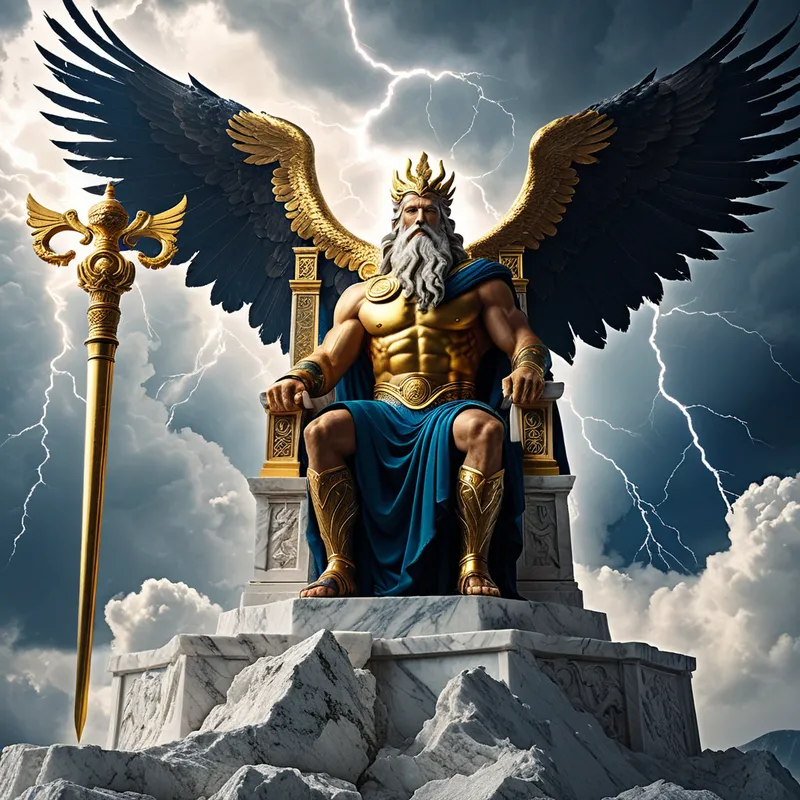
The Scepter of Zeus Myth Meaning & Symbolism
The scepter forged by the Cyclopes for Zeus, a symbol of ultimate authority, thunderous will, and the divine right to order the cosmos.
The Tale of The Scepter of Zeus
Hear now the tale of the foundation of the world, of the instrument by which chaos was bound and order given a voice. In the beginning, there was a war—a war that shook the very pillars of creation. The Titans, led by the cruel Kronos, ruled with a grip of stone, devouring their own children for fear of being overthrown. From this darkness, a spark survived. The infant Zeus, hidden away, grew to mighty strength. His heart was a gathering storm, his will a nascent thunderclap. But will alone could not unseat the old powers. He needed an instrument, a focal point for the fury of a new age.
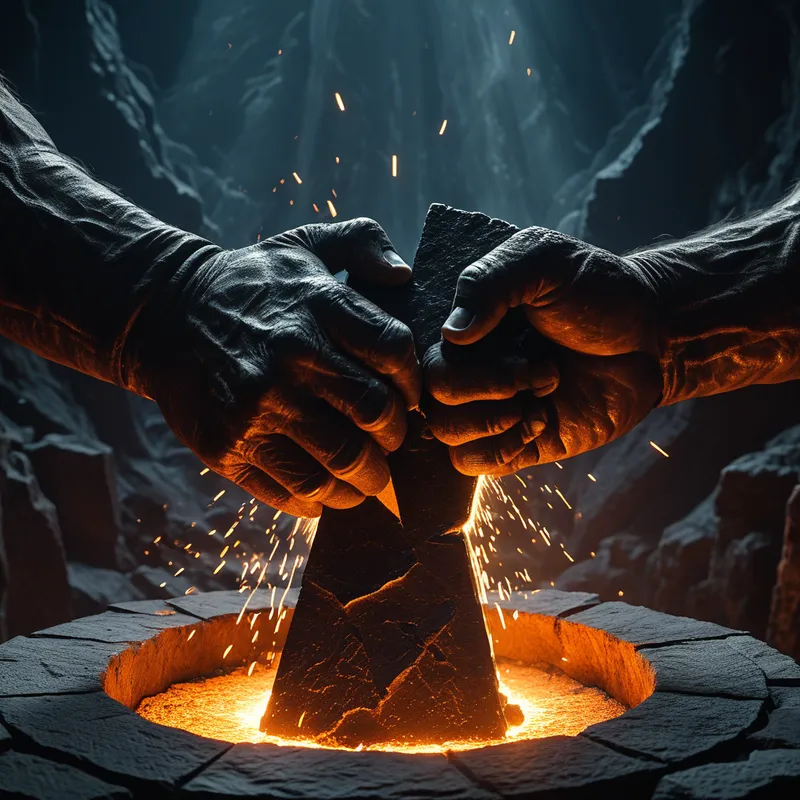
He descended not to the sunlit world, but into the abyssal gloom of Tartarus. There, in a forge lit by the fires of the earth’s core, labored the Cyclopes, imprisoned by the Titans. They were beings of pure craft, their single eyes seeing not beauty, but the true essence of materials. Zeus freed them, and in gratitude, they bent their immeasurable skill to his cause. They did not merely build a weapon; they forged a principle.
From unbreakable adamantine, they shaped the shaft—straight and true as the axis of the world. Upon its tip, they set a figure of the most keen-sighted of birds, the eagle, king of the skies, whose gaze could behold the entirety of the earth. But the true power was woven within. Into its very core, the Cyclopes bound the elements they had gifted Zeus separately: the rumble of the Thunder, the flash of the Lightning, and the terrifying roll of the Thunderbolt. The scepter became more than an object; it was a covenant, a conduit.
Armed with this scepter, Zeus ascended to the peaks of Mount Olympus. When the Titan host advanced, a sea of rage against the new order, Zeus did not merely raise an army. He raised the scepter. The air grew thick and silent. Then, from that golden eagle, a light erupted—a light that was also a sound, a crack that split the sky. Lightning, pure and white-hot, lanced forth, not as wild fire, but as directed will. The thunder that followed was not mere noise; it was the voice of authority itself, a sonic wave that shattered the confidence of the old regime. The scepter was the fulcrum upon which the universe turned, from the random brutality of the Titans to the ordained, if often severe, justice of the Olympians. It was the rod by which the cosmos was measured and the gavel by which its laws were decreed.
Cultural Origins & Context
The myth of the Scepter of Zeus is not a standalone fable but the bedrock of the Greek cosmological order. It is woven into the fabric of Hesiod’s Theogony, the seminal 8th- or 7th-century BCE epic that systematized the genealogy and ascendancy of the gods. For the ancient Greeks, this was sacred history. The scepter (skêptron) was not merely Zeus’s attribute; it was the symbol of his earned and rightful sovereignty, distinguishing him from the usurping tyranny of Kronos.
In a culture deeply concerned with kosmos (order, harmony) versus chaos (the void, disorder), the scepter’s origin story served a critical societal function. It legitimized hierarchical authority, both divine and, by extension, human. Kings and heralds carried scepters as emblems of their sanctioned power to command, judge, and speak with authority, directly mirroring Zeus’s celestial rule. The myth explained that true authority is not born of brute force alone (the Titan’s way) but is forged in alliance (with the Cyclopes), tempered by justice (the new order), and manifested through a recognizable, awe-inspiring symbol. It was a narrative that reinforced the idea that power, to be legitimate, must be structured, visible, and tied to a foundational act of creation and liberation.
Symbolic Architecture
Psychologically, the Scepter of Zeus represents the fully integrated and consciously wielded power of the Self. It is the antithesis of raw, unconscious id or the tyrannical grip of a rigid superego (the Titan Kronos). Its forging in the underworld forge points to its origins in the depths of the unconscious—the primal, creative, and often chthonic energies we must liberate (the Cyclopes) to serve our conscious aims.
The scepter is the symbol of the ego’s successful negotiation with the titanic powers of the unconscious, not to suppress them, but to channel their immense energy into a creative, world-ordering principle.
The three bound elements—Thunder, Lightning, Thunderbolt—are key. Thunder is the intimidating presence of authority, the resonant voice. Lightning is the brilliant, instantaneous insight or decisive action that cuts through confusion. The Thunderbolt is the transformative impact, the irreversible change enacted upon the world. Together, they symbolize a complete circuit of power: from rumbling potential, to illuminating flash, to transformative strike. The eagle atop the scepter signifies the soaring, overarching perspective of the ruler—the ability to see the whole pattern, to govern not from petty interest but from a vision of the greater order.
The Dreamer’s Resonance
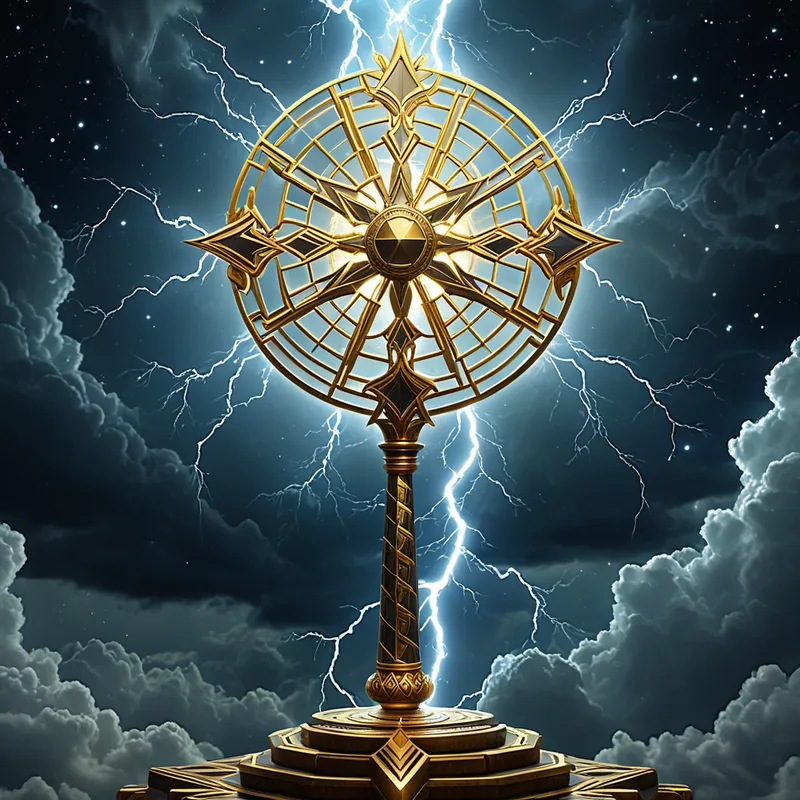
When the motif of the Scepter of Zeus appears in modern dreams, it seldom manifests as a literal golden rod. Instead, one might dream of finding a strangely authoritative object—a key, a remote control, a conductor’s baton, or simply a straight, significant branch—that feels imbued with a quiet, potent energy. The dreamer may feel a simultaneous awe and trepidation at holding it.
This dream signals a critical moment in the dreamer’s psychological process: the somatic and psychic integration of personal authority. The body may register this as a feeling of solidity in the spine, a deepening of the voice, or a sense of calm center amidst external storms. Psychologically, it marks the end of a period where one’s power was projected onto others (parents, bosses, institutions—the Titan rulers) or was felt as a chaotic, internal storm of unexpressed will and anger. The dream-scepter indicates the psyche is now forging these disparate energies into a usable, focused instrument of the conscious Self. The conflict is no longer about having power, but about the ethical and conscious wielding of it.

Alchemical Translation
The alchemical journey mirrored in this myth is the transmutation of chaotic potential into ordered manifestation, the core of the individuation process. We all contain our inner Tartarus—a chthonic realm of repressed talents, fiery passions, and imprisoned potentials (the Cyclopes). The first step is the “descent,” the courageous confrontation with this shadowy, creative depth to liberate these forces.
The “forging” is the long, often arduous, work of therapy, reflection, and discipline. It is the conscious effort to take our raw emotional thunder, our flashes of insight, and our potential for impactful action, and deliberately combine them into a coherent identity. The adamantine shaft is the enduring, resilient structure of the personality that results.
To hold one’s own scepter is to accept the sovereignty of the Self, to pronounce judgment on inner conflicts, and to direct one’s life-energy with intention, knowing that this authority carries the solemn responsibility of maintaining one’s inner cosmos.
Finally, “wielding the scepter” represents the mature phase of life where the individual, having integrated their powers, takes their rightful place in the world. They are no longer reacting to external tyranny nor ruled by internal chaos. They can “call down lightning”—make clear, decisive choices—and “roll out thunder”—assert their presence and values with conviction. They become a center of order and creativity in their own sphere, a small-scale reflection of the mythic act that once ordered a universe. The myth teaches that ultimate power is not domination, but the sacred ability to bring form out of chaos, first within, and then, perhaps, without.
Associated Symbols
Explore related symbols from the CaleaDream lexicon: