The Scapegoat Myth Meaning & Symbolism
An ancient ritual where a goat, burdened with the sins of a people, is driven into the wilderness to die, carrying away collective guilt.
The Tale of The Scapegoat
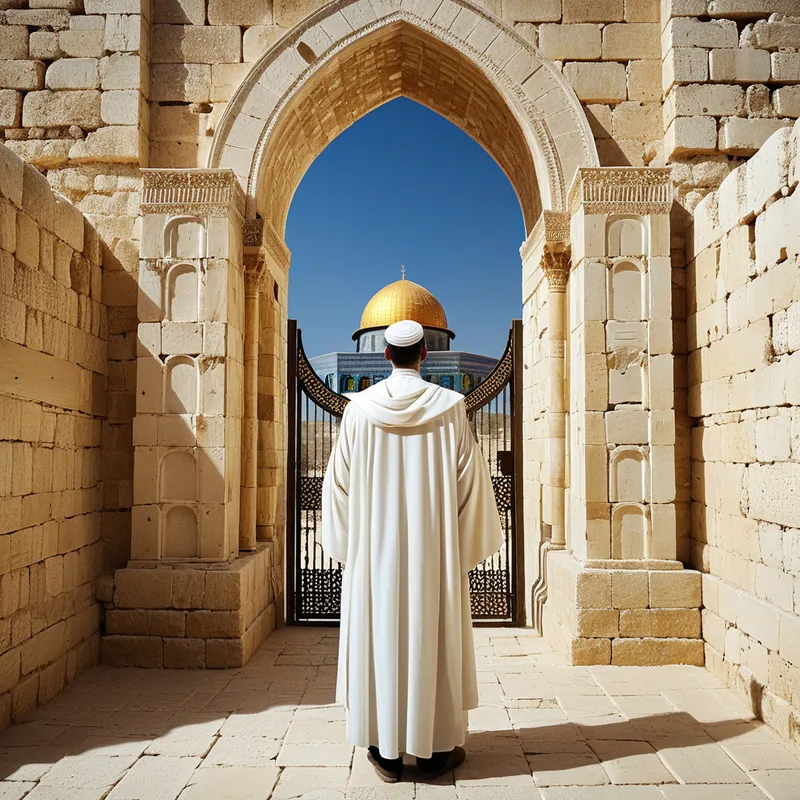
Hear now the tale of the burdened one, the silent carrier. It begins not with a hero’s cry, but with the heavy silence of a people gathered at the gate. The air is thick with the scent of dust, incense, and animal fear. The sun beats upon the stones of Jerusalem, and all eyes are fixed upon the High Priest, a figure swathed in linen and holiness, standing between two goats.
These two are brothers in form, yet destined for fates as different as life from death. One is chosen by lot for YHWH; its blood will soon sanctify the altar. The other stands apart, already marked by an invisible weight. This is the Azazel goat.
The Priest approaches the silent creature. He does not bring a blade, but his hands. He lays his palms upon the animal’s coarse-haired head, and as he does, he begins to speak. Not prayers of blessing, but a confession. He pours into the goat’s ears every transgression, every hidden hatred, every secret greed and public failing of the entire nation. The words are not mere sounds; they are tangible things—filthy, clinging spirits of guilt. They flow from the Priest’s mouth, through his trembling hands, and into the very being of the goat. The animal shifts, its hide twitching as if flies swarm it, but it bears the weight.
A scarlet thread is tied, a vivid mark upon its horn. Then, the solemn procession begins. A chosen man, his face set like stone, takes the goat’s lead. He does not walk towards the temple, but away from it—away from water, from home, from life. He drives the goat out, through the city gate, into the vast, waterless expanse. The wilderness awaits, a realm of tohu wa-bohu and scree demons.
The goat stumbles on the rocks. Its once-clean coat is now psychically stained, heavy with the moral filth of thousands. The attendant pushes on, deeper into the barren places, until the city is a memory and only desolation remains. Here, at the edge of the world, he releases the rope. Some say he pushed the creature over a precipice. Others say he simply turned his back and walked away, leaving the goat to wander, a living curse, until it perished from thirst or was torn by beasts. It does not die for atonement; it dies from it. It carries the stain away, into oblivion, and the people, watching the speck disappear into the haze, breathe a collective sigh of profound, uneasy relief. The sin is gone. For now.

Cultural Origins & Context
This ritual, meticulously detailed in the Book of Leviticus (Chapter 16), was the central act of Yom HaKippurim, the holiest day in the ancient Israelite calendar. It was not a folktale but a state-sanctioned, theological drama performed by the Aaronid priesthood. Its function was supremely practical in a world understood through a covenant with a holy deity: how does a community, inherently imperfect, remain in right relationship with divine order? The answer was an enacted metaphor.
The “scapegoat” (a term coined by William Tyndale in his 16th-century English translation, capturing the idea of the “escaping goat”) was sent to Azazel, a being or place associated with the chaotic, anti-creation forces of the wilderness. This was not a gift, but an expulsion. The ritual cleanly divided the sacred from the profane: one goat’s blood purified the holy sanctuary (the Holy of Holies), while the other removed the impurity entirely from the camp. It was a psychic hygiene for the nation, a way to metabolize collective guilt without internal collapse. The myth was passed down not by bards, but by priests and scribes, its power embedded in law and liturgy, ensuring its symbolic architecture would shape Western consciousness for millennia.
Symbolic Architecture
At its core, the Scapegoat is the ultimate symbol of projection—the psychological act of ejecting what is unbearable in ourselves onto an external carrier. The goat is not evil; it is innocent. Its function is to be made containable for evil. It represents the part of the self or the group that must be deemed “other” so that the “self” can feel pure.
The Scapegoat is the embodied lie that peace can be found by locating darkness out there rather than in here.
The two goats together form a complete psychic equation. The one sacrificed to YHWH represents the acknowledged cost, the conscious sacrifice made for order. The Scapegoat sent to Azazel represents the disowned cost, the repressed shadow banished to the unconscious (the wilderness). The ritual’s terrifying genius is its admission that sin/impurity cannot be destroyed; it can only be relocated. The wilderness is not a trash heap, but the unconscious itself—the place where all that we refuse to own wanders, hungry and potent.

The Dreamer’s Resonance
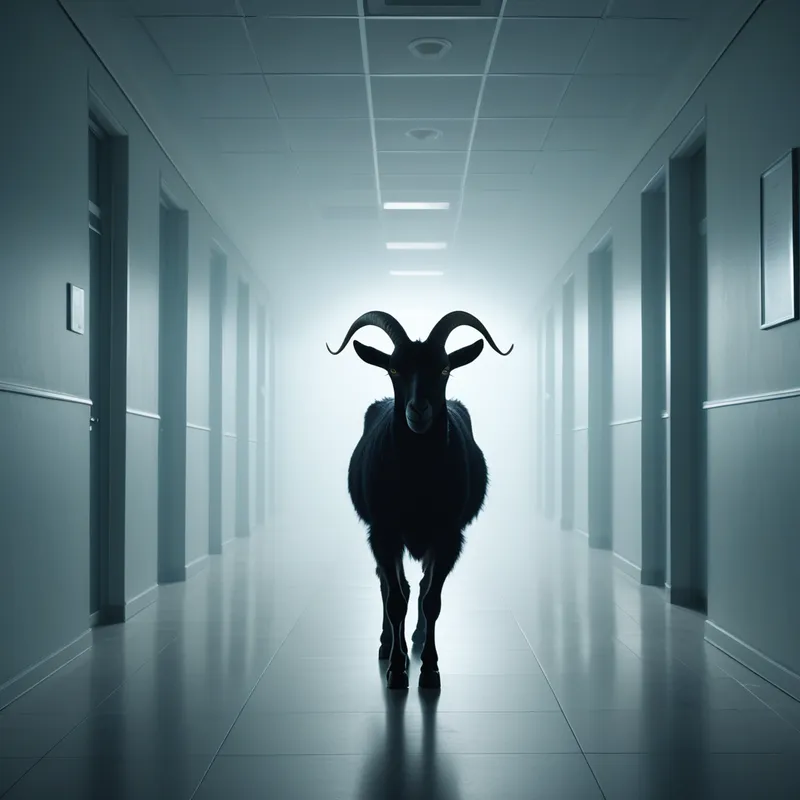
When this myth stirs in the modern dreamer, it rarely appears as a biblical scene. It manifests as the somatic experience of being unfairly blamed, or conversely, of blaming another with righteous fervor. You may dream of carrying a heavy, shameful secret for your family or workplace. You may dream of being chased from a community for a minor fault, cast into a psychological wasteland. Or you may dream of driving someone—a coworker, a family member, a faceless figure—out of a safe space, feeling a grim necessity in the act.
The psychological process is one of shadow projection and expulsion. The dream ego is either identifying with the burdened goat (carrying disowned aspects of others) or the community (trying to expel its own discomfort). The body often feels heavy, sluggish, or contaminated in such dreams, mirroring the goat’s laden state. The resolution, if it comes, is not a triumphant return, but a bleak relief born of exile. The dream signals that a part of the psyche is being made to carry an unsustainable burden, and the cost of this “peace” is a fractured wholeness.
Alchemical Translation
For the individual on the path of individuation, the Scapegoat myth models a critical, painful stage of psychic transmutation. The alchemical goal is not to repeat the ancient ritual, but to reverse its direction.
The first step is to recognize the Shadow—not in the colleague we vilify or the group we despise, but in ourselves. The modern “wilderness” is our own unconscious. The alchemical work is to go into that interior desert, to seek out the lost, burdened goat—the disowned rage, the hidden greed, the shameful weakness we have exiled. This is not an act of destruction, but of reclamation.
The alchemical triumph is to lead the Scapegoat back from the wilderness, to untie the scarlet thread of projected sin, and to reabsorb its essence, not as a curse, but as lost vitality.
This is the transmutation. The energy used to maintain the projection (the hatred, the blame, the moral superiority) is liberated. The “sin” once cast out is often revealed as a raw, neutral power: anger becomes assertive will, greed becomes a desire for sustenance, weakness becomes vulnerability that connects. The goat is no longer the carrier of death, but a paradoxical symbol of redeemed life. The individual learns that wholeness, not purity, is the true goal. One must eat their own shadow, lest they spend their life driving it into the wastes, forever fearing its return.
Associated Symbols
Explore related symbols from the CaleaDream lexicon: