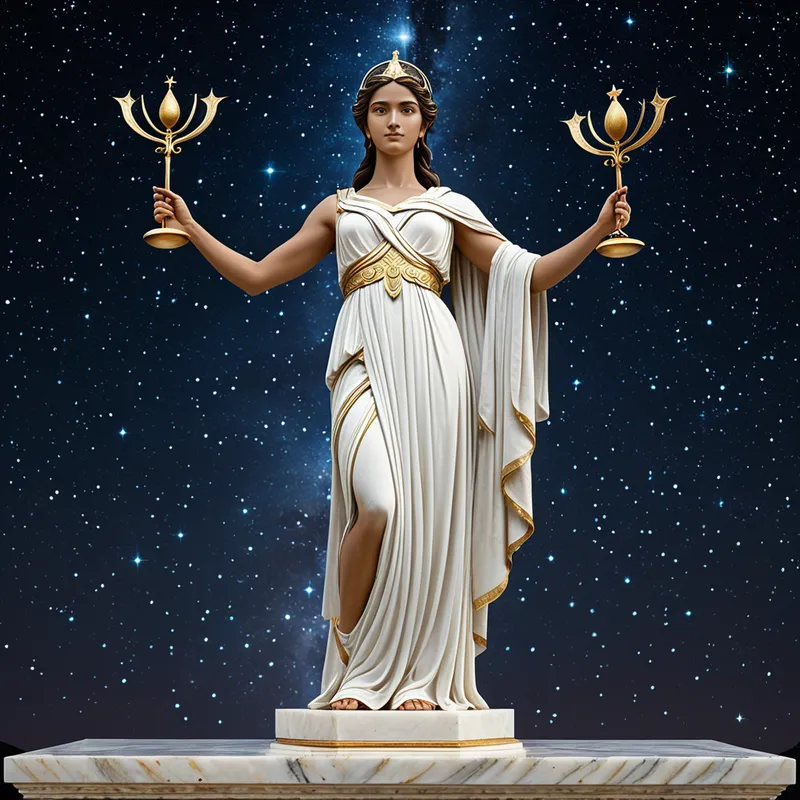
The Scales of Themis/Lady Justice Myth Meaning & Symbolism
The Titaness Themis holds the scales that weigh cosmic order against chaos, embodying the deep human need for a balanced and lawful reality.
The Tale of The Scales of Themis/Lady Justice
Before the halls of Zeus echoed with the boasts of heroes, before the first city-state laid its cornerstone, the world was raw potential. From this primal soup arose the Titans, and among them, a daughter of Uranus and Gaia who was not of storm or stone, but of a subtler, more binding substance. Her name was Themis. She did not command lightning or shake the seas; her domain was the invisible architecture of reality itself—the natural law, the sacred custom, the right way of things.
When the Olympians waged their terrible war and cast the old Titans into the abyss of Tartarus, a profound silence fell over the cosmos. Victory was won, but what was won? A throne atop a mountain of chaos. Zeus, the new king, wielded thunderbolts but lacked a throne’s true foundation. He looked out upon a universe ungoverned by anything but force, and in that moment, he felt the terrifying weight of his own power. It was a power that could create or annihilate on a whim, and a whim is a fragile thing upon which to hang the fate of all that is.
He remembered her then. Themis. She who had counseled his own mother to save him. She who had never raised a weapon, yet whose presence carried an authority that made even the boisterous gods lower their voices. He sought her out, not in a palace, but at the world’s omphalos—the world’s navel—where the veils between what is and what should be are thinnest.
There she sat, a figure of imperturbable calm. In her left hand, she held a set of scales, so finely wrought they seemed spun from moonlight and conscience. In her right, a sword, pointed ever downward. She did not speak of loyalty or tribute. She spoke of Balance. Of Measure. She spoke of the Dike—the way, the path, the consequence that follows every action as surely as night follows day.
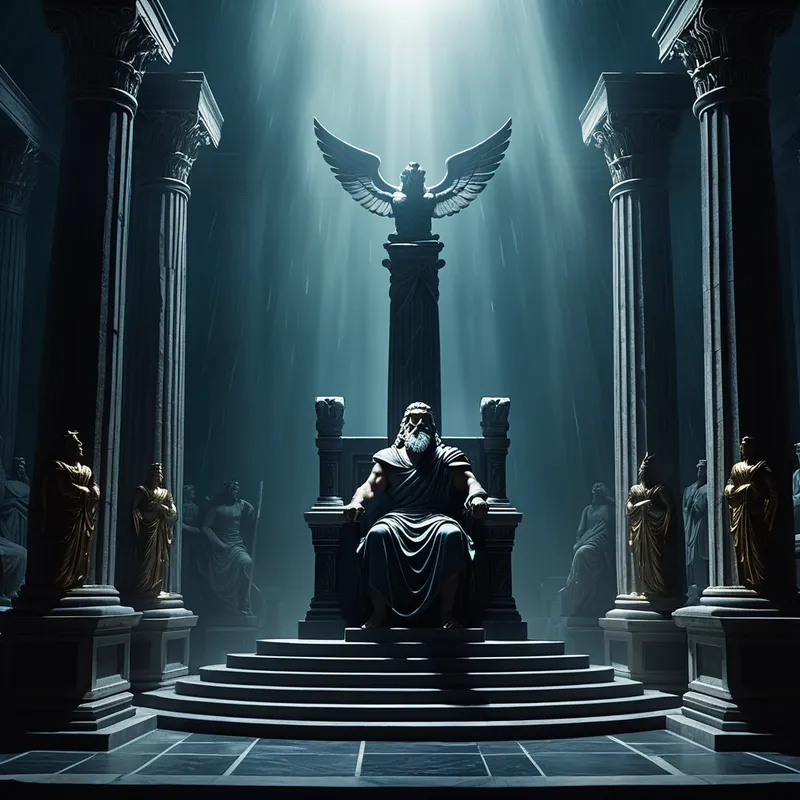
Zeus, the god of might, knelt before the goddess of right. He offered her a seat beside his throne, not as a consort of passion, but as his first and most vital counselor. And so, Themis ascended to Olympus. When disputes flared among the gods—when Poseidon and Athena quarreled over a city, when Ares’s rage threatened to spill beyond the battlefield—it was not Zeus’s thunder that stilled them first. It was the silent, solemn lifting of Themis’s scales. The combatants would fall silent, their eyes fixed on those two empty pans. Into one would go the claim, the argument, the desire. Into the other, the counterclaim, the law, the consequence. The air would grow still, charged with a terrible objectivity. The scales would tip, ever so slightly. And in their movement, conflict was not won, but resolved. Order was not imposed, but revealed.
Cultural Origins & Context
The figure of Themis is profoundly ancient, predating the Olympian pantheon itself. She is a Titan, a being of the old order who was integrated into the new, signifying that even revolutionary power must ultimately bow to foundational law. Her worship was not centered on grand temples filled with supplicants, but was embedded in the very fabric of Greek social and religious life.
She was the spirit of the themistes—the unwritten, divinely ordained rules and customs that governed everything from hospitality and oath-keeping to the proper rites for the gods. Her oracle at Delphi was said to have preceded even Apollo’s. When Apollo took over, he did so with Themis’s blessing, inheriting her mantle of prophetic order. In civic life, her scales became the metaphorical foundation of justice. Judges and arbitrators were seen as channeling her principle, aiming not for personal opinion but for the objective weighing of evidence (dike). Thus, the myth was not merely a story but a societal operating system, teaching that true authority flows from alignment with cosmic balance, not from mere strength.
Symbolic Architecture
The symbols held by Themis form a complete psychological and cosmological system. They are not tools of punishment, but instruments of revelation.
The scales do not create justice; they unveil the justice already inherent in the relationship between things.
The Scales represent the principle of objective measurement. They symbolize the mind’s capacity to hold two opposing truths, desires, or claims in simultaneous consideration. They are the antithesis of impulsive reaction. The empty pans signify that true judgment requires a space of receptive neutrality—what modern psychology might call observing ego. The act of weighing is a sacred hesitation, a ritualized space between stimulus and response where consciousness can enter.
The Sword, held downward in the right hand, is often misinterpreted as solely an instrument of punishment. Its position is critical. Pointed down, it represents the execution of the decision revealed by the scales. It is decisive action, cutting through ambiguity and enforcing the balance that has been discerned. It is will applied to insight. However, the downward orientation also roots this power, connecting it to the earth and reality, preventing it from becoming an arbitrary, sky-born tyranny.
Together, the Blindfold (a later Roman addition to the figure of Justitia) completes the triad: the scales for measure, the sword for action, the blindfold for impartiality. She does not see the status, wealth, or identity of the petitioners; she sees only the weight of their case in the cosmic balance. This is the archetype of the Ruler in its highest form: not a tyrant, but a steward of an order greater than themselves.

The Dreamer’s Resonance
When the scales of Themis appear in a modern dream, the dreamer is navigating a profound internal process of evaluation and moral-psychic reckoning. This is seldom about a literal courtroom.
Dreaming of calibrating or anxiously watching unbalanced scales often coincides with a life situation where two compelling values, paths, or obligations are in conflict (e.g., career vs. family, loyalty to self vs. loyalty to another, a safe past vs. an uncertain future). The somatic feeling is one of tension, of being “torn.” The psyche is attempting to objectively “weigh” these options on a deeper level than conscious pros-and-cons lists.
A dream where the scales tip decisively, or where a figure (perhaps unfamiliar) adjusts them, can signal the unconscious arriving at a resolution. This may precede a conscious decision, bringing a sense of destined clarity or, conversely, the sober acceptance of a difficult but necessary truth. The appearance of the sword in the dream can point to the recognized need for a clean, decisive cut—ending a relationship, quitting a job, or making a firm commitment—that will enact the balance sensed internally.
To dream of being Themis, holding the scales, suggests the dreamer is in a position of needing to adjudicate a situation in their waking life with extreme impartiality, perhaps between friends, family members, or parts of themselves. It is an invocation of the inner ruler who must prioritize systemic balance over personal preference.
Alchemical Translation
The journey of Themis from Titaness to Olympian counselor is a perfect allegory for the alchemical process of individuation. It models the transmutation of raw, unconscious power into wise, structured authority within the individual psyche.
Initially, our inner Zeus—the ego, the seat of consciousness and will—is all potent impulse. It conquers, desires, and acts without a governing principle. This leads to an inner kingdom of chaos, where conflicting impulses (the squabbling gods) create perpetual strife and anxiety. The “summoning of Themis” is the ego’s recognition that its power is destructive without an inner law. It is the moment we seek therapy, meditation, philosophy, or any discipline that introduces the principle of reflection before action.
Individuation is not the victory of one inner part over another, but the establishment of an inner court where all parts are heard and weighed.
The alchemical operation here is separatio followed by coniunctio. First, the scales (separatio):
- Weighing Shadow and Persona: Placing the unacceptable parts of ourselves (the shadow) in one pan and the acceptable social mask (the persona) in the other, seeking their true relational weight.
- Weighing Conscious and Unconscious: Holding a conscious attitude in one pan and an emerging dream symbol or intuition from the unconscious in the other.
This weighing is not to discard one for the other, but to find their just relationship. The resultant balance point is the coniunctio—the sacred marriage that produces a third, transcendent position. This is the “judgment,” the new conscious attitude that integrates both sides.
The sword is then the courage to live from this integrated position, to cut away old habits, relationships, or self-concepts that no longer serve the new, more balanced whole. It is the application of insight to life, forging a personal destiny that is not a whim, but a lawful expression of one’s deepest self. Thus, the individual becomes the rightful ruler of their own inner Olympus, not through suppression, but through the sacred, ongoing practice of divine balance.
Associated Symbols
Explore related symbols from the CaleaDream lexicon: