The Scales of Themis Myth Meaning & Symbolism
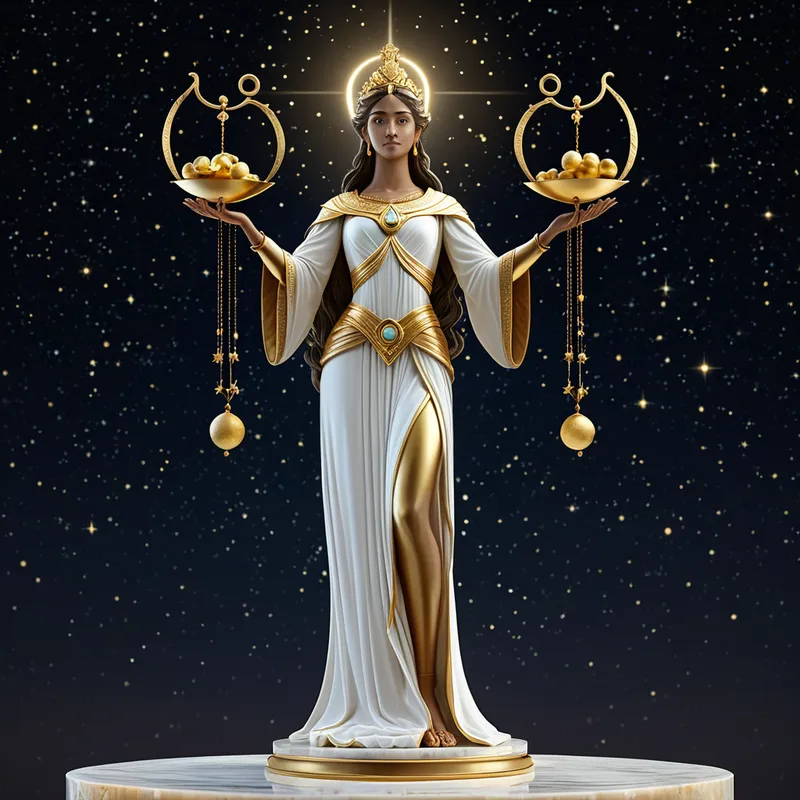
The Titaness Themis holds the scales that weigh truth from falsehood, embodying the divine principle of cosmic order and foundational justice.
The Tale of The Scales of Themis
Before the first city was built, before the first law was carved in stone, there was the foundation. Not of earth and rock, but of principle. In the age when the Titans held sway, one voice spoke not of power, but of pattern. Her name was Themis.
She did not dwell in the deep chasms like her brother, nor in the fiery forges. She stood in the space between breaths, in the silence after a question. Her temple was the very fabric of the cosmos, and her altar was the point of perfect equilibrium. When the young gods, the Olympians, wrested dominion from the old ones, chaos threatened to unmake the newborn world. Claims clashed like thunder, grievances swelled like the sea, and the raw, untamed forces of nature had no measure.
Then, Themis would step forward. Not with a weapon, but with an instrument. From the aether, she would summon them: the Scales. They were not forged of common gold, but of condensed starlight and the promise of dawn. The central beam was the axis of the world itself, and from it hung two pans, empty and waiting.
The air would still. The quarreling gods would fall silent, feeling the weight of her presence—a weight not of force, but of profound inevitability. With a gesture both gentle and absolute, she would gather the essence of a dispute—the searing heat of an accusation, the cool flow of a defense, the tangled threads of motive and action. These she would place, one by one, into the pans. The world watched. The scales did not judge; they revealed. They would dip, tremble, and then, with a finality that echoed in the bones of the earth, settle. The truth was not spoken; it was made visible, balanced against its counterpart for all to see. Her word, following this silent revelation, was not a verdict but a declaration of the order now made plain. She showed Zeus how to rule not by thunderbolt alone, but by this foundational balance. She showed Hestia how to center the home, and Poseidon how the sea must have its limits. Her scales measured the boundary between chaos and cosmos, and in their balance, civilization found its first, unwavering law.

Cultural Origins & Context
The figure of Themis is primordial, reaching back into the pre-Olympian, chthonic layers of Greek myth. She is a Titan, a daughter of Uranus and Gaia, which places her at the very origin of things. Her worship was not centered in grand temples filled with votive statues, as with later Olympians, but was woven into the fabric of civic and religious life. She represented themistes—the divine ordinances, the unwritten but inviolable laws of right conduct, hospitality, and proper ritual that were believed to be older than the gods themselves.
Her myth was not a single narrative told by bards for entertainment, but a foundational concept propagated through oracles (she was closely associated with the site of Delphi before Apollo) and embodied in the practice of law. Judges and rulers sought to channel Themis, to become vessels for her impartial balance. Her scales were the symbolic precursor to every courtroom, the ideal against which human justice was measured. In a society deeply concerned with order, fate, and avoiding the polluting chaos of hubris (excessive pride), Themis was the psychic and social anchor. She provided the assurance that the universe itself was not arbitrary, but operated on a principle of measurable, if often inscrutable, balance.
Symbolic Architecture
The Scales of Themis are not a tool of punishment, but an instrument of revelation. They symbolize the principle of dynamic equilibrium that underpins reality itself. Themis herself is not a judge in the modern sense, but the personification of the field in which judgment becomes possible. She is the precondition for justice.
The scales do not create balance; they make the existing balance, or profound imbalance, visible to the soul.
Her instrument works with several core symbolic pairs: truth and falsehood, claim and counterclaim, action and consequence, the individual and the collective. The act of weighing is an act of bringing hidden relational values into a shared visual field. Psychologically, Themis represents the superordinate function of the Self—the organizing principle of the psyche that seeks to integrate opposites, to move beyond the tyranny of one-sidedness. Her scales are the archetypal image of the ego’s necessary submission to a higher, transpersonal order. The beam that must remain impartial is the axis of consciousness itself, which must not be identified with the contents on either pan—be they our virtues or our vices, our aspirations or our resentments.

The Dreamer’s Resonance
When the image of scales—especially ancient, majestic, or impossibly large scales—appears in a modern dream, it signals a profound moment of intrapsychic reckoning. The dreamer is not necessarily in a legal dispute, but is in a state where an inner “case” is being tried. This is the psyche’s own court of equity.
Somatically, this process may feel like a pressure in the chest or a tightness in the gut—the physical sensation of a “weight” being carried. Psychologically, the dreamer is likely grappling with a moral dilemma, a life decision of great consequence, or the need to integrate two conflicting parts of themselves (e.g., career versus family, logic versus emotion, loyalty to self versus loyalty to others). The slow, oscillating movement of the dream scales reflects the unconscious process of weighing these factors, often with a deep, somatic wisdom the conscious mind lacks. A dream where the scales are violently unbalanced may point to a life situation or an internal state that feels profoundly unjust or unsustainable, urging a corrective rebalancing. A dream where they achieve perfect, silent balance often accompanies, or foreshadows, a hard-won inner resolution and peace.
Alchemical Translation
The alchemical process mirrored in this myth is not the dramatic solve et coagula (dissolve and coagulate) of destruction and rebirth, but the meticulous, essential operation of separatio and libra—separation and weighing. This is the less glamorous but utterly critical work of psychic distillation.
For the modern individual pursuing individuation—the process of becoming a coherent, whole Self—Themis’s scales model the necessary step of objective assessment. Before integration can occur, the contents of the psyche must be separated out and weighed. This means consciously placing our “gold” and our “lead” on the pans: our noble intentions against our shadowy motives, our love against our resentment, our need for security against our desire for freedom.
Individuation requires the courage to place every aspect of oneself, without exception, upon the sacred scale of self-honesty.
The triumph here is not a heroic victory, but the achievement of clarity. The “alchemical gold” produced is not a magical substance, but the stable, grounded consciousness that results from seeing oneself and one’s situation in true proportion. It is the internalization of Themis’s principle: the establishment of an inner temenos (sacred precinct) where the law is not one of punishment, but of natural consequence and equitable balance. To hold one’s own scales is to move from being a subject of fate to a steward of one’s own destiny, aligning the personal will with the impersonal, ordering wisdom of the Self. This is the quiet, mighty work of building a soul in balance.
Associated Symbols
Explore related symbols from the CaleaDream lexicon: