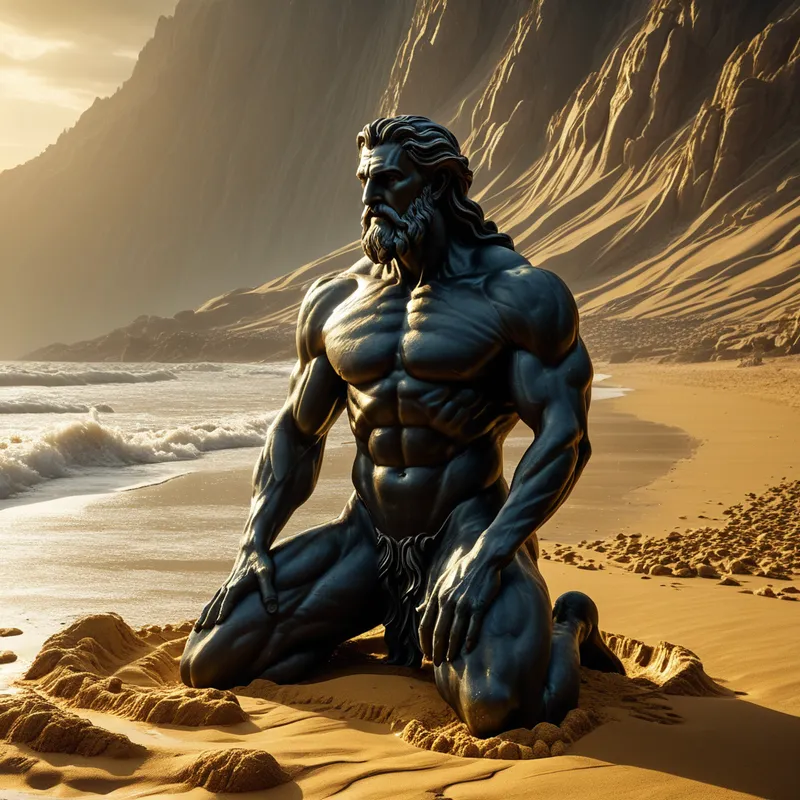
The Sands of Time Myth Meaning & Symbolism
A Titan's trick with sand steals the gift of immortality from humanity, forging our fate as mortal beings bound by time.
The Tale of The Sands of Time
Listen, and hear the whisper in the dust, the story written not on parchment, but in the very substance of our fleeting lives. In the age before ages, when the world was still soft from the hands of the gods, the great Titan Prometheus walked the lonely riverbanks. His heart, a forge of compassion, burned with a singular purpose. He looked upon the empty, fertile earth and saw not beasts, but potential. From the rich clay of the river Cephisus, he began to knead and shape. With fingers that had helped shape the stars, he sculpted a form in the image of the Olympians themselves—upright, gazing toward the heavens.
But this form was inert, a beautiful shell. It needed the divine spark, the pneuma, the breath of life. This, Prometheus bestowed, stealing a flicker of the celestial fire to animate his creation. Humanity drew its first breath, its eyes opening to a world of wonder and terror.
Yet, a shadow lay upon Prometheus's triumph. These new beings, his children, were vulnerable. They knew hunger, cold, and fear. To secure their place in the cosmic order, a pact had to be made with the king of gods, Zeus. The time came to decide what gifts humanity would receive, what portion of divine essence would be theirs.
Zeus, in his remote majesty, decreed a ritual of division. A great bull was sacrificed, and from it, two portions were prepared. One portion contained the rich, nourishing meat and organs, hidden beneath the unappealing, rough stomach of the ox. The other was a magnificent pile of white bones, expertly wrapped and glistening with a lavish covering of shining fat. Zeus, with a gaze that saw all yet could be deceived, was offered first choice. He saw the splendid, glistening bundle and claimed it for the gods, leaving the humble, messy package for mankind. When he unwrapped his prize to find only bare bones, his wrath was a thunderclap that shook the foundations of Olympus. But the law of first choice was sacred; he could not take back the meat.
In his fury, Zeus withheld the final, most crucial gift: the secret of immortality. He hid it away. But Prometheus, the fore-thinker, was not finished. He journeyed to the secret place where the substance of eternity was kept. He found not a flame or a fruit, but two urns. One, crafted by the divine smith Hephaestus, was of gleaming, imperishable gold. It was filled with the Sands of Immortality, each grain a crystal of endless time. The other was a simple, coarse vessel of baked clay.
With a cunning born of love and desperation, Prometheus acted. Under the watchful eye of a sun he convinced to look away for a moment, he switched the contents. He poured the immortal sands into the fragile clay urn, and filled the sturdy golden urn with ordinary dust from the earth. He presented both to Zeus.
The Lord of the Sky, still simmering from the first trick, examined the offerings. He saw the humble clay vessel and the glorious golden one. Certain that the precious gift would be in the stronger, more beautiful container, he granted the golden urn to the gods, and the clay urn to humanity. When the urns were opened, the truth was revealed. The immortal sands were forever bound to the brittle vessel of human life. The gods retained their eternal youth in their golden prison of bones and fat, while humanity received the sublime, tragic gift: a finite measure of glorious, conscious life, poured into a body of clay. We are the children of the clay urn, living our brilliant, brief lives one precious grain of sand at a time.

Cultural Origins & Context
This profound myth, interwoven with the broader narrative of Prometheus’s benefaction, finds its roots in the poetic works of Hesiod, particularly the Theogony and Works and Days. It is a foundational etiological myth, answering the most haunting human question: why do we die? In the oral tradition of ancient Greece, recited by bards and later codified by poets, this story served a crucial societal function. It explained the fundamental and painful divide between the divine and the mortal condition, justifying the human lot of labor, sickness, and death as the result of a primordial divine conflict.
More than mere explanation, it established the complex Greek relationship with the gods—one of reverence mingled with a sense of inherent injustice and tragic separation. The myth places humanity squarely in a middle world: fashioned with divine aid, possessing stolen divine fire (intelligence and technology), yet irrevocably bound by a mortal fate sealed through trickery. It framed human existence as inherently heroic and tragic, a finite spark of consciousness aware of its own inevitable extinction.
Symbolic Architecture
The myth’s power lies in its stark, alchemical symbolism. The two urns represent the fundamental duality of existence. The Golden Urn is the appearance of perfection, the lure of the eternal, untouchable, and static. It is the realm of the gods, beautiful but ultimately sterile—containing only "bones and fat," the inedible show of power. The Clay Urn is the reality of the mortal condition: fragile, earthly, humble, yet containing the true substance of life.
The Sands of Time are not merely a measure of duration; they are the granular substance of experience itself. Each grain is a moment of joy, sorrow, love, and loss—the very stuff of a soul.
Prometheus’s trick is the birth of human consciousness. By securing the sands for the clay vessel, he did not make us immortal; he made us aware. We are the only creatures who know we hold a finite amount of sand. This knowledge is the stolen fire—it ignites ambition, art, love, and the desperate, beautiful urge to create meaning before the last grain falls. The "trick" is thus the installation of the existential condition: the glorious, painful burden of self-awareness within a decaying form.

The Dreamer's Resonance
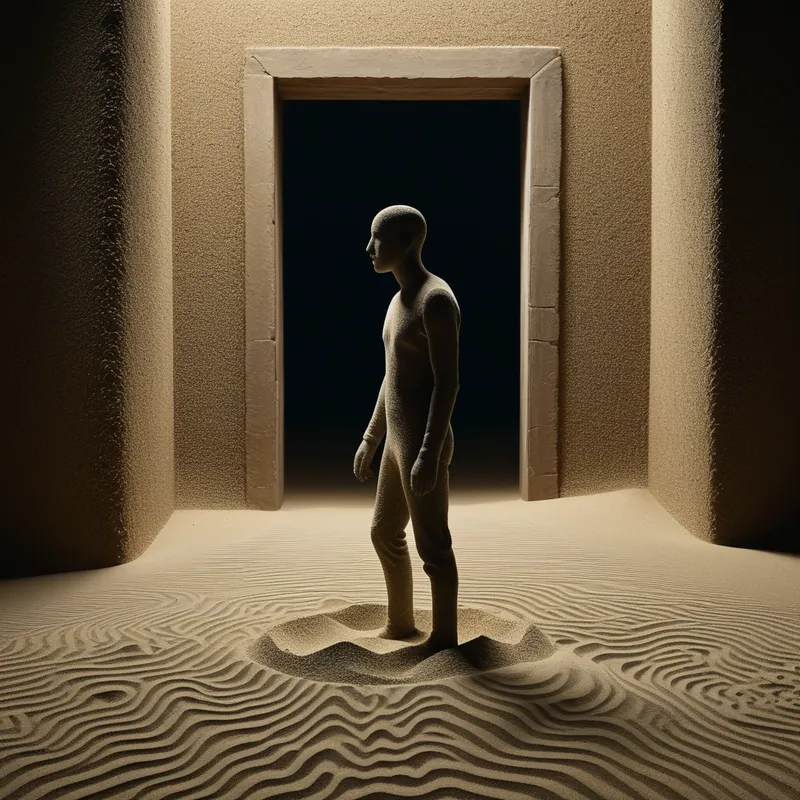
When this myth stirs in the modern unconscious, it manifests in dreams of profound somatic and psychological transition. One may dream of an hourglass cracking, of trying to gather spilled sand that slips through one’s fingers, or of standing before two doors—one ornate and cold, the other plain but radiating a warm, fearful light. These are dreams of life-stage passages: the midlife crisis, the diagnosis of illness, the birth of a child, or the confrontation with aging.
The somatic feeling is often one of granular disintegration—a sense of the self as not a solid "I," but a temporary collection of moments threatening to scatter. Psychologically, this is the ego confronting the reality of the shadow of time, the repressed knowledge of mortality. The dreamwork is an attempt by the psyche to reconcile with this fundamental condition, to stop fighting the fragile clay of one’s body and life, and to begin valuing the sand within.
Alchemical Translation
The individuation process modeled here is the transmutation of lack into essence. The core struggle is accepting the "trick" as the foundation of our humanity, not its curse. The alchemical work begins when we stop yearning for the golden urn—the illusion of perfect, unchanging, god-like stasis (perfect health, eternal youth, absolute security)—and turn our attention to the clay urn we already possess.
The great work is not to become gold, but to become conscious of the sacredness of the clay and the priceless quality of the sand it holds.
This involves a sacred accounting: taking stock of our remaining sand not with anxiety, but with reverence. It means pouring that sand into the vessels of relationship, creativity, and service—using the fire of consciousness to warm the brittle clay of our existence from within. The triumph is not immortality, but integration. The mortal, who fully accepts their finite, grainy, clay-bound nature, achieves a paradoxical wholeness. They stop living in the shadow of the gods and start authoring a human-sized destiny. In embracing the trick, we defeat its sting. We discover that the Sands of Time were never meant to grant eternity, but to compel depth, and that a life fully lived in conscious mortality holds a richness the eternal gods can never know.
Associated Symbols
Explore related symbols from the CaleaDream lexicon: