The Sand Mandala Myth Meaning & Symbolism
A sacred, intricate world is painstakingly built from colored sand, only to be offered to the winds in a final, liberating act of non-attachment.
The Tale of The Sand Mandala
Listen, and let the story settle in the space behind your eyes.
In a high, silent place where the air is thin and the mountains touch [the sky](/myths/the-sky “Myth from Persian culture.”/), a sacred space is cleared. Not with brooms, but with breath and bell and the low, resonant chant that calls [the world](/myths/the-world “Myth from Tarot culture.”/) to attention. Upon a platform, a design is drawn—a blueprint of a universe. It begins as a memory in the mind, a vision of a perfect, ordered cosmos, a palace where enlightenment itself resides.
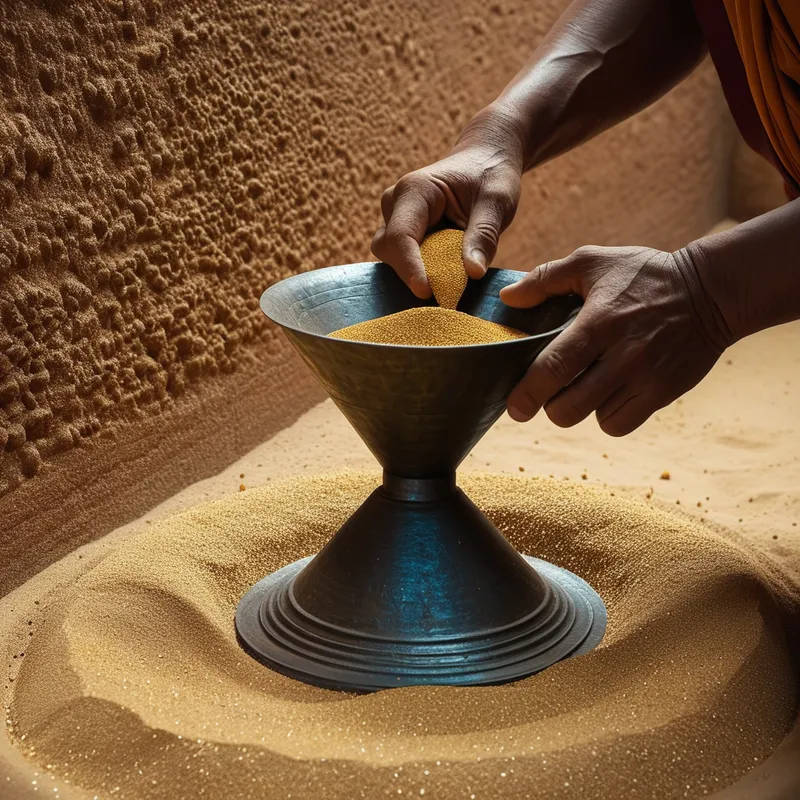
Then, the work begins. It is a work not of building, but of whispering. The artisans—monks with eyes of deep calm—take up their tools: slender, metal chak-pur. They fill them with sand, ground from precious stone—lapis lazuli for the boundless sky, malachite for the living earth, coral for the pulse of life, gold for the sun’s heart. Grain by single grain, they converse with [the void](/myths/the-void “Myth from Buddhist culture.”/). They lean close, and with a gentle rasp of metal on metal, they persuade the sand to fall. It is a sound like a distant waterfall, like the sigh of time itself.
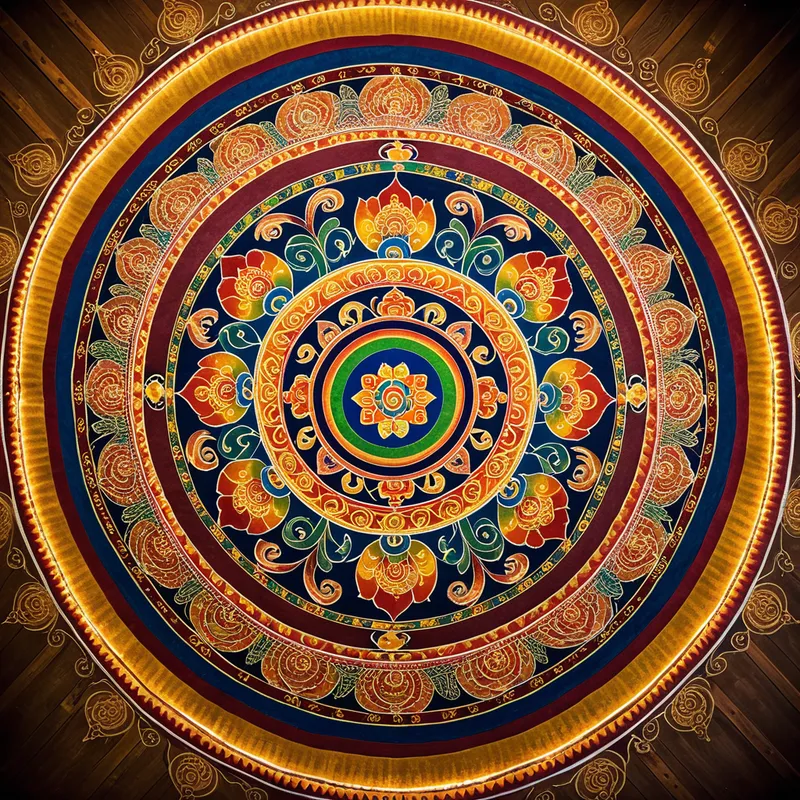
For days, for weeks, the world is born under their hands. Walls of rainbow light rise to form the palace. Gates open to the four directions, guarded by Dharmapalas and adorned with symbols of endless knot and [lotus](/myths/lotus “Myth from Hindu culture.”/). At the very center, a seed syllable or the form of a Buddha emerges, [the axis mundi](/myths/the-axis-mundi “Myth from Chinese culture.”/) of this meticulously imagined realm. The air hums with concentration. Each grain is placed with an intention, a prayer, a fragment of a [sutra](/myths/sutra “Myth from Hindu culture.”/). This is not decoration; it is invocation. They are not making a picture; they are summoning a presence, constructing a vessel for the divine to inhabit.
The final grain is placed. The universe is complete. It sits in radiant, fragile perfection. The monks circle it, their chants now songs of praise and fulfillment. The deity is invited, visualized, present in the intricate lattice of color and form. [The mandala](/myths/the-mandala “Myth from Architectural culture.”/) lives. It breathes with the sacred.
Then, the moment arrives. The chant changes. The prayers turn to ones of gratitude and release. The head monk takes a [vajra](/myths/vajra “Myth from Hindu culture.”/), a ritual dagger that cuts through illusion. He draws a line through the beauty, breaking the symmetry. He begins at the edges, sweeping the colored sands inward, collapsing the gates, dissolving the walls, gathering the palace of the gods back into a mound of mere sand. The vibrant cosmos of weeks is undone in minutes. The sands are collected in a urn, carried to a flowing river, and poured into the current. [The wind](/myths/the-wind “Myth from Various culture.”/) takes the last, dust-like remnants. The universe is offered back. Nothing remains on the platform but a memory and a blank, open space.
Cultural Origins & Context
This practice, a pinnacle of Vajrayana Buddhist ritual, originates in the tantric traditions of India, entering Tibet around the 8th century CE. It is not a single, codified “myth” in a narrative sense, but a living myth—a performative, ritual drama that enacts the core tenets of Buddhist philosophy. The knowledge is passed down through unbroken lineages from master to disciple, contained in sacred texts called sadhanas.
Its societal function is multifaceted. For the monastic community, it is a supreme exercise in concentrated meditation, artistic skill, and philosophical understanding. For the lay community who witnesses it, it is a powerful, visceral teaching. The ritual transforms abstract doctrine—anicca ([impermanence](/myths/impermanence “Myth from Buddhist culture.”/)), anatta (non-self), and the perfection of generosity—into a tangible, breathtaking spectacle. It is a public ceremony that maps the journey from ordinary perception to enlightened vision and back again, demonstrating that the most profound wisdom is not in clinging to beauty, but in understanding its essential, empty nature.
Symbolic Architecture
The [Sand](/symbols/sand “Symbol: Sand in dreams often symbolizes time, transience, or the foundation of life and the fluidity of existence.”/) [Mandala](/symbols/mandala “Symbol: A sacred geometric circle representing wholeness, the cosmos, and the journey toward spiritual integration.”/) is a [multi](/symbols/multi “Symbol: Multi signifies multiplicity and diversity, often representing various aspects of life or identity in dreams.”/)-layered symbolic engine. Architecturally, it is a cosmogram. The outer rings often represent the elemental forces and the cycle of suffering ([samsara](/myths/samsara “Myth from Buddhist culture.”/)), while the inner [palace](/symbols/palace “Symbol: A palace symbolizes grandeur, authority, and the pursuit of one’s ambitions or dreams, often embodying a desire for stability and wealth.”/) is the Buddhafield, a map of the enlightened mind itself. The process is the [symbolism](/symbols/symbolism “Symbol: The use of symbols to represent ideas or qualities, often conveying deeper meanings beyond literal interpretation. In dreams, it’s the language of the unconscious.”/).
The act of creation is the act of visualization: building order from chaos, manifesting a perfected reality from the raw materials of perception.
The monks are not artists; they are yogis. Each [grain](/symbols/grain “Symbol: Represents sustenance, growth cycles, and the foundation of civilization. Symbolizes life’s harvest, patience, and transformation from seed to nourishment.”/) of sand represents a [moment](/symbols/moment “Symbol: The symbol of a ‘moment’ embodies the significance of transient experiences that encapsulate emotional depth or pivotal transformations in life.”/) of [consciousness](/symbols/consciousness “Symbol: Consciousness represents the state of awareness and perception, encompassing thoughts, feelings, and experiences.”/), a single thought or [perception](/symbols/perception “Symbol: The process of becoming aware of something through the senses. In dreams, it often represents how one interprets reality or internal states.”/). The meticulous placement is the training of the mind—focus, patience, and the [intention](/symbols/intention “Symbol: Intention represents the clarity of purpose and direction in one’s life and can symbolize motivation and commitment within a dream context.”/) to see the world not as fragmented, but as an interconnected, sacred whole. The central deity symbolizes one’s own innate [Buddha](/symbols/buddha “Symbol: The image of Buddha embodies spiritual enlightenment, peace, and a quest for inner truth.”/)-[nature](/symbols/nature “Symbol: Nature symbolizes growth, connectivity, and the primal forces of existence.”/), the potential for awakening that resides at the core of our being.
The [dissolution](/symbols/dissolution “Symbol: The process of breaking down, dispersing, or losing form, often representing transformation, release, or the end of a state of being.”/), however, is the [heart](/symbols/heart “Symbol: The heart symbolizes love, emotion, and the core of one’s existence, representing deep connections with others and self.”/) of the teaching. It is the active, ritualized practice of non-attachment. It demonstrates that the sacred palace was never “out there”; it was always a [projection](/symbols/projection “Symbol: The unconscious act of attributing one’s own internal qualities, emotions, or shadow aspects onto external entities, people, or situations.”/) of the mind. To destroy it is to realize that enlightenment is not a place to arrive at, but a quality of seeing through all constructs.
The offering of the sand to the river is the ultimate generosity: giving back the entire universe, keeping nothing for the self.
The Dreamer’s Resonance
When this myth surfaces in modern dreams, it rarely appears as a literal [mandala](/myths/mandala “Myth from Buddhist culture.”/). Instead, one might dream of painstakingly building something exquisite—a model, a career, a relationship, an identity—only to watch it be swept away by a tide, a wind, or an inexplicable internal command. The somatic feeling is often one of acute tension during the “building” phase, a prideful but fragile completion, followed by a profound, sometimes terrifying, release during the “dissolution.”
Psychologically, this dream pattern signals a deep process working through the [psyche](/myths/psyche “Myth from Greek culture.”/): the confrontation with the enantiodromia, where any conscious position held too long generates its opposite. [The ego](/myths/the-ego “Myth from Jungian culture.”/) has invested immense energy in constructing a particular self-image or life structure. The unconscious, in its wisdom, is now orchestrating its deconstruction. The dream is not a prophecy of literal loss, but an initiation into the necessity of release. It asks the dreamer: What have you built that you must now, for your own soul’s growth, learn to let flow through your fingers?
Alchemical Translation
For the modern individual on the path of individuation, the [Sand Mandala](/myths/sand-mandala “Myth from Buddhist culture.”/) is a masterful model of psychic transmutation. [The first stage](/myths/the-first-stage “Myth from Alchemical culture.”/)—the careful, intentional creation—mirrors the conscious work of building the ego: developing skills, forming values, crafting a [persona](/myths/persona “Myth from Greek culture.”/) that can function in the world. This is necessary and sacred work.
The alchemical magic, however, happens in the ritual destruction. This is the stage of shadow-work and the encounter with [the Self](/myths/the-self “Myth from Jungian culture.”/). It is the voluntary de-identification from the very structures the ego worked so hard to build. The career you identified with, the role you played, the narrative you told about your life—these are your sand palaces.
The transmutation is not in the palace, but in the courage to sweep it away. The gold is not in the finished form, but in the act of release itself.
The offering to [the river](/myths/the-river “Myth from Buddhist culture.”/) symbolizes the final stage: integration. The released sands do not vanish; they re-join the flow of life, the great river of the unconscious, now carrying the blessing of your conscious work within them. The ego, having willingly sacrificed its prized creation, does not end up impoverished. It finds itself paradoxically enriched, no longer identified with a fragile structure but participating in the boundless flow. The platform is empty, and in that spacious, clean-swept emptiness lies the potential for a new, more authentic creation—not as a fortress for the ego, but as a temporary, beautiful expression of a self that knows it is part of the endless, gracious cycle of forming and unforming.
Associated Symbols
Explore related symbols from the CaleaDream lexicon: