The Samhain Bonfire Myth Meaning & Symbolism
A king must kindle a sacred fire to save his people from a winter of death, confronting the spirits of the land to forge a new covenant.
The Tale of The Samhain Bonfire
Listen. [The wind](/myths/the-wind “Myth from Various culture.”/) carries the memory of it, a whisper of smoke and frost. It was on the night when the [sídhe](/myths/sdhe “Myth from Celtic / Irish culture.”/) grew thin as a moth’s wing, when summer’s breath finally fled before the coming teeth of winter. In the kingdom of Tara, the people huddled, not from cold, but from a deeper chill. [The hearth](/myths/the-hearth “Myth from Norse culture.”/)-fires of every home had been doused, one by one, until not a single spark glowed in the land. It was [the law](/myths/the-law “Myth from Biblical culture.”/), and it was the curse. For the Aos Sí demanded it so. Without their blessing, no flame could catch, no seed would sprout, and the long dark would be a dark of bones.
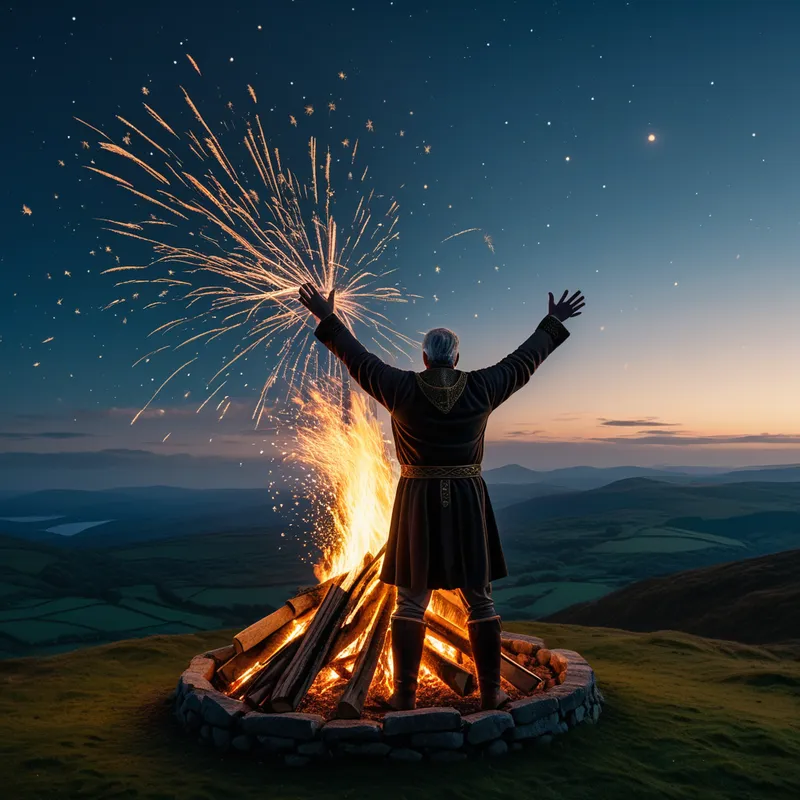
The king, a man whose crown felt heavier than stone, climbed the sacred hill of Teamhair. His cloak was the grey of the gathering dusk. At [the summit](/myths/the-summit “Myth from Taoist culture.”/), a circle of ancient stones stood sentinel around a pit of cold, black ash. This was the place of the Tine Chnamh, the Fire of Bones. His task was to kindle it anew, to bargain with the unseen for the life of his people. But the wind stole his breath, and the tinderbox in his hand felt like a child’s toy against the immensity of the dying year.
He struck the flint. A spark died. He struck again. Nothing. The shadows in the stones seemed to lean closer, whispering of failure. He knew then that this was no mere lighting of a fire. This was a summoning. He cast aside the tinderbox. From his belt, he drew a knife, its edge honed not for battle, but for oath. He cut a lock from his own hair, the colour of faded gold, and laid it upon the ash. “A life for a life,” he murmured, not to [the sky](/myths/the-sky “Myth from Persian culture.”/), but to [the earth](/myths/the-earth “Myth from Hindu culture.”/) beneath his feet. “My sovereignty for their warmth.”
He struck the flint a third time. The spark fell upon the hair. For a heartbeat, nothing. Then, a sizzle, a tiny thread of smoke that smelled of lightning and old forests. A flame, blue and hesitant, trembled into life. It did not roar. It listened.
And the hill listened back. From the stones, forms emerged—not quite solid, shimmering like heat haze. The Cailleach, the Old One of Winter, stood before him, her eyes deep wells of frost. Beside her, the Dagda, his great club rooted in the soil, watched with a face as impassive as the land itself. They were the spirits of the place, the true rulers of this threshold.
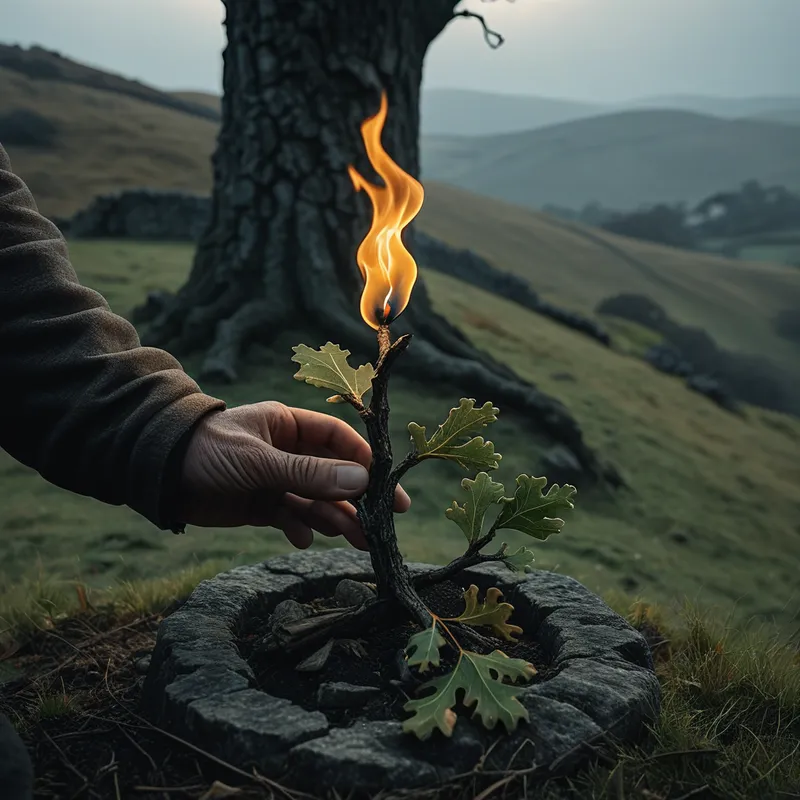
The king did not flinch. He fed the tiny flame with dry oak leaves, then with a branch of sacred hazel. As the fire grew, so did the presence of the Others. They did not speak with words, but with visions that flashed in the heart of the flames: the green promise of Beltane, the full bounty of [Lughnasadh](/myths/lughnasadh “Myth from Celtic culture.”/), the decay that feeds new growth. The fire became a gateway, a roaring, spinning wheel of time and season.
The king thrust his staff into the heart of the blaze. When he pulled it out, its tip was a blazing brand. He raised it high, a single point of defiance and prayer against the starless sky. From that one fire on the hill, runners took torches and sped like falling stars down into the valley, to relight every hearth in the kingdom. The covenant was struck. The winter would come, but it would not be endless. The people would live. The king stood in the light of his own making, his shadow stretching long behind him, a bridge between [the world](/myths/the-world “Myth from Tarot culture.”/) of flesh and the world of spirit.
Cultural Origins & Context
The myth of the [Samhain](/myths/samhain “Myth from Celtic culture.”/) bonfire is not a single, codified story from a ancient text, but a tapestry woven from folklore, archaeological inference, and the recorded practices of the early medieval Irish. Samhain (pronounced sow-in), marking the end of the pastoral year and the beginning of winter, was one of the four great cross-quarter days. It was a time of profound communal importance, where the boundaries of the tribe were reaffirmed through a sacred, and perilous, ritual.
The central practice was the extinguishing of all domestic hearth fires. The community’s vitality was symbolically gathered into a single point—the druid-kindled bonfire on a tribal hilltop, often at a site like Tara or Cruachan. This was no mere celebration; it was a thermodynamic prayer. The fire represented the concentrated life-force and sovereignty of the people and their land. By kindling it through specific rites (which likely involved friction from sacred woods like oak), [the druids](/myths/the-druids “Myth from Celtic culture.”/) and the king were performing a act of cosmic diplomacy with the Aos Sí, who were believed to be particularly active and close to the human world at this time.
The myth, as a narrative, served as the sacred charter for this ritual. It explained why the ritual was necessary (to avert cosmic winter), defined the role of the sovereign as the intermediary between people and gods, and encoded the terrifying stakes of failure. It was a story told not just for entertainment, but for survival, reinforcing the social order and the sacred contract with the land itself.
Symbolic Architecture
At its core, the myth is a [drama](/symbols/drama “Symbol: Drama signifies narratives, emotional expression, and the exploration of human experiences.”/) of sovereignty and sacrifice. The [king](/symbols/king “Symbol: A symbol of ultimate authority, leadership, and societal order, often representing the dreamer’s inner power or external control figures.”/) is not a [warrior](/symbols/warrior “Symbol: A spiritual archetype representing inner strength, discipline, and the struggle for higher purpose or self-mastery.”/)-[hero](/symbols/hero “Symbol: A hero embodies strength, courage, and the ability to overcome significant challenges.”/), but a [priest](/symbols/priest “Symbol: A priest symbolizes spirituality, guidance, and the quest for understanding the deeper meanings of life.”/)-[king](/symbols/king “Symbol: A symbol of ultimate authority, leadership, and societal order, often representing the dreamer’s inner power or external control figures.”/), whose primary [weapon](/symbols/weapon “Symbol: A weapon in dreams often symbolizes power, aggression, and the need for protection or defense.”/) is [ritual](/symbols/ritual “Symbol: Rituals signify structured, meaningful actions carried out regularly, reflecting cultural beliefs and emotional needs.”/) and whose battlefield is the liminal [space](/symbols/space “Symbol: Dreaming of ‘Space’ often symbolizes the vastness of potential, personal freedom, or feelings of isolation and exploration in one’s life.”/) between worlds.
The sacred fire is not lit against the dark, but is born from a covenant with it. It is the conscious point of contact between the human realm of order and the chaotic, ancestral potency of the Otherworld.
The extinguishing of all hearth fires symbolizes a collective surrender, a voluntary return to a primordial, unified state. All individual [identity](/symbols/identity “Symbol: Identity represents the sense of self, encompassing personal beliefs, cultural background, and social roles.”/) and warmth is given up to face the unknown together. The king’s personal sacrifice—his [hair](/symbols/hair “Symbol: Hair often symbolizes identity, power, and self-expression, reflecting how we perceive ourselves and how we wish to be perceived by others.”/), his pride, his claim to autonomous power—represents the necessary offering of [the ego](/myths/the-ego “Myth from Jungian culture.”/) to a [reality](/symbols/reality “Symbol: Reality signifies the state of existence and perception, often reflecting one’s understanding of truth and life experiences.”/) greater than itself. The [hair](/symbols/hair “Symbol: Hair often symbolizes identity, power, and self-expression, reflecting how we perceive ourselves and how we wish to be perceived by others.”/), in particular, is a powerful [symbol](/symbols/symbol “Symbol: A symbol can represent an idea, concept, or belief, serving as a powerful tool for communication and understanding.”/) of personal vitality and [strength](/symbols/strength “Symbol: ‘Strength’ symbolizes resilience, courage, and the ability to overcome challenges.”/), an offering of one’s very substance.
The [bonfire](/symbols/bonfire “Symbol: A bonfire symbolizes warmth, community, and the celebration of gatherings, often illuminated by the flame of shared experiences.”/) itself is the [axis](/symbols/axis “Symbol: A central line or principle around which things revolve, representing stability, orientation, and the fundamental structure of reality or consciousness.”/) mundi of the tribe. It is the fiery navel of the world, from which all [life](/symbols/life “Symbol: The symbol of ‘Life’ represents a journey of growth, interconnectedness, and existential meaning, encompassing both the joys and challenges that define human experience.”/) and light radiates [outward](/symbols/outward “Symbol: Movement or orientation away from the self or center; expansion, expression, or externalization of inner states into the world.”/) once more. Its kindling is an act of creation ex nihilo, mirroring the first spark of [consciousness](/symbols/consciousness “Symbol: Consciousness represents the state of awareness and perception, encompassing thoughts, feelings, and experiences.”/) igniting in the dark waters of the unconscious. The spirits who appear—the Cailleach and the Dagda—are personifications of the archetypal forces of [nature](/symbols/nature “Symbol: Nature symbolizes growth, connectivity, and the primal forces of existence.”/): the destructive, transformative power of time ([the Cailleach](/myths/the-cailleach “Myth from Celtic culture.”/)) and the abundant, sustaining ground of being ([the Dagda](/myths/the-dagda “Myth from Celtic culture.”/)). To treat with them is to acknowledge the full [spectrum](/symbols/spectrum “Symbol: A continuum of possibilities, representing diversity, transition, and the full range of existence from one extreme to another.”/) of reality, not just the comfortable parts.
The Dreamer’s Resonance
When this mythic pattern stirs in the modern [psyche](/myths/psyche “Myth from Greek culture.”/), it often manifests in dreams of profound transition and responsibility. You may dream of being tasked with lighting a fire that refuses to catch, while a crowd of shadowy figures watches silently. You may find yourself in a cold, dark house, knowing you must venture outside into a terrifying but necessary night to find the one spark. The somatic feeling is one of deep, anxious chill in the chest, coupled with a fierce, focused determination.
Psychologically, this signals a liminal phase where old structures, identities, or “hearths” (jobs, relationships, self-concepts) have grown cold and must be consciously surrendered. The dream-ego is being called to the “hilltop”—a place of solitary accountability—to perform the difficult ritual of creating a new center. The watching spirits represent the unconscious contents (memories, complexes, innate potentials) that must be acknowledged and integrated for the new fire to burn cleanly. It is a dream of sovereignty, asking: What must you personally sacrifice to reign authentically over your own life? What ancient, ignored part of your psyche holds the tinder for your renewal?
Alchemical Translation
The myth of the Samhain Bonfire is a perfect allegory for the Jungian process of individuation, specifically the ordeal of confronting the unconscious to reclaim one’s authentic authority.
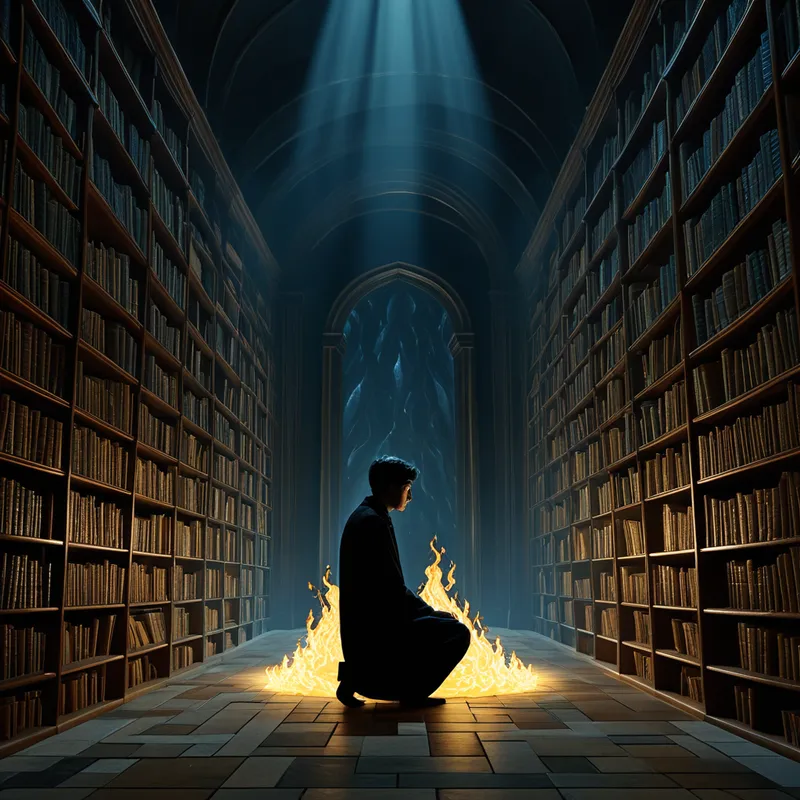
The first alchemical stage, [nigredo](/myths/nigredo “Myth from Alchemical culture.”/), is represented by the extinguished hearths—[the dark night of the soul](/myths/the-dark-night-of-the-soul “Myth from Christian Mysticism culture.”/), a state of depression, confusion, or meaninglessness where all previous sources of light and warmth fail. The ego is plunged into the [prima materia](/myths/prima-materia “Myth from Alchemical culture.”/) of raw, unorganized psychic experience.
The king’s ascent to the hilltop is the conscious decision to engage with this darkness, to move toward the center of the crisis rather than flee from it. The kindling struggle is the mortificatio, the symbolic death of the old, inflated ego (represented by the sacrifice of his hair). The ego must humble itself, offer up its pretensions, to make contact with the transformative spark.
The fire that is finally lit is the lapis philosophorum, the philosopher’s stone of the psyche. It is not the old ego-reign restored, but a new, tempered consciousness forged in the meeting of the personal will and the transpersonal archetypes.
The appearance of the Cailleach and the Dagda is the critical encounter with the anima/animus and the Senex archetypes. Integrating their lessons—acceptance of life’s cycles, connection to the instinctual ground—is what transmutes the lead of psychic chaos into the gold of wisdom. Finally, the distribution of the fire represents the multiplicatio, the stage where the integrated consciousness radiates out, renewing and re-ordering all aspects of one’s life. The individual becomes a true sovereign, not by dominating the inner landscape, but by faithfully tending [the sacred fire](/myths/the-sacred-fire “Myth from Native American culture.”/) at its center, in perpetual covenant with the vast and ancient dark.
Associated Symbols
Explore related symbols from the CaleaDream lexicon: