The Salmon of Wisdom Myth Meaning & Symbolism
A magical salmon gains all the world's knowledge. A young poet's quest to taste it reveals the price and power of true wisdom.
The Tale of The Salmon of Wisdom
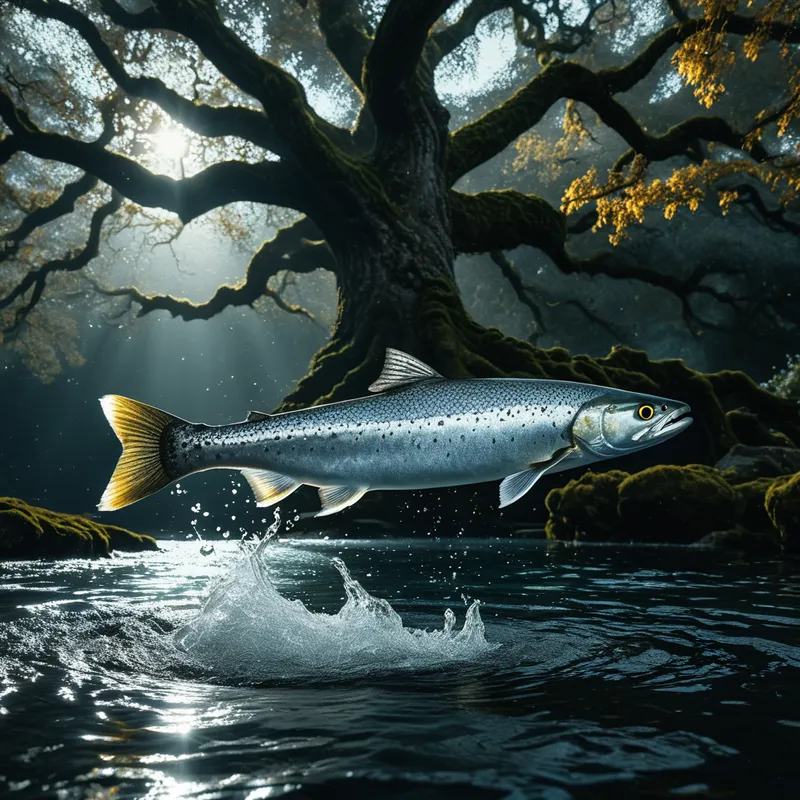
Listen. In the deep time of the Tuatha Dé Danann, when the world was still singing its first songs, there was a pool. Not just any pool, but the Pool of Segais, where nine sacred hazel trees dropped their nuts of crimson knowledge into the dark water. The nuts were eaten by a salmon—a singular, ancient fish, whose silver scales began to glow with every nut consumed. With each one, it absorbed all the knowledge in the world: the history of every stone, the true name of every wind, the secret thoughts of every heart. It became the Salmon of Fintan.
This was known to the great druid and poet, Finegas. For seven long years, he camped on the banks of the Boyne, his nets cast, his eyes weary from watching the shimmering currents. His soul ached for the salmon’s wisdom, for the poet’s power that came not from study, but from a taste of the divine.
Into his solitude came a youth, Fionn mac Cumhaill, sent to learn the arts of poetry and war. The old druid saw the boy’s potential, a bright, untamed flame. He taught him, and the boy served him, and together they watched the river.
Then, on a day when the light fell in spears through the oak leaves, Finegas’s net grew heavy. He hauled it in, his old hands trembling. There it was—the Salmon, its body a ripple of captured moonlight, its eye holding the depth of the night sky. A profound silence fell upon the wood. Finegas, with reverence, kindled a fire of rowan wood. He spitted the sacred fish and gave Fionn a solemn charge: “Turn the salmon, boy, but on your life, do not taste it. The first taste is mine, and the wisdom with it.”
Fionn obeyed, turning the spit as the skin crackled and blistered gold. But a blister rose, burst, and a drop of hot fat leapt onto his thumb. With a gasp of pain, he thrust his thumb into his mouth.
The world dissolved.
It was not a thought, but an inundation. He knew the turning of the stars before they turned. He heard the root-songs of the mountains. He saw the tangled threads of past and future, the sorrows of kings and the laughter of hidden streams. The knowledge of the Salmon flooded into him, a river through the door of a single, burned thumb.
When Finegas saw the boy’s eyes—no longer a youth’s eyes, but the eyes of an ancient, knowing soul—he wept. Not with anger, but with the bittersweet recognition of destiny. The wisdom had chosen its vessel. The old sage’s long vigil was over; the new poet-king was born. He named him Fionn, “the Fair One,” and bowed to the will of the world. The gift had passed, not by theft, but by the painful, accidental grace of a scalded hand.

Cultural Origins & Context
This myth is preserved in the Fenian Cycle, the lore of the Fianna. It was not scripture, but living story, told by fili (poet-seers) around chieftains’ fires and in communal halls. Its function was multifaceted: it was an origin story for the proverbial wisdom of Fionn, a foundational myth for the poetic class, and a deep map of the Celtic worldview.
In this culture, wisdom (imbas) was not merely intellectual; it was a numinous, almost dangerous force, accessed through liminal states—dreams, visions, and poetic frenzy. The hazel tree and its nuts were universal symbols of concentrated wisdom. The salmon, a creature that returns to its birthplace against all odds, symbolized instinct, perseverance, and sacred knowledge. The myth encodes the belief that ultimate understanding comes not from seeking alone, but from a moment of transformative, often painful, contact with the numinous. It also portrays the graceful, if sorrowful, passing of the mantle from one generation to the next, a core societal value.
Symbolic Architecture
The myth’s symbols form a perfect psychic ecosystem. The Pool of Segais is the unconscious itself—the dark, nourishing source. The hazelnuts are the concentrated kernels of latent knowledge that fall into it from the world-tree of life. The Salmon is the daimon of wisdom, the psychoid archetype that swims in the depths, integrating all this raw data into a living, coherent form.
The seeker, Finegas, represents the disciplined ego, the part of us that consciously strives for enlightenment through effort and ritual. His seven-year vigil is the long, often frustrating work of analysis and conscious seeking.
Fionn is the spontaneous, receptive Self—the wider psychic totality that is sometimes called upon by destiny. His burning thumb is the critical symbol. The thumb, the digit of grasp and control, is wounded. The burning is the necessary injury that opens a conduit.
True wisdom does not enter through the gate of the intellect alone; it enters through a wound. The ego’s control (the thumb) must be breached for the transpersonal knowledge of the Self (the salmon’s essence) to flood in.
The transfer is accidental yet fated. It signifies that the deepest knowing arrives not when we command it, but in a moment of vulnerable, unguarded contact with the transformative fire of life.
The Dreamer’s Resonance
When this myth stirs in the modern dreamer, it signals a profound shift in the relationship to knowledge and identity. To dream of trying to catch a glowing or elusive fish speaks of a soul-hunger for deeper meaning, a sense that vital knowledge is just out of conscious reach. Dreaming of burning one’s hand or mouth while cooking signifies an impending, perhaps painful, integration—a “baptism by fire” where a cherished self-concept must be altered to accommodate a new truth.
The somatic feeling is key: a sudden, overwhelming influx, a feeling of being flooded or “knowing too much.” This can manifest upon waking as anxiety or awe. Psychologically, the dreamer is in the grip of what Jung called a numinous experience—an encounter with an archetypal force (the Sage) that reorganizes the personality. The old, careful structures of understanding (the druid’s long vigil) are being bypassed by a more direct, instinctual, and total knowing from the Self. It is the psyche preparing for a quantum leap in consciousness, often preceded by a sense of crisis or burning pressure.

Alchemical Translation
The myth is a perfect allegory for the alchemical opus, the work of individuation. Finegas’s long vigil by the river is the nigredo—the blackening, the lengthy and often melancholic work of gathering the raw material of the soul. The catching of the Salmon is the albedo—the whitening, the emergence of the shining, elusive spirit from the murky waters of the unconscious.
The fire is the citrinitas—the yellowing, the application of the transformative flame of conscious attention and often, suffering. This is the crucible.
The moment the blister bursts and Fionn’s thumb meets his mouth is the rubedo—the reddening. It is the sacred marriage (coniunctio) of the human and the divine, the ego and the Self, the seared flesh and the ultimate knowledge. The separate elements are fused into a new, indelible substance: the wise king.
For the modern individual, this translates to the process where lifelong seeking and study (Finegas) must ultimately surrender to a moment of transformative, often wounding, experience (the burned thumb). Our accumulated insights only become true, embodied wisdom when they are seared into us by lived reality. We are not just readers of life; we must, at the crucial moment, taste it, even if it burns. The goal is not to become the solitary druid on the bank, but to become Fionn—the one in whom wisdom lives, breathes, and guides action in the world. The myth tells us that enlightenment is not a private hoard; it is a force that chooses its vessel to flow into the community, healing and leading from a place of painful, hard-won grace.
Associated Symbols
Explore related symbols from the CaleaDream lexicon: