The Sacred Thread Myth Meaning & Symbolism
A myth of a divine thread binding duty to destiny, where a mortal's promise to the gods weaves the fabric of cosmic order and personal awakening.
The Tale of The Sacred Thread
Listen. Before the world knew its own name, when the great ocean of milk churned with both nectar and poison, a promise was made in the silence between heartbeats. The cosmos, in its infinite dance, had grown weary. The axis of Dharma wobbled, its weight too great for the shoulders of gods and demons alike. Mortals, lost in the forest of their own becoming, had forgotten the path.
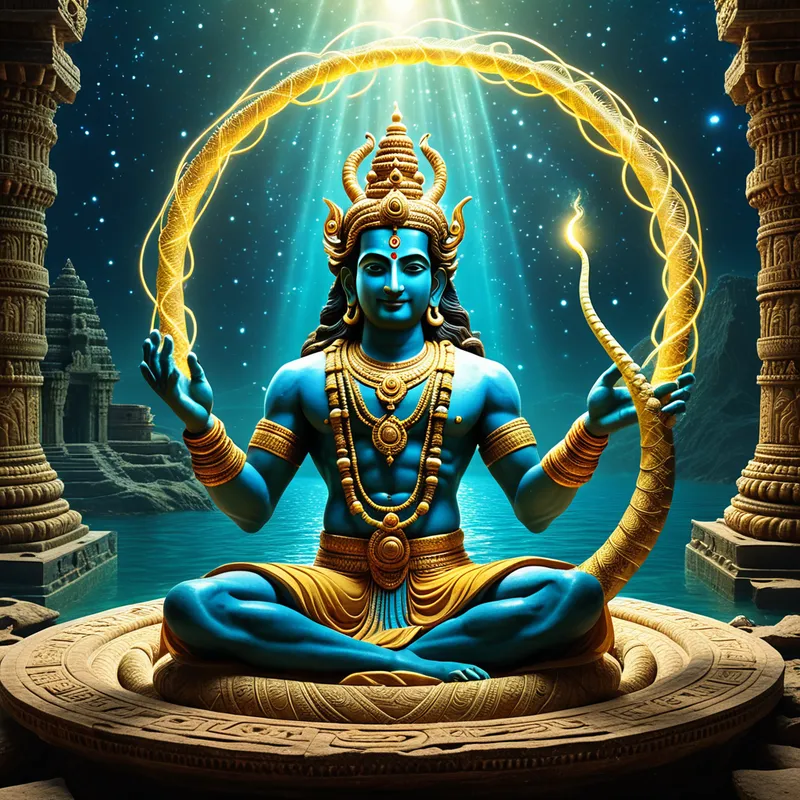
In the highest realm, seated upon the coils of the endless serpent Shesha, the preserver Vishnu beheld the unraveling. His eyes, deeper than time, saw not just the chaos, but the single, fraying strand that connected all things—the thread of duty, of promise, of sacred connection. It was thinning, threatening to snap. A great sigh escaped him, a wind that rustled the leaves of the Kalpavriksha and stirred the dust of forgotten altars on Earth.
He summoned a humble, steadfast king named Shibi. Not the mightiest, nor the most learned, but one whose word was carved into the bedrock of his soul. In a vision that pierced the veil of sleep, Vishnu appeared. The air hummed with the scent of lotus and ozone. “The thread that binds duty to destiny weakens,” spoke the god, his voice the sound of a river flowing underground. “The world forgets its vows. Its promises are written on water. I require an anchor, a knot tied in the fabric of reality itself.”
King Shibi, prostrate yet unshaken, listened. “Name your need, Preserver.”
“You must become the guardian of a thread,” said Vishnu. “Not of cotton or silk, but of resolve itself. You will hold one end. I shall hold the other. Across the chasm between the divine and the mortal, across the ages of doubt and despair, this cord must not break. It will be tested by fire, by flood, by the seductive whispers of oblivion. Your charge is simple: do not let go. Your promise to hold fast will become the loom upon which Dharma is rewoven.”
Without hesitation, Shibi agreed. A strand of light, cool and humming with potential, manifested between his hands. As his fingers closed around it, he felt the weight of all promises—the farmer’s vow to the seed, the student’s oath to truth, the parent’s silent pledge of protection. He felt the pull of Vishnu’s end, a gravitational force of pure order. The moment the connection was made, a shockwave of stillness spread outwards. The stars in their courses seemed to pause. The thread was set.
And the tests came. Not as grand battles, but as erosions. Plague visited his kingdom, and voices hissed that letting go would end the suffering. Drought parched the land, and the temptation to release the thread to grasp for water was a physical ache. Years turned into decades. Shibi aged, his hands gnarled, his body frail. The thread remained, a constant, luminous pressure. On his deathbed, his breath a shallow tide, his family wept around him. Yet his grip did not slacken. His final act was not a letting go, but a conscious transfer—a look to his most devoted disciple, a silent passing of the charge. As his soul departed, the disciple felt the thread’s presence settle into his own palms. The connection held. The promise endured. The sacred thread, through the unwavering will of a mortal, had been secured, becoming the unseen axis upon which the wheel of the world continues to turn.
Cultural Origins & Context
The motif of the Sacred Thread is woven deeply into the fabric of Hindu culture, finding its most explicit ritual form in the Upanayana ceremony. This rite of passage, dating back to the Vedic period, marks a young person’s formal entry into studenthood and their responsibility towards learning and Dharma. The mythic narrative, however, transcends this specific ritual. It is a Puranic archetype, passed down through oral tradition by sages and storytellers, often embedded within larger epics like the Mahabharata in tales of kings like Shibi or Rantideva.
Its societal function was multifaceted. For the individual, it was a map for ethical living, illustrating that one’s personal vow (Sankalpa) was a tangible force with cosmic implications. For the community, it reinforced the foundational idea of Rta (cosmic order), where every being, from monarch to farmer, had a sacred duty (Swadharma) that sustained the whole. The myth was told not to create priests, but to forge conscious humans—individuals who understood themselves as vital, active nodes in a vast, living network of reciprocal responsibility.
Symbolic Architecture
Psychologically, the Sacred Thread represents the ego’s conscious tether to the Self—Jung’s term for the central, unifying archetype of the total psyche. Vishnu, the preserver, symbolizes this transcendent, ordering Self. The mortal guardian represents the conscious ego.
The thread is the individuating impulse itself—the fragile, luminous line of purpose that connects our temporal awareness to our eternal essence.
The physical thread is a symbol of relationship: the relationship between student and teacher (Shishya and Guru), between humanity and the divine, between an action and its ethical consequence (Karma). It is not a chain of bondage, but a lifeline of meaning. To hold it is to accept the burden and the blessing of consciousness. The “tests”—plague, drought, aging—are the inevitable erosions of life: suffering, doubt, mortality, and the allure of the unconscious (the temptation to “let go” and dissolve back into undifferentiated existence). The successful transfer of the thread at the moment of death is perhaps the most profound symbol: it signifies that the duty of consciousness, of holding the connection, is the true human legacy, passed from generation to generation, from one integrated psyche to the next.

The Dreamer’s Resonance
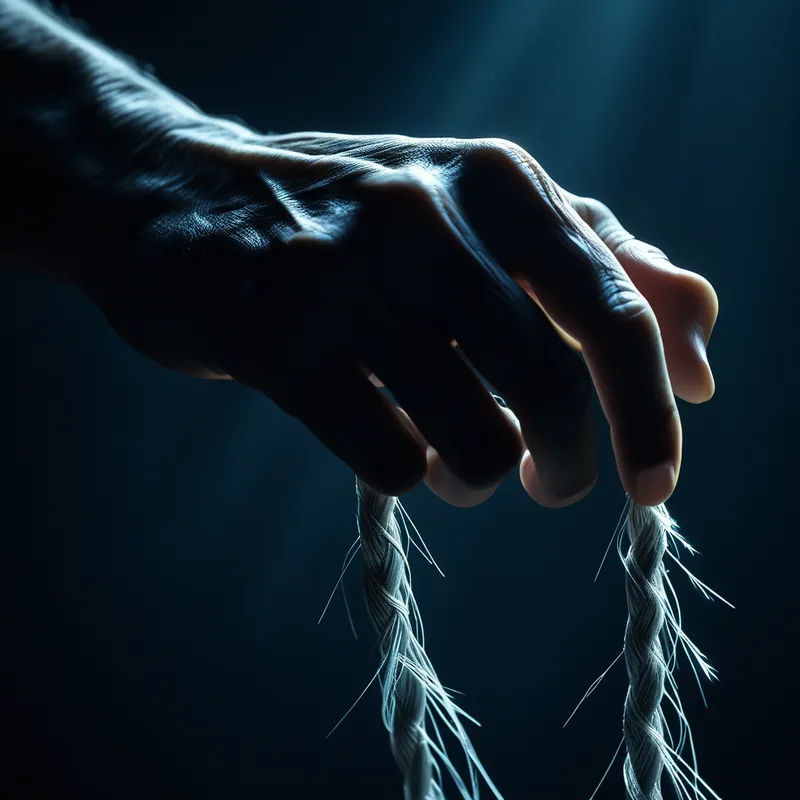
When this myth activates in the modern psyche, it often manifests in dreams of tenuous connections. One might dream of desperately holding a rope during a storm, repairing a broken telephone line, or trying to keep two pieces of a severed bridge from drifting apart. The somatic sensation is one of acute tension in the hands, arms, and solar plexus—a literal feeling of “holding on.”
Psychologically, this dream pattern signals a critical phase in the dreamer’s relationship with their own integrity. It appears when one’s core values, a long-held promise to oneself (like a creative pursuit, a principle, or a path of healing), are under extreme pressure from external circumstances or internal doubt. The dream is not necessarily an instruction to “keep holding on” at all costs, but a diagnostic image. It asks: What is the thread you are holding? Is it your true Swadharma, or someone else’s expectation? Is the tension creative or destructive? The dream presents the archetypal dilemma, forcing the dreamer into conscious relationship with their own deepest commitments.

Alchemical Translation
The alchemical process modeled here is the transmutation of casual choice into sacred vow, and of personal endurance into transpersonal continuity. The initial “call” from Vishnu is the awakening of the Self, the first stirring of a meaning that feels larger than one’s personal desires. Agreeing to hold the thread is the nigredo—the commitment that often feels like a burden, darkening one’s former, carefree life.
The long vigil of holding, through all of life’s erosions, is the albedo—the whitening, the purification. It is the slow, often lonely, work of aligning every thought, word, and deed with that original promise.
The fire of plague and the drought of despair are the necessary separatio, burning away all motivations except the essential one. The final test—transferring the thread at the point of death—is the rubedo, the reddening, the culmination. It represents the moment when the personal struggle achieves a symbolic, eternal value. The thread is no longer just “yours”; it becomes a function of the cosmic order you have helped sustain. For the modern individual, this translates to the journey of individuation: discovering the unique “thread” of one’s authentic life (one’s vocation in the deepest sense), holding to it against all internal and external pressures, and ultimately weaving it into the larger tapestry of human experience, thereby transforming a personal life into a myth lived. The promise made is to one’s own wholeness, and in keeping it, one silently becomes a pillar of the world.
Associated Symbols
Explore related symbols from the CaleaDream lexicon: