The Sacred Fire Drill Myth Meaning & Symbolism
A primal myth of two divine beings creating the first fire through sacred friction, birthing light, culture, and consciousness from the void.
The Tale of The Sacred Fire Drill
In the time before time, when [the world](/myths/the-world “Myth from Tarot culture.”/) was a breath held in the throat of the Darkness, there was no flame. There was only the cold, the silence, and the long, unbroken sleep. Creatures moved through the gloom as shadows, and the heart of [the world](/myths/the-world “Myth from Tarot culture.”/) beat slow and cold.
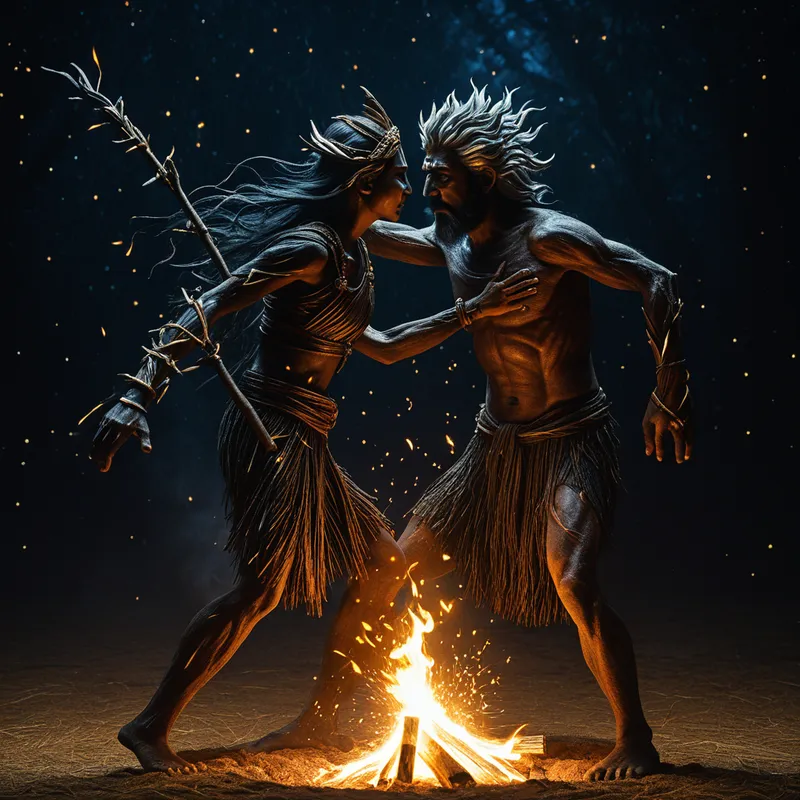
But within that womb of potential stirred two beings, the First Pair. He was the Upright Spindle, made of the hardest, driest wood from the core of the world-tree. She was the Hearthboard, crafted from a softer wood, her surface bearing a small, precise notch. They were not lovers, not yet siblings, but complements—two halves of a single, unspoken need.
The Darkness was not empty; it was full of a terrible, pressing weight. It whispered of eternity without change, of a peace that was indistinguishable from death. The Spindle felt a restless energy in his grain, a need to pierce, to move, to act. The Hearthboard felt a profound receptivity, a hollow ache that yearned to be filled, not with substance, but with transformation.
He came to her in the absolute dark. No words were exchanged, for language did not exist. His pointed end found her notch—a fit so perfect it was as if they had been carved from the same forgotten thought. He began to turn. Slowly at first, the friction a mere whisper of protest between their bodies. Then faster, driven by a desperation that was both his and hers. The air filled with the scent of their own essence being ground away: the perfume of cedar and oak, of sap and heartwood.
It was an act of immense strain. His body grew hot with the effort, her surface blackened and scarred. This was not gentle union, but a vigorous, relentless, and sacred struggle. They were wearing each other down, sacrificing their very substance. The Darkness watched, a palpable presence resisting this violation of its silent reign.
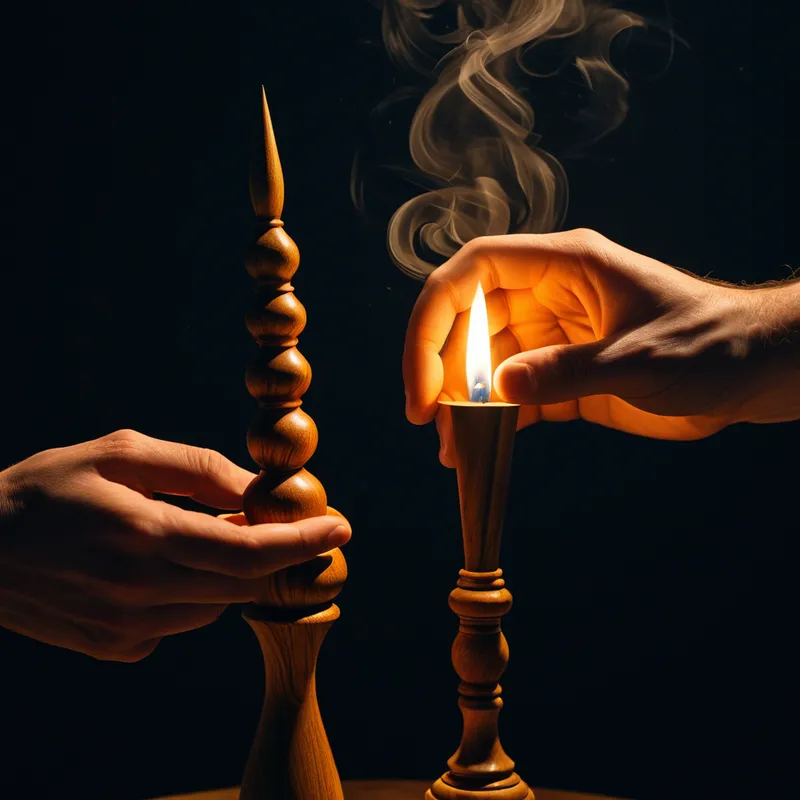
Smoke began to rise. Not the grey smoke of destruction, but a thin, fragrant blue thread—the first prayer. It coiled upward, the first [thing](/myths/thing “Myth from Norse culture.”/) in all existence to ever rise. The heat became unbearable, a concentrated agony at the point of their meeting. They did not pull apart. They pressed harder, spun faster, their shared purpose now a fire in their souls before it was a fire in the world.
And then, in the blackened cup of her notch, nurtured by the dust of their mutual sacrifice, a glow appeared. A single, pulsating ember, red as a newborn’s heart. It breathed. They ceased their motion, trembling, and together they bent over their creation. With the tenderest breath—a blend of his exhalation and hers—they coaxed the ember onto a bed of dry tinder. The breath became a flame.
Light, sharp and shocking, tore through the Darkness. It did not banish the dark, but made it a background, defining shape and form for the first time. In that flickering light, they saw each other’s faces—strained, sooted, and radiant. They saw the world around them, no longer a formless void, but a space waiting to be filled. [The Sacred Fire](/myths/the-sacred-fire “Myth from Native American culture.”/) Drill had ceased its work. The First Fire now lived, and with it, the dawn of all things.
Cultural Origins & Context
The myth of the [Sacred Fire](/myths/sacred-fire “Myth from Various culture.”/) Drill is not the property of a single people, but a profound archetype that has sparked into consciousness across disparate continents and cultures. Variations are found among Indigenous peoples of the Americas, in the Vedic traditions of India (as the Agni-kindling lore), and in the foundational stories of many fire-dependent societies. Its transmission is oral, passed down not as mere history, but as a sacred technology of the soul, often recited during the actual ritual of fire-making at ceremonies, initiations, or at the founding of a new hearth.
Its societal function was multifaceted. On the practical level, it sanctified the vital, daily act of creating fire, elevating it from chore to cosmogony. On the communal level, it modeled the essence of partnership—not as effortless harmony, but as productive, necessary friction between complementary forces (male/female, clan/moiety, sky/earth) that generates the “heat” of culture, law, and family. It was a foundational narrative explaining the origin of consciousness itself: light, understanding, and social order born from a deliberate, strenuous act against the passive, unconscious state of nature.
Symbolic Architecture
At its core, the myth is a masterful [allegory](/symbols/allegory “Symbol: A narrative device where characters, events, or settings represent abstract ideas or moral qualities, conveying deeper meanings through symbolic storytelling.”/) for the [birth](/symbols/birth “Symbol: Birth symbolizes new beginnings, transformation, and the potential for growth and development.”/) of [consciousness](/symbols/consciousness “Symbol: Consciousness represents the state of awareness and perception, encompassing thoughts, feelings, and experiences.”/) from the unconscious. The Darkness is the undifferentiated, primal [psyche](/myths/psyche “Myth from Greek culture.”/)—the unconscious in its pure state. The First Pair are the nascent, opposing principles within that psyche that must engage for anything new to emerge.
The first light is always born from friction. There is no creation without the sacrifice of wholeness, no consciousness without the heat of conflict.
The Upright [Spindle](/symbols/spindle “Symbol: A spindle is a tool used for spinning thread, symbolizing creativity, the act of weaving, and the intertwining of life’s stories.”/) represents active will, focused intent, the penetrating spark of [spirit](/symbols/spirit “Symbol: Spirit symbolizes the essence of life, vitality, and the spiritual journey of the individual.”/) or [logos](/myths/logos “Myth from Christian culture.”/). The Hearthboard symbolizes the receptive [body](/symbols/body “Symbol: The body in dreams often symbolizes the dreamer’s self-identity, personal health, and the relationship they have with their physical existence.”/), the nourishing [earth](/symbols/earth “Symbol: The symbol of Earth often represents grounding, stability, and the physical realm, embodying a connection to nature and the innate support it provides.”/), the [vessel](/symbols/vessel “Symbol: A container or structure that holds, transports, or protects something essential, representing the self, emotions, or life journey.”/) of matter and instinct that holds the potential. The [fire drill](/symbols/fire-drill “Symbol: The fire drill represents preparedness and the human instinct for survival in the face of danger, often evoking a sense of urgency and proactivity.”/) is the coniunctio oppositorum—the sacred [marriage](/symbols/marriage “Symbol: Marriage symbolizes commitment, partnership, and the merging of two identities, often reflecting one’s feelings about relationships and social obligations.”/) of opposites. Their vigorous, even violent, [interaction](/symbols/interaction “Symbol: Interaction in dreams symbolizes communication, relationships, and connections with others, reflecting the dynamics of personal engagement and social settings.”/) is not conflict in a destructive sense, but the essential, energetic engagement required to generate the transformative “heat” of psychological evolution. The resulting fire is Ego-consciousness, culture, art, and [soul](/symbols/soul “Symbol: The soul represents the essence of a person, encompassing their spirit, identity, and connection to the universe.”/)—the luminous [child](/symbols/child “Symbol: The child symbolizes innocence, vulnerability, and potential growth, often representing the dreamer’s inner child or unresolved issues from childhood.”/) of this primal union.
The Dreamer’s Resonance
When this myth stirs in the modern dreamscape, it often manifests not as a literal story, but as a somatic or situational pattern. The dreamer may find themselves in a dark, cold place, desperately trying to make two objects work together—turning a stubborn key, rubbing stones, or trying to connect wires that spark but won’t catch. There is a profound urgency, a sense that survival depends on this difficult, manual task.
Psychologically, this signals a moment where two opposing elements within the dreamer’s psyche are ripe for engagement. It could be the friction between ambition and security, logic and emotion, or a shadow aspect and the conscious [persona](/myths/persona “Myth from Greek culture.”/). The dream is highlighting the necessary, often uncomfortable, work of integration. The exhaustion felt in the dream is [the ego](/myths/the-ego “Myth from Jungian culture.”/)‘s resistance to this internal labor. The moment the spark or flame appears in the dream marks a nascent insight, the birth of a new attitude or creative solution that can only come from enduring the heat of this internal conflict.

Alchemical Translation
The journey of the Sacred Fire Drill is the alchemical opus in miniature, mapping directly onto the process of individuation. The initial Darkness ([nigredo](/myths/nigredo “Myth from Alchemical culture.”/)) is the state of psychic confusion, depression, or stuckness—the raw, unworked material of [the self](/myths/the-self “Myth from Jungian culture.”/).
The conscious decision to bring the Spindle and Hearthboard together is the beginning of analysis or deep self-reflection ([separatio](/myths/separatio “Myth from Alchemical culture.”/) and coniunctio). This is not a peaceful meditation, but the hard, repetitive work of engaging with our complexes, rubbing our neuroses against our ideals, facing the friction between who we are and who we aspire to be. We are both the agent wearing down and the substance being worn away.
The sacred flame is not found by avoiding friction, but by consecrating it. The self is kindled in the very place where we are being ground to dust.
The smoke and heat (albedo, the whitening) represent the painful but purifying release of old identities, illusions, and defenses. Finally, the glowing ember and first flame ([rubedo](/myths/rubedo “Myth from Alchemical culture.”/), the reddening) symbolize the birth of the integrated Self—the sacred, inner fire of awareness that is both transformative and sustaining. This “fire” is not the inflated ego, but the warming, illuminating center of a more complete personality. It provides light to see oneself truly, heat to cook raw impulses into disciplined action, and a sacred hearth around which the disparate parts of one’s being can finally gather. We do not escape the dark by fleeing from it, but by generating, from within its very substance, a light that makes the darkness sacred.
Associated Symbols
Explore related symbols from the CaleaDream lexicon: