
The Sacred Fire Myth Meaning & Symbolism
A myth of how the first fire was stolen from the sun and given to humanity, a gift born of sacrifice and guarded by eternal vigilance.
The Tale of The Sacred Fire
In the time before memory, when the world was young and the People walked in the cold shadow of the sun, there was no fire. The nights were long and black, filled with the whispers of frost and the teeth of the wind. The People huddled in the dark, eating their food raw, their bones aching with a chill that lived in the marrow. They looked to the sky, to the great Sun, who held all warmth captive in his distant lodge. They saw his light, but they could not touch his heart.
A council was called beneath the sighing pines. The elders spoke of a great emptiness, a longing for the spark of life that danced in the eyes of the predator and the flash of lightning, but never stayed. From among them, a figure of quiet resolve stepped forward. He was not the strongest warrior, nor the loudest speaker, but his eyes held the patience of the stone and the resolve of the root seeking water. He would go, he said. He would journey to the lodge of the Sun and ask, or take, what was needed for the People.
His journey was a path of ordeal. He crossed mountains that scraped the belly of the sky and rivers that sang with the voices of the drowned. He fasted, he prayed, and the animal peoples saw his pure intent. The Rabbit offered swiftness. The Bear offered fortitude. But it was the ancient Turtle who offered the final, crucial aid. “The Sun’s lodge is on an island of light in a sea of sky,” Turtle rumbled. “I will carry you on my back, but you must be still as stone, for the Sun sees all that moves.”
And so the seeker climbed upon Turtle’s great shell, and they began the impossible ascent. The air grew thin and hot. The light became a blinding, golden wall. They reached the island, a place of terrifying brilliance where flames danced as trees and rivers of molten gold flowed. The seeker, his eyes slitted against the glare, crept to the very heart of the lodge. There, in a pit of eternally burning stones, was the Sacred Fire itself, crackling with the voice of creation.
There was no asking. The Sun would never willingly give up this essence of his power. With a swiftness gifted by Rabbit and a focus honed by his journey, the seeker plunged a branch of dry, resilient wood into the pit. A single, glorious ember caught and clung. At that moment, the Sun roared, a sound that shook the foundations of the sky. The seeker fled, the ember a searing star in his hands, back to the waiting Turtle.
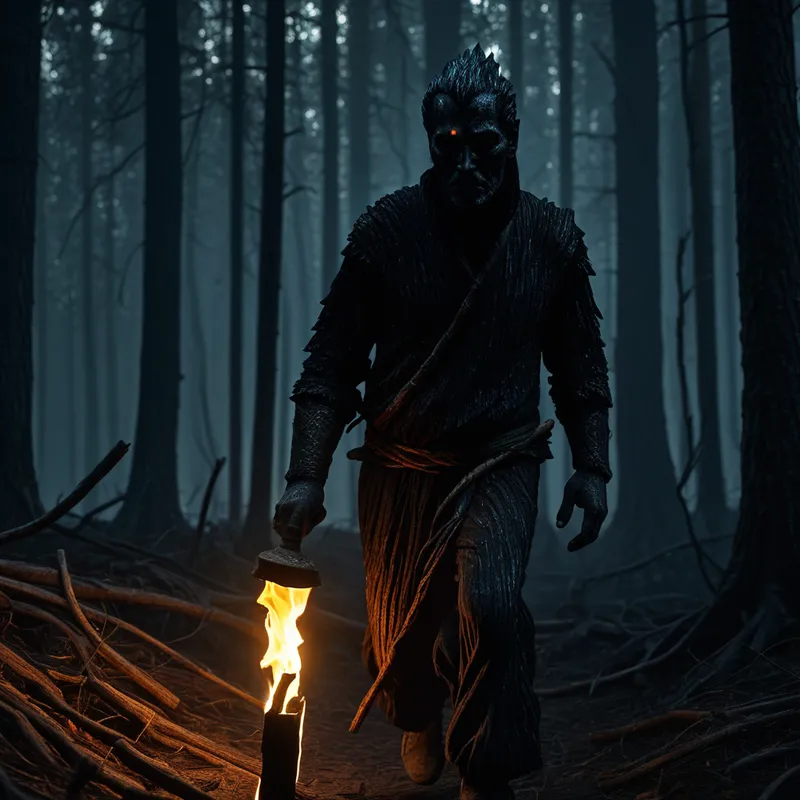
The descent was a chase of fire and fury. The Sun sent burning winds and falling stars to snatch the ember back. The seeker curled around his prize, his skin blistering, his breath coming in scorching gasps. He held the branch aloft, letting the wind feed the ember just enough to keep it alive, but not so much it would consume him or his vessel. Turtle’s shell grew hot, its edges beginning to smoke. Just as the heat became unbearable, as the seeker felt his own spirit beginning to char, they plunged through the veil of clouds and back to the cool, green world.
He stumbled onto the shore, his body a testament to pain, but in his hands, the ember glowed. He touched it to a prepared bundle of dry grass and tinder. A wisp of smoke, a crackle, and then—flame! A living, breathing, dancing light. The People gathered, their faces awash in its orange glow, feeling its warmth for the first time. The fire was fed, and it grew. It cooked their food, warmed their lodges, and pushed back the endless night. But as they celebrated, the seeker, now the Firebringer, spoke his final warning. “This gift is not without cost. It is alive. It must be fed, but never allowed to feast unchecked. It must be guarded, for it can become a devourer as easily as a protector. It is a piece of the Sun’s own heart, and we are now its keepers.” From that day, a fire was kept always burning in the center of the village, a sacred trust, a stolen fragment of the celestial, now tended in the heart of the earthly.
Cultural Origins & Context
The myth of the theft of fire is a foundational narrative found across many Indigenous cultures of North America, with variations among the Cherokee, Algonquian, and other Eastern Woodlands and Plains peoples. It was not a singular, monolithic story but a powerful archetypal truth expressed through local geography, flora, fauna, and clan identities. The teller was often a designated storyteller, an elder, or a knowledge keeper, passing it down during the long winter nights or at important gatherings. Its function was multifaceted: it was an etiological myth explaining the origin of a fundamental technology, a sacred narrative encoding the proper relationship between humanity and a powerful natural force, and a moral lesson on sacrifice, responsibility, and the dual nature of gifts from the spirit world. The fire was not merely a tool; it was, and is, a relative—a living presence in the lodge, around which community, ceremony, and story revolve.
Symbolic Architecture
At its core, the myth maps the human journey from a state of primal need to a state of cultural and spiritual responsibility. The fire represents more than warmth; it is consciousness itself, the illuminating spark of culture, technology, and sacred knowledge that separates humanity from a purely instinctual existence. Its theft from the Sun signifies that this awakening is often experienced as a transgression, a necessary rebellion against a static, if orderly, state of being.
The hero does not receive the fire; he must seize it, accepting the burn of consciousness and the wrath of the old order.
The seeker is the archetypal hero, but not a warrior of conquest. He is a hero of receptivity and endurance, whose primary weapons are patience, sacrifice, and the ability to form alliances (with Rabbit, Bear, Turtle). His journey is an initiation, where the old self is metaphorically burned away to make room for the new, responsible self—the Firekeeper. The Turtle’s role is profound; it represents the sustaining, grounding power of the Earth and the unconscious that supports the perilous journey to the heights of consciousness (the Sun). The final warning underscores the central symbolic truth: the fire of consciousness is a controlled paradox. It is creative and destructive, illuminating and blinding, a servant and a potential master. Its sacredness lies in this very tension, requiring eternal vigilance.
The Dreamer’s Resonance
When this myth stirs in the modern dreamer, it often signals a critical moment of psychic ignition or responsibility. To dream of desperately carrying a fragile ember through a dark landscape speaks to the somatic feeling of nurturing a nascent idea, a new awareness, or a creative spark that feels precious and threatened. The burning hands are the psyche’s registration of the cost of this new consciousness—the anxiety, the isolation, the “burn” of seeing what one did not see before.
Dreams of being chased by a celestial force (a burning sun, a fiery figure) after taking something illuminate the guilt or fear that accompanies psychological independence, breaking from internalized “suns” like parental complexes, dogma, or outdated self-concepts. Conversely, dreaming of successfully tending a hearth fire, especially one that has almost gone out, points to the active, often quiet work of sustaining one’s inner light—one’s values, vitality, or spirit—through a period of emotional or spiritual winter. The dream is an affirmation of the keeper’s role.
Alchemical Translation
The myth is a perfect allegory for the Jungian process of individuation. We begin in the collective cold, identified with the tribe’s norms but feeling an essential lack. The call to journey is the stirring of the Self, urging us to seek our own unique “fire”—our authentic life and purpose.
The journey to the Sun is the arduous ascent into consciousness, confronting the brilliant, often tyrannical, dominant attitudes of our personal psyche (the Solar Logos). Stealing the fire is the crucial act of differentiation: seizing a piece of that overarching energy not to destroy it, but to make it personally usable, to bring its light down to the human level. This is always experienced as a theft, a creative betrayal of the status quo within oneself.
The alchemical vessel is not the flask, but the soul of the hero who can contain the opposing forces of celestial fire and earthly gravity without shattering.
The burning descent is the nigredo, the blackening, where the ego suffers the necessary dissolution as it integrates this powerful new content. The final act is not the celebration, but the warning—the establishment of the sacred precinct. In psychological terms, this is the creation of a conscious relationship with the newly integrated energy. The fire of the liberated libido, the awakened intellect, or the spiritual fervor must be “tended.” It must be given a sacred space (a valued place in one’s life), fed appropriately (channeled into creative work, relationships, service), and guarded from inflation (the ego claiming the fire as its sole property) or neglect (allowing the spark to die). The individual becomes, like the Firebringer, a keeper of the sacred flame, responsible for transforming a stolen, raw power into a sustaining, cultural, and spiritual hearth for their own inner community.
Associated Symbols
Explore related symbols from the CaleaDream lexicon: