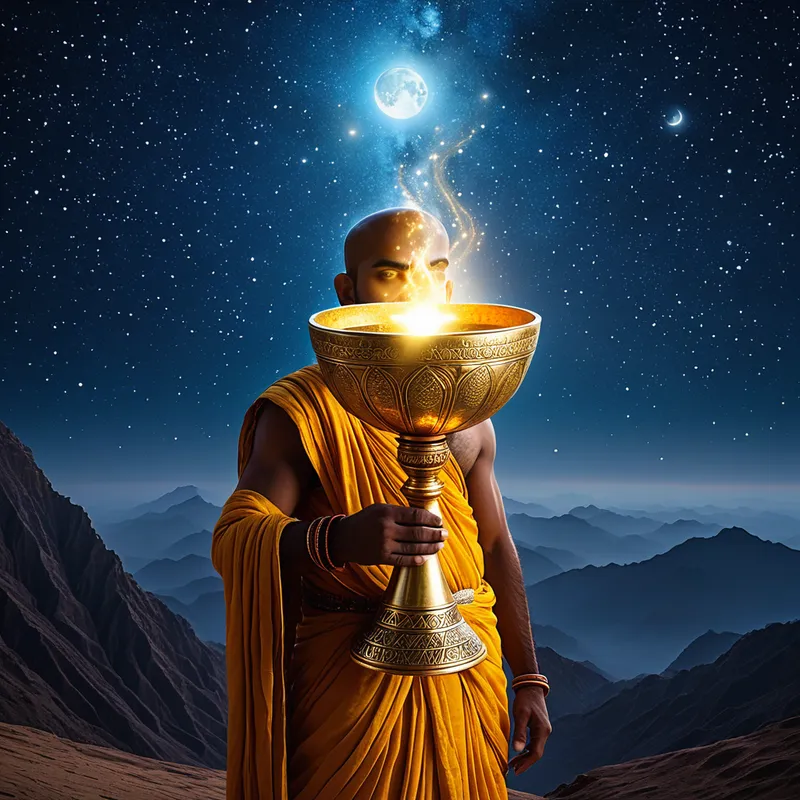
The sacred drink Soma from Ved Myth Meaning & Symbolism
A celestial elixir, pressed from a sacred plant, grants immortality and divine vision to gods and mortals, embodying the quest for ultimate consciousness.
The Tale of The sacred drink Soma from Ved
Before the world knew the names of all things, when the sky was a dark, thirsty bowl and the earth a silent, sleeping giant, there was a longing. It was a thirst deeper than any riverbed, a hunger older than the first fire. It was the longing of the gods themselves, the Devas, who, though mighty, felt the creeping shadow of limitation, the dull ache of a consciousness not yet fully awake.
Their gaze turned inward, to the secret heart of the world. There, upon the highest mountain, where the breath of creation still lingered, grew a plant. It was not like other plants. Its stems were the color of moonlight on water, its leaves shimmered like beaten silver, and from its heart emanated a fragrance that was the very memory of dawn. This was the Soma.
But Soma was not for the taking. It was a prisoner, a radiant secret held fast by a mighty eagle, Śyena, who perched upon the world’s peak, its feathers like polished obsidian, its eyes holding the cold fire of stars. The gods knew that without this essence, the cosmos would remain half-formed, a song without its final, ecstatic note. They would age, their brilliance would dim, and the great work of ordering reality would falter.
So they called upon Indra, the thunder-wielder, whose strength was born of a thousand sacrifices. And they called upon Viśvakarman, the maker of all forms. A plan was woven in the space between thoughts. Viśvakarman fashioned two stones of perfect smoothness—not of this earth, but of concentrated intention, the Grāvan. They were the world’s first altar, the first technology of transcendence.
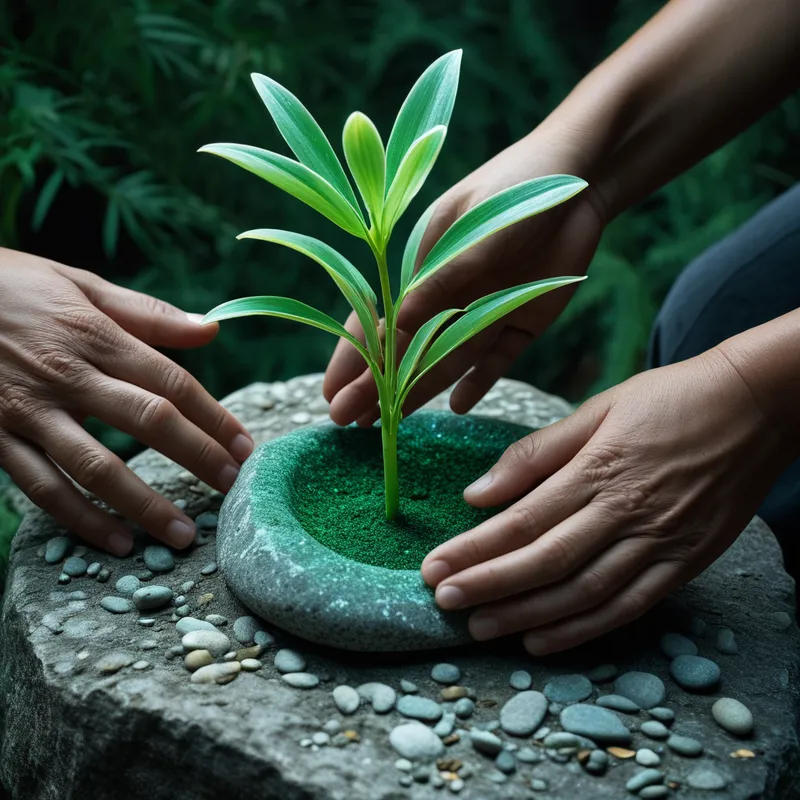
Under a sky pregnant with potential, the gods gathered. The great eagle watched, unmoving. With a chant that vibrated in the bones of the mountains, they placed the silvery stalks of Soma upon the lower stone. Indra, his muscles coiled like cosmic serpents, raised the upper stone high. The air grew still. The very wind held its breath.
He brought the stone down.
It was not a crushing, but a pressing. A sacred, immense pressure. And from the plant came not sap, but light. A radiant, golden fluid, singing as it flowed. It was the sound of a thousand bees humming in a sunbeam, the color of a liquid sunrise. This was the draught. This was the Soma-rasa.
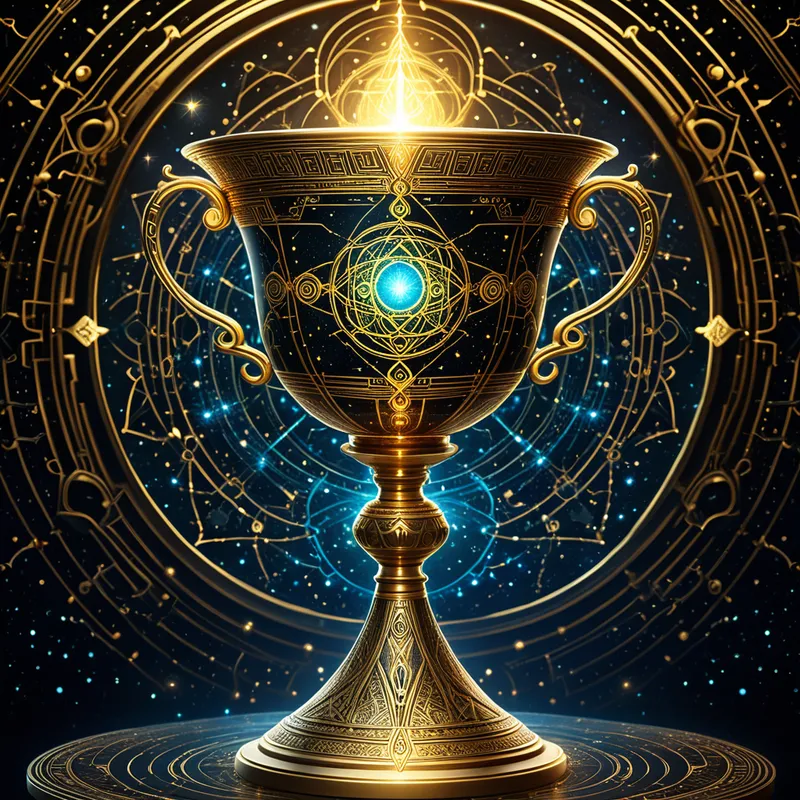
They caught it in a cup, the Camasa, which seemed to drink the light itself. One by one, the gods partook. And as the elixir touched their throats, a transformation seized them. Their eyes, once bright, now saw the weave of fate itself. Their bodies swelled with a force that made the mountains feel like pebbles. Their voices became the thunder, the wind, the rushing river. Mortality’s shadow fled. In its place bloomed immortality, Amṛtatva, and a fierce, boundless joy. They were not just powerful; they were awake. With this awakened might, they shaped the worlds, fixed the sun in its course, and drove back the forces of chaos, the Vṛtra.
And from that day, the ritual was born. The pressing, the offering, the sharing. For the gods, having tasted the ultimate, knew the thirst would return. And they knew that when mortals, with reverence and sacrifice, pressed their own Soma upon the stones of their own hearts, a echo of that divine awakening could be theirs.
Cultural Origins & Context
The myth of Soma is the pulsating heart of the Ṛgveda, the most ancient layer of Indian literature and among humanity’s oldest recorded poetic texts. Over 120 hymns in the Ṛgveda are dedicated solely to its praise, more than any deity save Indra, with whom Soma is intrinsically linked. This was not a mere story for entertainment; it was the central liturgical and experiential core of a vast ritual technology. The myth was performed, not just recited. It was the sacred narrative underpinning the elaborate Soma Yajña, where priests, embodying the gods, would physically press the juice of a (now lost) plant, filter it through wool, mix it with other ingredients, and offer it into the sacred fire while chanting the very hymns that tell its story.
The “societal function” was cosmic maintenance. The ritual was believed to directly nourish the Devas, strengthening them to uphold Ṛta, the fundamental order of the universe. A successful Soma sacrifice ensured the sun would rise, rains would fall, and the community would prosper. It was the axis mundi connecting the human, natural, and divine realms. The myth and its ritual were the exclusive domain of the priestly class, the Brāhmaṇas, who were the “bard-scientists” preserving and enacting this sacred knowledge through meticulous oral tradition for millennia before it was committed to writing.
Symbolic Architecture
Soma is the ultimate symbol of the activated essence. It represents not a thing, but a process: the extraction of the radiant, immortal core from the matrix of mortal, material form. The plant is the embodied world, dense with potential. The pressing stones are the catalyst of intense experience—be it ascetic discipline, deep meditation, artistic struggle, or psychological crisis—that applies the necessary pressure to release the hidden nectar.
The divine is not found by escaping the world, but by pressing upon its heart with such sacred intensity that it reveals its inner light.
The eagle, Śyena, is the guardian at the threshold, representing the lofty, detached, and often fierce aspect of consciousness that initially holds the secret captive. It is the intellect or the spiritual pride that must be engaged or bypassed to access the raw, transformative experience. The resulting elixir symbolizes the integrated consciousness—a state where the mortal mind is infused with immortal awareness, where individual perception expands to perceive the underlying unity of all things. It is the experience of enlightenment, not merely its concept: inebriating, energizing, illuminating, and life-affirming all at once.
The Dreamer’s Resonance
When the Soma myth stirs in the modern dreamscape, it signals a profound somatic and psychic process of extraction and infusion. To dream of searching for a rare, luminous plant or a hidden spring of glowing liquid speaks to a deep, often spiritual thirst. The psyche is seeking its own essential nourishment, something beyond the mundane satisfactions of daily life.
Dreams of pressing or crushing objects to release a surprising, beautiful substance point to a period of intense pressure—perhaps a creative block, a psychological conflict, or a life transition—that is secretly working to distill something vital from the experience. The dreamer may feel “under the stone,” but the unconscious is narrating a myth of alchemy. Dreaming of drinking a radiant, potent liquid and feeling a surge of expansion, light, or fearlessness reflects a moment of psychic integration. A new insight or a hard-won piece of self-knowledge is being assimilated, promising a taste of inner wholeness and power. Conversely, dreams of a spoiled, withheld, or poisoned elixir may warn of inauthentic sources of inspiration or a spiritual path that has become corrupted by ego.
Alchemical Translation
The Soma myth is a master blueprint for the alchemical process of individuation. It begins with the longing (the gods’ thirst), which in the individual is the first stirring of the Self, the feeling that there is more to existence than the persona-driven life. The sacred plant is the latent Self, hidden within the complex, tangled growth of the personal unconscious and the physical being.
The work of becoming whole is a sacred pressing. The stone of discipline bears down upon the stone of suffering, and from between them flows the gold of consciousness.
The pressing stones are the indispensable opposites of the transformative journey: effort and surrender, analysis and intuition, suffering and its meaning. The modern individual performs this pressing not with literal stones, but through the ordeals of life, the discipline of introspection, and the courageous engagement with the shadow. The eagle-guardian is the resistance—the fear of inflation, the rational mind’s skepticism, or the comfort of known limitations that must be acknowledged.
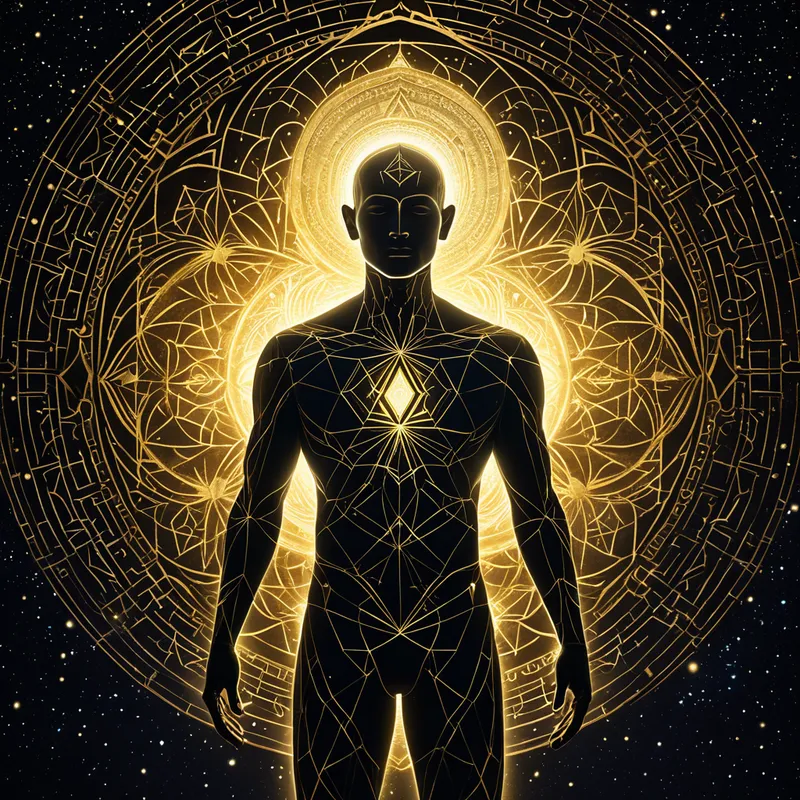
The final act of drinking the Soma is the coniunctio, the sacred marriage. It is the moment when the distilled essence of one’s deepest experience is consciously integrated into the personality. This is not about becoming a god in a literal sense, but about achieving a state of psychic sovereignty—immortality as the experience of transcending the identification with the ephemeral ego and touching the timeless ground of being. The myth teaches that enlightenment is not a static state of bliss, but a dynamic, potent, and sometimes intoxicating activation of one’s full potential, which must be continually renewed through one’s own inner sacrifice and offering.
Associated Symbols
Explore related symbols from the CaleaDream lexicon: