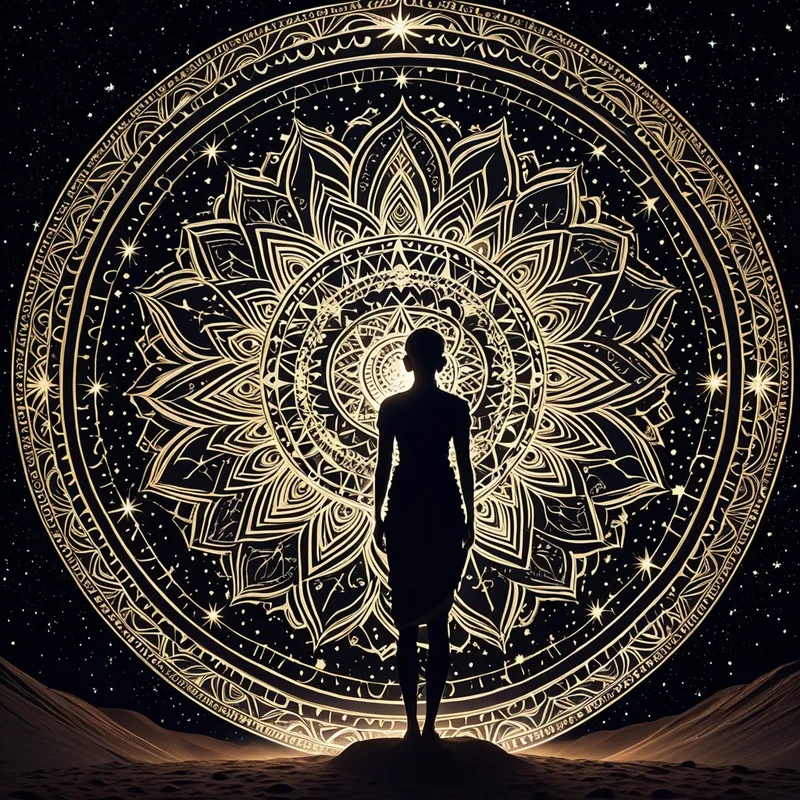
The Sacred Circle Myth Meaning & Symbolism
A primordial being sacrifices its form to create the world, establishing the sacred circle as the blueprint for all life, death, and renewal.
The Tale of The Sacred Circle
In the time before time, there was no earth beneath the feet, no sky above the head. There was only the One, the Ur-Being, who was both singer and song, dreamer and dream. It existed in the profound silence of potential, a perfect, solitary sphere of conscious light. Yet within that perfection, a longing stirred—a desire not for company, but for expression, for the story of itself to be told in form and contrast.
And so, the Ur-Being began to sing. Its voice was not sound, but the vibration of intention. It sang of mountains that would scrape the heavens, and of valleys deep enough to hold shadows. It sang of rivers that would chase the horizon, and of roots that would clutch the dark earth. With each note, a possibility shimmered into being around it, a phantom landscape of breathtaking beauty. But these visions had no substance; they were echoes without a canyon to hold them. The world was a magnificent thought, but not yet a reality.
The Ur-Being saw the ghostly tapestry of its song and knew a terrible, beautiful truth. To give its dream a home, it would have to become the home. To give the song a body, it would have to shatter its own. A great stillness fell, a moment of cosmic decision. Then, with a final, silent breath of acceptance, the Ur-Being enacted the ultimate generosity.
It stretched its luminous arms wide in a gesture of ultimate release. Its skin peeled away, becoming the dome of the sky, freckled with the sparks of its own dissolving thoughts—the first stars. Its bones sank down, hardening into the bedrock and the towering spines of mountains. The rivers of its blood began to flow, carving channels of life through the newborn stone. The lush tapestry of its hair became the forests and the grasslands, whispering with the memory of its mind. Its two eyes rose, one becoming the sun to rule the day with a father’s clarity, the other becoming the moon to govern the night with a mother’s mystery.
But as its form scattered, the Ur-Being did not vanish. Its heart, the central fire of its being, did not shatter. Instead, it remained, beating at the very center of the new creation. From this heart radiated a pattern, a shimmering, geometric law written in light and stone: the Sacred Circle. This was not a mere shape, but the living blueprint of existence—the cycle of day and night, the rhythm of the seasons, the journey from birth to death and back to life again. The world was born from a sacrifice of unity, and in its place was established the eternal promise of the circle: that every ending is woven into a new beginning, and every scattered part remembers the whole.
Cultural Origins & Context
The myth of The Sacred Circle is not the property of a single tribe or nation, but a foundational story that has emerged, independently and yet with uncanny similarity, from countless cultures across the globe. We find it in the Ymir of the Norse, whose flesh became the earth and whose skull became the heavens. We hear its echo in the Purusha of the Rigveda, whose dismemberment gave rise to the castes and elements of the world. It resonates in the Chinese myth of Pangu, and in the Mesoamerican tales of dismembered gods whose parts become sustenance.
This was not a story told for mere entertainment. It was a sacred narrative, recited during solstice ceremonies, initiation rites, and times of planting and harvest. Shamans, elders, and griots were its custodians. Its function was ontological—it explained why the world is structured as it is. It taught that the cosmos is not a random accident, but a conscious, sacred artifact born from a willing sacrifice. It provided a moral and spiritual framework: if the very world is a gift born of self-giving, then human life must be lived with reciprocal reverence, within the cycles established at the dawn of time.
Symbolic Architecture
At its core, this myth is a master symbol of the psyche’s journey from unconscious unity to conscious, differentiated wholeness. The Ur-Being represents the original, unconscious state of the Self—complete, but unrealized. Its longing is the first stirring of consciousness, the ego’s nascent desire to know itself through experience and opposition.
The birth of the world is the birth of the conscious mind, a catastrophic and glorious fragmentation of the primal Self.
The sacrifice is the essential, painful process of individuation. To become who we are, we must “dismember” the safe, unified fantasy of perfection. We must project parts of ourselves outward—our strength becomes our career, our love becomes our relationships, our creativity becomes our art. We feel scattered, lost from our source. Yet, the myth assures us this is not annihilation. The enduring heart, radiating the Sacred Circle, is the indestructible core of the Self. The Circle is the archetype of order, the promise that all these scattered aspects of our being are held within a greater, intelligible pattern. It symbolizes the psyche’s innate tendency toward synthesis, healing, and return to a more complex, earned wholeness.
The Dreamer’s Resonance
When this myth stirs in the modern unconscious, it often surfaces in dreams of profound transformation and existential reckoning. One might dream of their own body dissolving—fingers turning to sand, chest opening to reveal a galaxy within. This is not a nightmare of disintegration, but a somatic expression of the ego’s necessary deconstruction. The dreamer is undergoing a psychic “sacrifice,” where old, rigid identities must break apart to make way for a new, more authentic way of being.
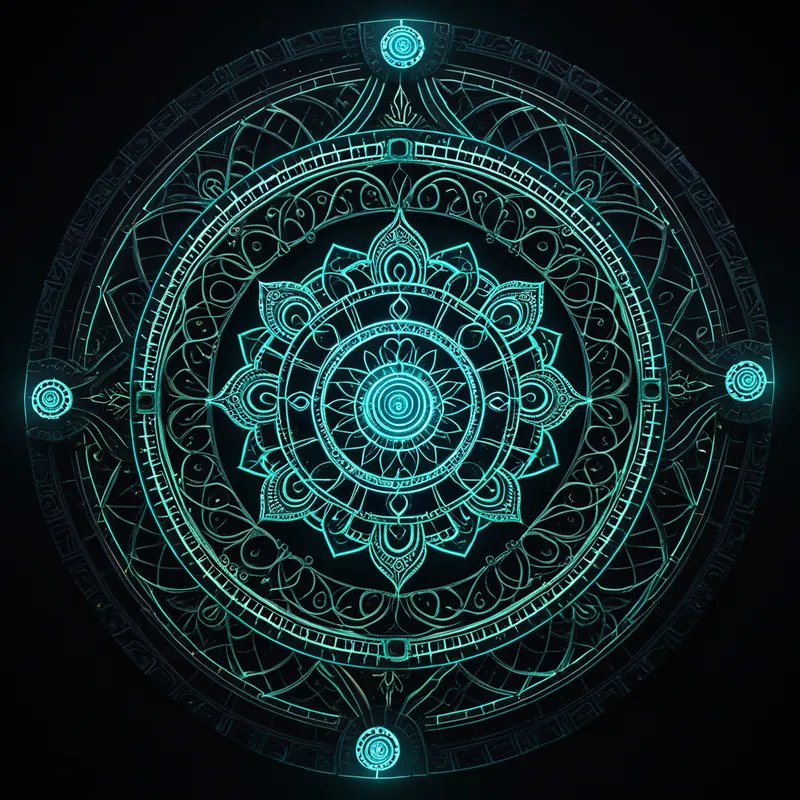
Other common motifs include finding a mysterious, glowing geometric pattern (the Circle) etched into a familiar floor or landscape, or standing at the center of a vast, cyclical process like a turning wheel or a spiraling galaxy. These dreams often arrive during life transitions: the end of a career, the dissolution of a long-term relationship, a spiritual crisis. The body may feel heavy with grief (the loss of the old unity) or strangely weightless and anxious (the state of being scattered). The dream is the psyche’s way of narrating this upheaval not as a meaningless catastrophe, but as a sacred, if terrifying, cosmogony—the creation of your new world.
Alchemical Translation
The alchemical journey, like the myth, begins with the prima materia—the confused, heavy mass of the unexamined life. This corresponds to the silent Ur-Being, full of potential but unmanifest. The stage of separatio, the painful breaking apart of elements, is the myth’s sacrificial dismemberment. In our lives, this is the crisis that forces us to distinguish what is truly “us” from the expectations, roles, and complexes we have unconsciously embodied.
The crucible of suffering is the womb of the world. We are not destroyed in the fire; we are distilled into our essential nature.
The radiating Sacred Circle represents the alchemical conjunctio—the sacred marriage of opposites on a higher plane. It is the realization that our broken pieces are not garbage, but the very ingredients of our wholeness. The sun and moon of the myth are the conscious and unconscious, now seen as complementary rulers of our inner sky, not warring factions.
For the modern individual, the myth models the path to psychic sovereignty. It teaches that true wholeness is not achieved by retreating to an infantile state of undifferentiated bliss, but by courageously offering our one, precious identity to the transformative fire of experience. We are dismembered by life—by failure, loss, and insight. The alchemical work is to recollect those parts, not as they were, but as they have become, and to re-member them around the enduring heart of the authentic Self. We become, at last, both the creator and the creation, living consciously within the Sacred Circle of our own, hard-won existence.
Associated Symbols
Explore related symbols from the CaleaDream lexicon: