The Rubedo Stage Myth Meaning & Symbolism
The final, fiery alchemical stage where the purified soul emerges from the crucible, radiant and whole, having endured dissolution and purification.
The Tale of The Rubedo Stage
Listen, and I will tell you of the final fire, the great and terrible dawn that follows the long, silent night of the soul. The work was long. The [Prima Materia](/myths/prima-materia “Myth from Alchemical culture.”/) had been wrestled from [the earth](/myths/the-earth “Myth from Hindu culture.”/)’s dark womb, a heavy, leaden [thing](/myths/thing “Myth from Norse culture.”/) of confusion and shadow. It had endured the [Nigredo](/myths/nigredo “Myth from Alchemical culture.”/), a descent into a blackness so complete it swallowed memory and form, a mortification where all that was false was burned away in cold, invisible flames.
Then came the Albedo, a washing in the silver tears of [the moon](/myths/the-moon “Myth from Tarot culture.”/), a distillation into a spirit so pure and white it was like a ghost of itself, fragile and detached from the weight of [the world](/myths/the-world “Myth from Tarot culture.”/). The King and Queen, Sol and Luna, had been separated, purified in their own solitudes.
But this was not the end. It was a pregnant pause.
In the heart of [the athanor](/myths/the-athanor “Myth from Alchemy culture.”/), [the alchemist](/myths/the-alchemist “Myth from Various culture.”/)’s furnace, a tension built. The white powder, the White Stone, lay upon the altar of fire. A breath was held—by the operator, by the very universe watching this tiny, concentrated world. Then, the heat was raised. Not the gentle warmth of incubation, but the fierce, unwavering gaze of the sun itself.
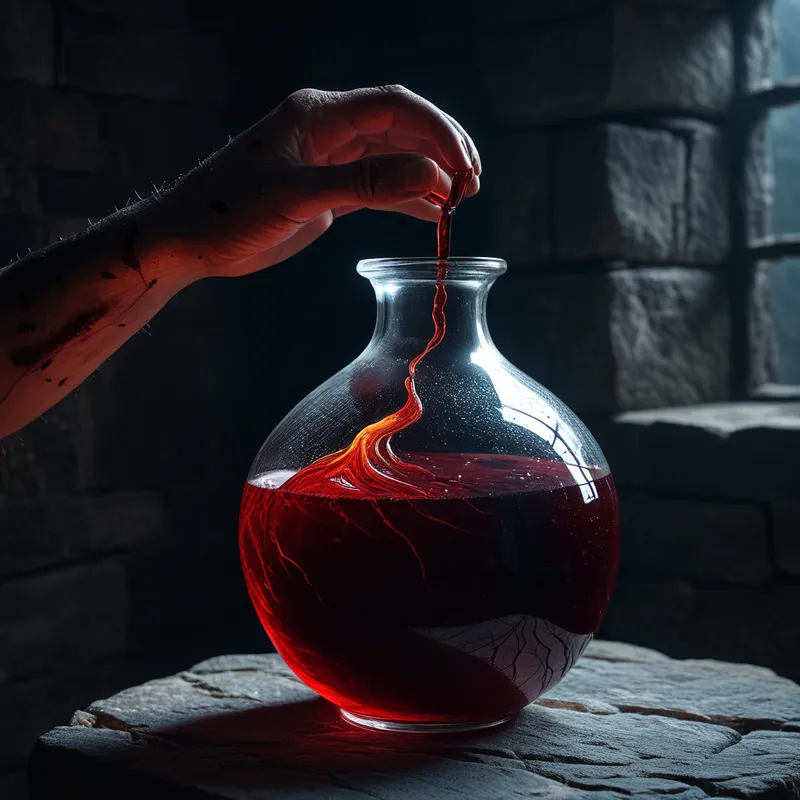
A change began, subtle as a blush. The pristine white began to tinge with the faintest hue of rose, then of rust, then of a living, pulsing crimson. This was the [Rubedo](/myths/rubedo “Myth from Alchemical culture.”/). It was not a mere coloration; it was a suffering into being. The matter within [the vessel](/myths/the-vessel “Myth from Alchemical culture.”/) seemed to bleed, to sweat, to weep tears of molten ruby. The separated principles—the solar, active fire and the lunar, receptive [water](/myths/water “Myth from Chinese culture.”/)—stirred in their agony. They did not merely mix; they fought a final, glorious battle for supremacy, each seeking to consume the other, and in that consummation, they found they could not exist apart.
The vessel became a tiny, contained sun. The crimson deepened, glowing from within, casting bloody, beautiful light upon the soot-stained walls of [the laboratory](/myths/the-laboratory “Myth from Alchemical culture.”/). The air hummed with a palpable vibration, a song of unbearable pressure and imminent birth. This was the Coniunctio, [the chemical wedding](/myths/the-chemical-wedding “Myth from Alchemical culture.”/), performed not in a chapel but in a crucible.
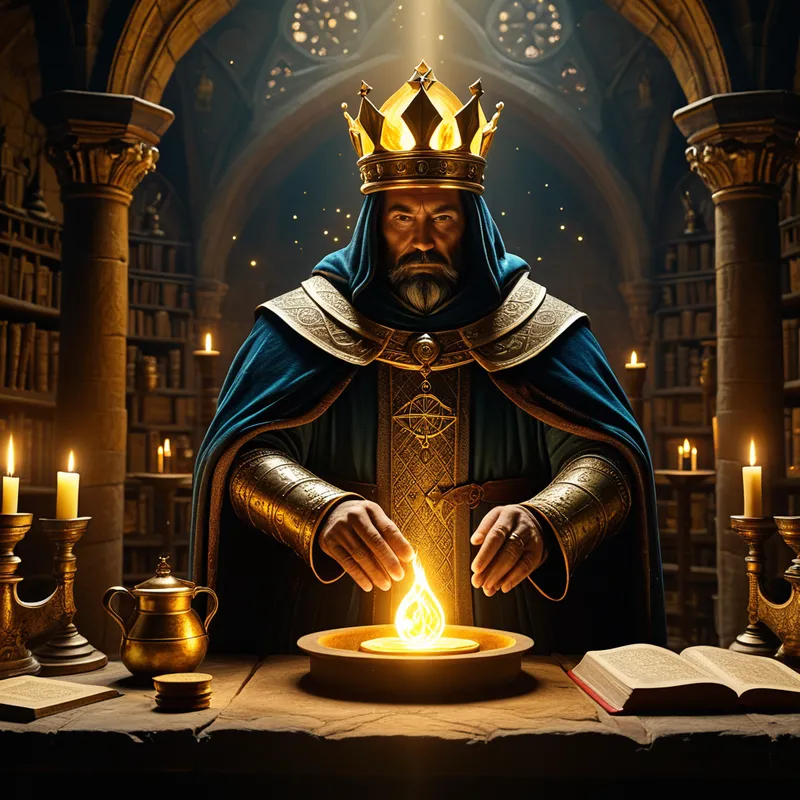
And then, at the zenith of the fire, when it seemed the vessel itself would shatter and all would be lost to ash, the crimson coalesced. It solidified, not into a dead stone, but into a living, breathing presence. The glow intensified from red to a brilliant, stable gold. From the opened vessel emerged not a powder, but a figure—a Corpus Glorificatum. It wore [the crown](/myths/the-crown “Myth from Various culture.”/) of the sun and the robe of the earth, its eyes holding the peace of the moon and the power of the stars. It was the Red King, the [Lapis Philosophorum](/myths/lapis-philosophorum “Myth from Alchemical culture.”/) made flesh. The long work was done. The base had become noble. The leaden soul had endured its own funeral, its purification, and now stood resurrected, radiant, and whole.
Cultural Origins & Context
The myth of [the Rubedo](/myths/the-rubedo “Myth from Alchemical culture.”/) is not a story told around hearths, but one encoded in cryptic texts, illustrated in enigmatic woodcuts, and practiced in the silent, smoke-filled laboratories of medieval and Renaissance Europe. Its primary tellers were the alchemists themselves—figures like Paracelsus or the anonymous authors of the [Rosarium Philosophorum](/myths/rosarium-philosophorum “Myth from Alchemical culture.”/). They were a bridge between worlds: part proto-chemist, part mystic, part psychologist.
The myth was transmitted through a “veiled language” (lingua franca), using the processes of physical chemistry—distillation, calcination, fermentation—as an elaborate allegory for spiritual and psychological transformation. Its societal function was deeply subversive and deeply personal. In an age of rigid religious dogma, it offered a direct, experiential path to divinity and immortality that bypassed institutional authority. It was a map for the salvation of the soul, but also a manual for the perfection of the individual self. The laboratory was a sacred microcosm, and the alchemist’s own [psyche](/myths/psyche “Myth from Greek culture.”/) was the true subject of [the great work](/myths/the-great-work “Myth from Alchemical culture.”/).
Symbolic Architecture
At its core, the Rubedo symbolizes the final [integration](/symbols/integration “Symbol: The process of unifying disparate parts of the self or experience into a cohesive whole, often representing psychological wholeness or resolution of internal conflict.”/) of the conscious and unconscious psyche, the [birth](/symbols/birth “Symbol: Birth symbolizes new beginnings, transformation, and the potential for growth and development.”/) of the Self from the union of opposites. The long trials of Nigredo (confronting the [shadow](/symbols/shadow “Symbol: The ‘shadow’ embodies the unconscious, repressed aspects of the self and often represents fears or hidden emotions.”/)) and [Albedo](/symbols/albedo “Symbol: In alchemy, the whitening stage representing purification, spiritual ascension, and the emergence of consciousness from darkness.”/) (assimilating the [anima](/symbols/anima “Symbol: The feminine archetype within the male unconscious, representing soul, creativity, and connection to the inner world.”/)/[animus](/symbols/animus “Symbol: In Jungian psychology, the masculine inner personality in a woman’s unconscious, representing logic, action, and spiritual guidance.”/)) are necessary precursors, but they leave the psyche in a state of refined, yet detached, purity.
The Rubedo is the suffering of spirit as it takes on flesh, and of flesh as it becomes spirit. It is incarnation.
The reddening is the critical phase. It represents [passion](/symbols/passion “Symbol: Intense emotional or physical desire, often linked to love, creativity, or purpose. Represents life force and deep engagement.”/), [blood](/symbols/blood “Symbol: Blood often symbolizes life force, vitality, and deep emotional connections, but it can also evoke themes of sacrifice, trauma, and mortality.”/), and [life](/symbols/life “Symbol: The symbol of ‘Life’ represents a journey of growth, interconnectedness, and existential meaning, encompassing both the joys and challenges that define human experience.”/) itself flooding back into the purified but disembodied [spirit](/symbols/spirit “Symbol: Spirit symbolizes the essence of life, vitality, and the spiritual journey of the individual.”/). It is [the ego](/myths/the-ego “Myth from Jungian culture.”/)’s final [resistance](/symbols/resistance “Symbol: An object or tool representing opposition, struggle, or the act of pushing back against external forces or internal changes.”/) to being utterly dissolved into the greater Self, and [the Self](/myths/the-self “Myth from Jungian culture.”/)’s insistence on manifesting through the individual. The fiery conflict in the [vessel](/symbols/vessel “Symbol: A container or structure that holds, transports, or protects something essential, representing the self, emotions, or life journey.”/) is the psychic [tension](/symbols/tension “Symbol: A state of mental or emotional strain, often manifesting physically as tightness, pressure, or unease, signaling unresolved conflict or anticipation.”/) of this ultimate commitment to wholeness. The [emergence](/symbols/emergence “Symbol: A process of coming into being, rising from obscurity, or breaking through a barrier, often representing birth, transformation, or revelation.”/) of the Red [King](/symbols/king “Symbol: A symbol of ultimate authority, leadership, and societal order, often representing the dreamer’s inner power or external control figures.”/) is the [symbol](/symbols/symbol “Symbol: A symbol can represent an idea, concept, or belief, serving as a powerful tool for communication and understanding.”/) of the individuated [personality](/symbols/personality “Symbol: Personality in dreams often symbolizes the traits and characteristics of the dreamer, reflecting how they perceive themselves and how they believe they are perceived by others.”/)—no longer at war with its parts, but ruling them with [the authority](/symbols/the-authority “Symbol: A figure representing power, control, and societal structure, often embodying rules, leadership, or external judgment.”/) of integrated experience. It is psychological sovereignty.
The Dreamer’s Resonance
When this myth stirs in the modern unconscious, it announces a profound somatic and psychological climax. Dreams may feature intense, transformative heat—a house fire that does not destroy but purifies, a crucible or forge, a heart glowing like a coal. The color red dominates: roses in impossible bloom, vast sunsets, blood that is not frightening but vital and rich.
Somatically, the dreamer may be processing a final, necessary “heating up” of a long-standing issue—a relationship, a creative project, a therapeutic breakthrough—where previously analyzed and understood components are now being subjected to the fire of lived reality and emotional commitment. There is a feeling of pressure, of a “point of no return,” and often, upon waking, a surprising sense of solidity and calm resolution, as if an internal alchemy has reached its conclusion outside of conscious awareness.
Alchemical Translation
For the modern individual, the Rubedo models the terrifying and glorious process of bringing one’s deepest realizations fully into life. We can understand our shadows (Nigredo). We can achieve clarity and insight (Albedo). But the Rubedo is the stage where we must “redden” that insight with our own blood, sweat, and tears—where we live our truth in the messy, complex, and passionate arena of daily existence.
It is the artist who, after years of study and false starts, finally pours their entire being into a work that is vulnerably, unmistakably them. It is the person who, having understood their patterns in therapy, must now make the agonizingly concrete choice to act differently in a heated argument with a loved one. The purified “white” understanding must marry the “red” passion of real-world engagement.
The Stone is not found in transcendence, but in the fully embodied, passionate, and compassionate engagement with a world that is both base and divine.
The [triumph](/myths/triumph “Myth from Roman culture.”/) of the Rubedo is not escape from humanity, but its ultimate fulfillment. It teaches that wholeness is achieved not by avoiding the fires of conflict, desire, and incarnation, but by passing through them with conscious intent, to emerge on the other side not as a disembodied spirit, but as a fully human being, radiantly and humbly alive. The lead of our limitations is not discarded; it is the essential ingredient transmuted into the gold of a meaningful life.
Associated Symbols
Explore related symbols from the CaleaDream lexicon: