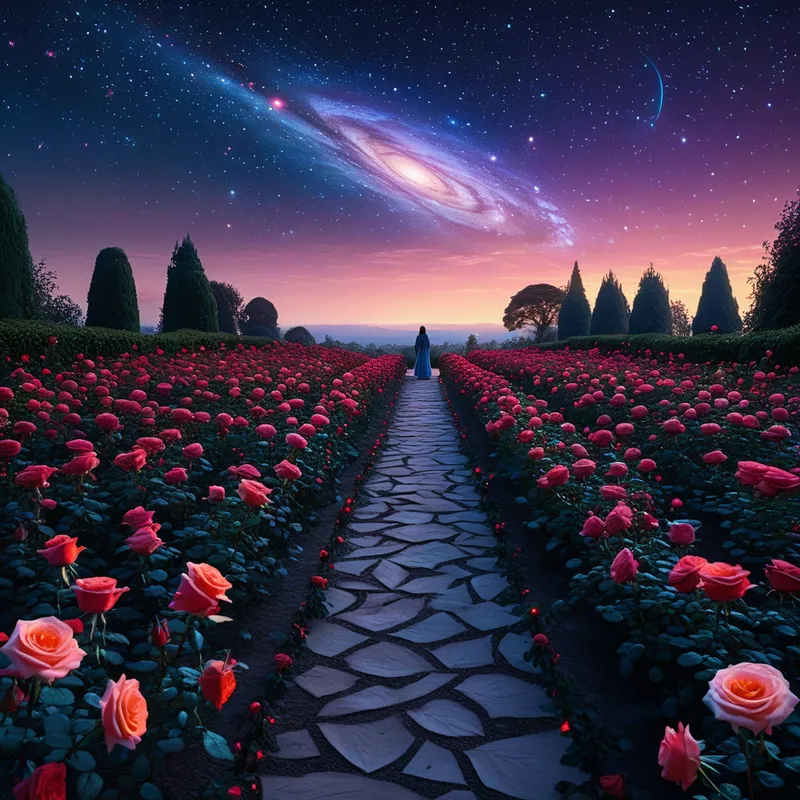
The Rose Garden Myth Meaning & Symbolism
A soul, separated from its divine source, journeys through the world of forms seeking the intoxicating fragrance of its true home, the Rose Garden of the Beloved.
The Tale of The Rose Garden
Listen, and let the story settle in your heart.
In the time before time, there was a garden. But this was no garden of earth and water; it was the Garden of the Essence, a place of pure, unmediated presence. Here, the Beloved walked among roses that were not flowers, but living expressions of divine attributes—roses of compassion, roses of beauty, roses of knowing. Their fragrance was not a scent, but the very atmosphere of union, so intoxicating that to breathe it was to know you were home.
And within this garden, there were sparks. Countless, luminous sparks, each a unique note in the symphony of the Beloved’s contemplation. They danced among the roses, their light reflecting the rose-light, their essence inseparable from the fragrance. They knew nothing of separation, for they were the garden and the garden was them.
Then came the Word: “Be.” And with that divine imperative, a great longing stirred—not a lack, but a deepening of love. The Beloved desired to be known, and to know Itself through the gaze of the Other. A mirror was needed. So, from the heart of the garden, a wind began to blow, a sacred breath. It was not a harsh wind, but a wind of creative yearning. It gathered the sparks, not to cast them out, but to send them forth on a journey of becoming.
One by one, the sparks were swept from the rose-laden branches. They did not fall, but were poured—like precious wine from a celestial decanter—into the vessel of the world. They found themselves clothed in clay, in form, in distance. The unity of the garden was replaced by the duality of creation: here and there, self and other, lover and Beloved. The direct fragrance was gone, replaced only by a memory so deep it felt like a wound in the soul—a sweet, aching homesickness known as the ishq.
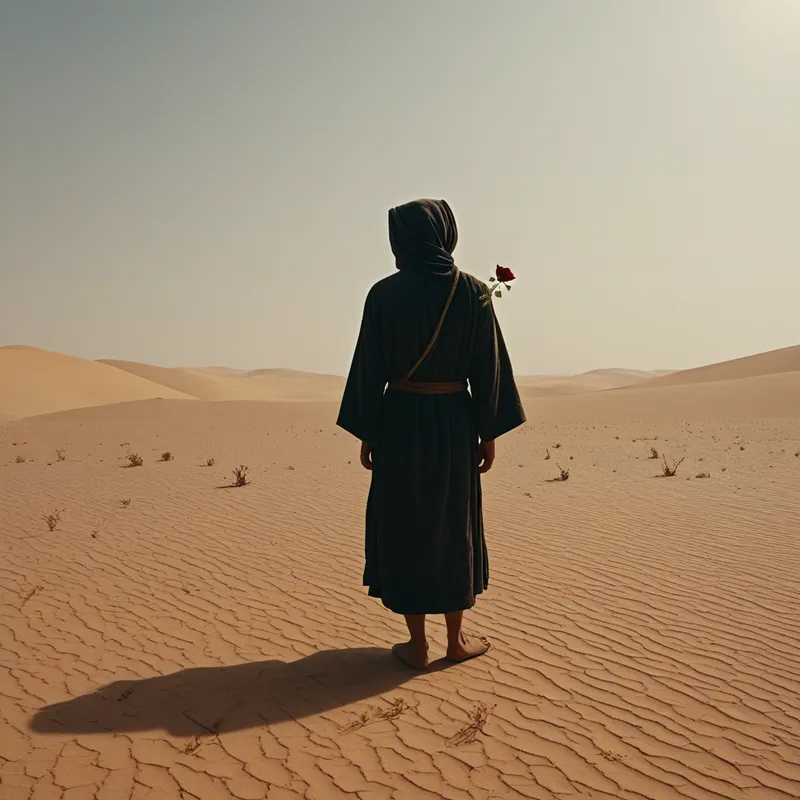
And so the journey begins. Each soul, now a wanderer in the arid plains of forgetfulness, moves through a world of shadows. It seeks in every beautiful face a reflection of that first beauty, in every kindness a whisper of that first compassion. It builds palaces of thought and towers of achievement, but the walls are cold and silent. It drinks from cups of pleasure, but the thirst remains. All the while, a faint, impossible fragrance teases the edge of awareness—a scent of roses carried on a wind from nowhere.
The soul becomes a seeker, a salik. It learns to still the noise of the world, to polish the heart-mirror clouded by the dust of identity and desire. It follows the fragrance through acts of love, through prayer that is not asking but remembering, through service that sees the Beloved in all faces. The path is the tariqa, and its milestones are not miles but states of burning and annihilation.
Until one day, the seeker stops seeking. The polished heart, cleansed by tears of longing, simply shatters. Not into pieces, but into openness. And in that shattering, the wind shifts. The faint fragrance becomes a storm of perfume. The wanderer looks down and sees that the desert sands have, without a sound, become rose petals. The path beneath their feet is the path. The garden was never a place to be reached, but a truth to be remembered. The Beloved turns, and the seeker realizes they are not looking at the Beloved, but from the Beloved’s eyes. The rose and the gardener are one. The journey ends where it began: in the breathless, fragrant silence of the Tawhid.
Cultural Origins & Context
The myth of the Rose Garden is not a single, codified story from a specific text, but a living, breathing tapestry woven from the core metaphors of Sufi poetry and teaching across centuries, from Persia to Anatolia, from the Maghreb to the Indian subcontinent. It finds its most exquisite expressions in the works of poets like Jalaluddin Rumi, for whom the rose garden (gulistan) was the soul’s true state, and Hafez, who used the rose’s beauty and thorns as the perfect analogue for the bittersweet agony of divine love.
It was passed down not as scripture, but as song, in the lyrical ghazals sung in taverns and khanqahs (Sufi lodges). It was whispered in teachings by a murshid to a disciple, using the imagery to map the interior landscape of the heart. Its societal function was profoundly subversive and unifying. In a world of religious law and social hierarchy, it spoke of a direct, intimate, and ecstatic connection with the divine that transcended form. It offered a mystical framework that could hold the pain of human existence—the poverty, the injustice, the heartbreak—and reframe it as the necessary fire of longing that purifies the soul for its ultimate return.
Symbolic Architecture
The myth is a masterclass in symbolic language, each element a key to an inner door.
The Garden: It represents the alam al-mithal, the imaginal world—not imaginary, but a realm of pure meaning and archetypal forms that exists between the divine essence and the material world. It is the soul’s pre-existent state of unity, the unconscious wholeness we carry within but have forgotten.
The Rose: The ultimate symbol of paradox. Its breathtaking beauty represents the sublime revelation of the Divine. Its intoxicating fragrance is the direct experience of grace, impossible to grasp or contain. Its sharp thorns are the necessary pains of existence—loss, limitation, yearning—that protect the beauty and make the journey toward it authentic. The rose is the Beloved itself, in all its alluring and dangerous glory.
The rose does not speak of its beauty; it is the beauty. In its presence, the seeker learns to stop describing God and start breathing God.
The Fragrance: This is the trace of the divine in the world, the ayat (signs) that point the way. It is intuition, synchronicity, moments of inexplicable grace, and the pang of beauty that brings tears to the eyes. It is the evidence of the garden’s reality in the midst of the desert.
The Journey & The Desert: The manifest world of multiplicity, separation, and ego-consciousness. The desert is not evil; it is the necessary condition for longing to arise. It is the stage where the drama of seeking—with all its trials, distractions, and egoic constructions—plays out, all to make the eventual discovery of the garden within the desert all the more revolutionary.
The Dreamer’s Resonance
When this myth stirs in the modern psyche, it often surfaces in dreams not of literal gardens, but of profound searching and scent. You may dream of wandering through endless, institutional corridors (the modern desert) following a faint, beautiful melody you can never find. You may dream of a door in your own home that you never noticed, slightly ajar, with golden light and the smell of rain-wet earth and flowers pouring out. You may struggle to open a book whose pages are blank, yet which emit a powerful emotional fragrance of nostalgia and promise.
Somatically, this is the process of the soul feeling its own existential homesickness. Psychologically, it signals a deep, often uncomfortable transition: the ego’s projects are losing their meaning. The career, the relationships, the possessions—the palaces built in the desert—are felt as ultimately insubstantial. A deeper, more authentic Self is pressing for recognition. The dreamer is experiencing the ache of the ruh calling to the conscious mind, initiating what Jung called the “numinous,” the sacred inner imperative that begins the process of individuation.

Alchemical Translation
The myth of the Rose Garden is a precise map for the alchemy of the Self. The prima materia (base material) is the soul in a state of identification with the persona and the personal history—the wanderer lost in the desert. The first stage, nigredo (blackening), is the burning thirst, the dark night of the soul where all worldly consolations fail and the longing becomes acute pain.
The albedo (whitening) is the polishing of the heart-mirror—the conscious work of self-observation, shadow integration, and letting go of egoic attachments. It is following the fragrance through therapy, art, meditation, or any discipline that purifies perception.
The climax is the rubedo (reddening), symbolized by the rose itself. This is not an achievement of the ego, but its annihilation (fana in Sufism). The conscious mind surrenders its central position and allows the larger, transpersonal psyche—the Self, the Beloved—to become the orienting principle. The desert becomes the garden. The personal pain of longing is revealed as the universal pulse of love that structures reality.
The final secret of the alchemy is that the furnace, the fuel, and the gold were never separate. The seeker’s burning was the rose’s blooming all along.
For the modern individual, this translates to a profound shift from seeking fulfillment from the world to recognizing the sacred within the world and within the very fabric of one’s own experience. The goal is not to escape life, but to see through its forms to the essential Rose Garden that sustains them. The triumph is the realization that you are not a stranger seeking home; you are the home, patiently awaiting your own recognition.
Associated Symbols
Explore related symbols from the CaleaDream lexicon: