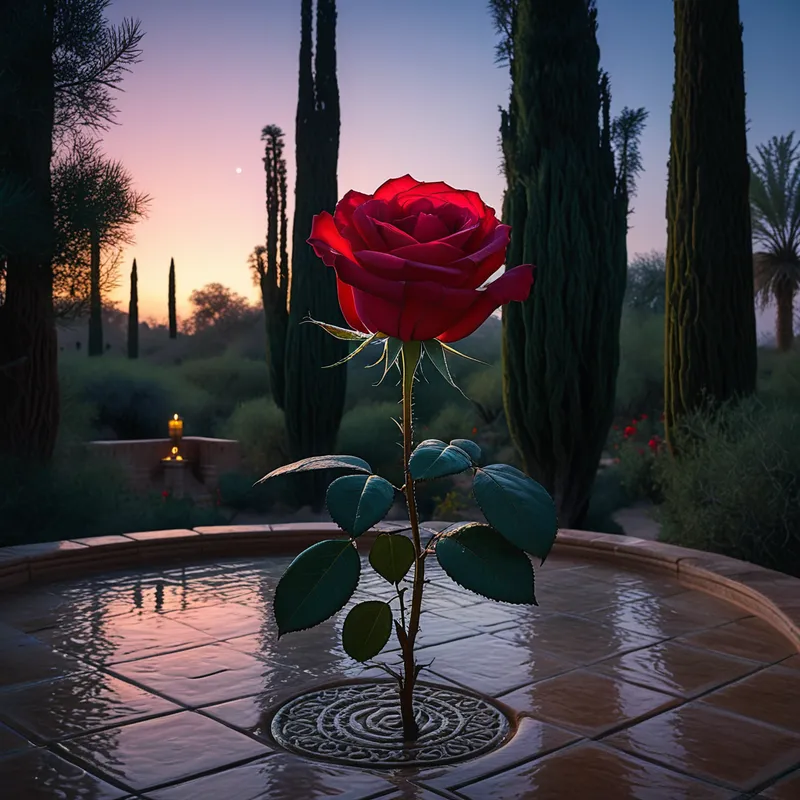
The Rose Myth Meaning & Symbolism
A myth where the first rose blooms from the sweat of the Prophet Muhammad, born from the tears of a nightingale mourning the coming of dawn.
The Tale of The Rose
Before time was counted in hours, when the world was a canvas of dust and longing, there existed a silence so profound it was a presence itself. This was the desert’s heart. In this expanse, under a cloak of stars so thick they seemed a solid dome of crushed diamond, there walked a being of pure song: the Bulbul. His life was the night, his soul a melody of yearning for the unattainable—the Moon. Each evening, he would pour his heart into the darkness, weaving songs of such piercing beauty that the very sands trembled.
One fateful night, as the Bulbul reached the crescendo of his celestial lament, a new light pierced the horizon. Not the cool silver of the Moon, but a burning, prophetic gold. It was the dawn, heralding the arrival of Muhammad upon the Earth. The Bulbul’s song choked into a silence more terrible than any sound. His beloved night was being torn asunder, his purpose shattered by this brilliant, inexorable light. A grief, vaster than the desert, welled up within him. He did not merely cry; his soul wept. A single, perfect tear, containing the essence of all his nocturnal devotion and his profound loss, fell from his eye.
That tear did not vanish into the sand. It was caught by the hand of the Divine, a sacred offering of pure, unadulterated feeling. From it, a miracle was fashioned. The first Rose was born. Its stem was green promise, its thorns the memory of pain, and its blossom—a burst of crimson softer than a sunset—was the tear itself, transformed. It held the perfume of the night and the color of dawn’s first blush.
But the story does not end in the soil. The Rose, this child of sacred sorrow, was presented to the Prophet. As he held this new, wondrous creation, a bead of perspiration formed upon his blessed brow from the awe of this divine gift. That drop, mingling with the essence of the Bulbul’s tear, fell upon the Rose’s heart. Where it landed, the scent intensified, becoming not just a fragrance, but a story—an eternal, wordless poem of love, loss, and the sublime beauty that bridges the two. The Bulbul, seeing his own grief made incarnate and blessed, found a new object for his eternal song. He flew to the Rose, pressing his breast against its thorn, singing now to the beauty born from his own pain, in a union of lover and beloved, sacrifice and creation.

Cultural Origins & Context
This myth, in its many variations, is woven into the very fabric of Persian-Islamic mystical tradition. It is not a single, canonical text from the Achaemenid or Sassanian eras, but a living story that blossomed in the rich soil of Persian Sufi poetry and oral tradition following the 7th-century Arab conquest. It represents a profound synthesis: the ancient Persian reverence for nature, particularly flowers like the lily and the rose, merged seamlessly with the new Islamic worldview, finding a place for divine prophecy within a framework of natural beauty and cosmic emotion.
The tale was carried by poets and mystics—thinkers like Ferdowsi, Saadi, and most notably Jalaluddin Rumi. In the Khaniqah and the court, it was recited not as mere folklore, but as a metaphysical teaching. Its societal function was multifaceted: it naturalized the arrival of Islam within the Persian aesthetic universe, it provided a model for understanding intense emotional and spiritual experience (especially love, or ‘ishq), and it offered a symbolic language for the soul’s relationship with the divine. The Rose became the ultimate symbol of this culture—a bridge between earth and heaven, pain and ecstasy, human longing and prophetic revelation.
Symbolic Architecture
At its core, the myth presents a sacred alchemy where the raw materials of human experience are transmuted into eternal beauty. Each element is a profound psychological symbol.
The Bulbul represents the soul in its state of primal longing—the ego attached to a specific object (the Moon/night) as its source of meaning. His devastating grief at the dawn is the necessary death of an old identity, the shattering of a worldview that precedes transformation.
The most profound beauty is never born in comfort; it is the alchemical child of a shattered heart.
The Dawn (and the Prophet) symbolizes a disruptive, transcendent truth entering the conscious world. It is the call to a higher order of being that initially feels like annihilation to the smaller self. The Bulbul’s tear is the crucial moment of surrender—the conscious acceptance of this painful new reality. It is the liquid essence of felt experience, the raw psychic material required for creation.
The Rose is the Self, the ultimate psychic creation born from this process. Its thorns are the necessary boundaries and protections (the memory of pain), its sublime fragrance and form are the integrated beauty of the transformed personality. The Prophet’s sweat—a human exertion in response to divine beauty—signifies that this creation is then blessed by consciousness, making it whole and holy.
The Dreamer’s Resonance
When this mythic pattern stirs in the modern unconscious, it often manifests in dreams of poignant, beautiful loss. One might dream of weeping tears that turn into jewels or flowers. They may dream of a beloved bird falling silent, or of a stunning, unexpected dawn that brings both awe and sorrow. The somatic sensation is often a sharp, sweet pain in the chest—the press of the thorn.
Psychologically, this signals a process of sacred mourning. The dreamer is not merely grieving a loss (a relationship, a job, an identity), but is in the fertile, painful space where that grief is being unconsciously recognized as the raw material for a new birth. The ego (the nightingale) is singing its last song to an old moon. The dream is the first tear falling—the psyche’s initial, involuntary acceptance of a transformative change. It is the feeling of profound vulnerability that precedes genuine growth, where the heart is being broken open, not just broken.
Alchemical Translation
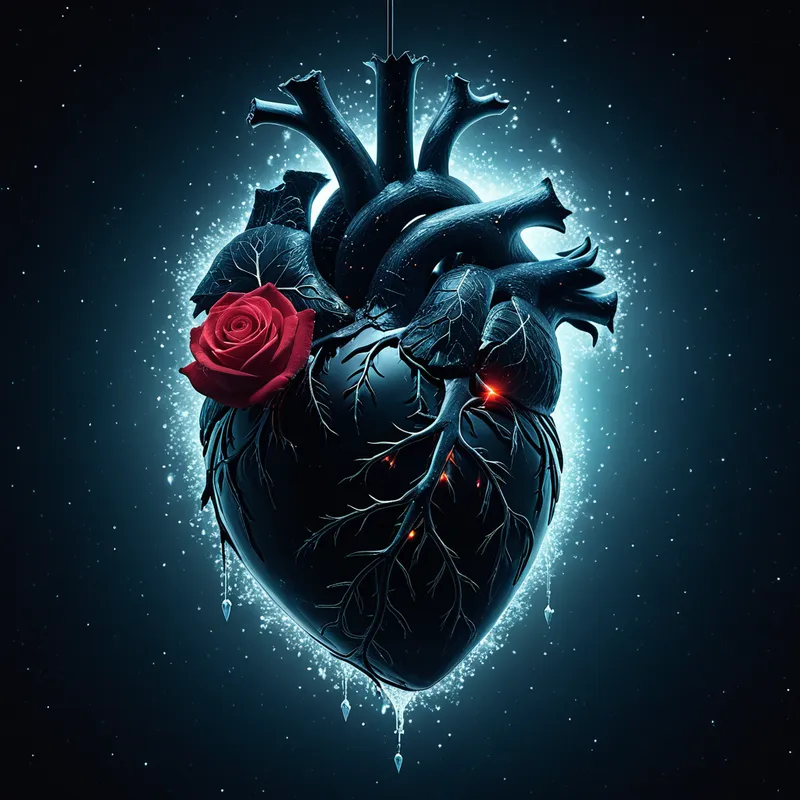
For the individual on the path of individuation, the myth of the Rose is a master map for psychic transmutation. The process begins with the Nigredo, the blackening: the Bulbul’s devastating realization that his old world (the night) is ending. This is the depression, confusion, or crisis that often initiates deep psychological work.
The Albedo, the whitening, is the shedding of the tear—the conscious engagement with the pain, the allowing of feeling without resistance. This is the purification, where one stops fighting the dawn and instead weeps at its beauty and its cost.
The thorn is not the Rose’s flaw, but its integrity; it remembers the cost of its own existence, and in doing so, makes its fragrance meaningful.
The Citrinitas, the yellowing, is the formation of the Rose itself—the slow, often unseen integration of the experience into the fabric of the self. New insights bud, a different perspective begins to color one’s life.
Finally, the Rubedo, the reddening, is the blessing of the Prophet’s sweat. This is the conscious realization and embodiment of the transformation. The integrated self (the Rose) is not a private treasure but a blessed creation that interacts with the world, offering its fragrance—its wisdom, compassion, or creativity—born directly from its encounter with the thorn. The modern individual completes this alchemy when they can look at their deepest wounds and, without denying the pain, recognize them as the source of their unique beauty, their sacred offering to the dawn of their own becoming.
Associated Symbols
Explore related symbols from the CaleaDream lexicon: