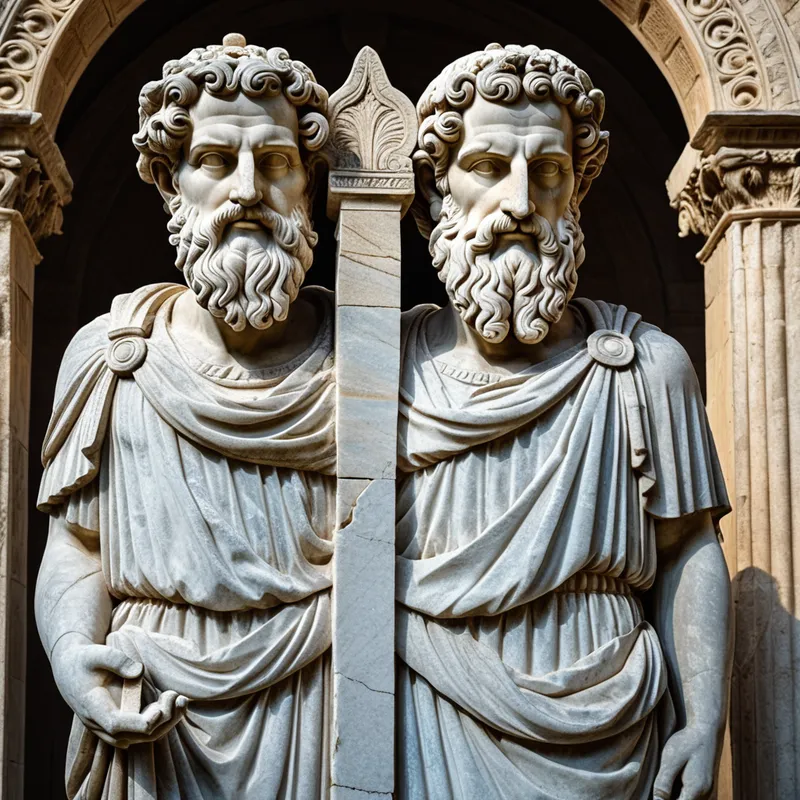
The Roman god Janus (god of ga Myth Meaning & Symbolism
The ancient Roman deity who sees past and future, guarding all thresholds and presiding over every beginning and ending with his dual gaze.
The Tale of The Roman god Janus (god of ga
Before Rome was a name, before the first stone of the Forum was laid, there was the threshold. And at the threshold, there was He.
Listen. In the primal silence, when the world was all potential and no form, a presence stirred at the very hinge of things. He was not born of the sky or the earth, but of the moment between them—the first deity, they would whisper, older than Jupiter, older than time as mortals know it. He was Janus.
Picture him not as a statue, but as a living force. He stands where the path meets the door, where the river meets the sea, where night bleeds into day. His form is one, yet his gaze is two. One face, weathered and wise, looks steadfastly into the deep, receding past, its eyes holding the memory of every footstep that has ever fallen. The other face, alert and resolute, peers into the unfolding, shimmering future, watching the paths that have yet to be walked. He does not merely watch; he is the watching. He is the guardian of the limen.
His domain was every beginning. The first cry of a newborn. The first prayer at a new altar. The first step of a journey. Before any other god could be invoked, his name was spoken: “Ianitor,” the Doorkeeper. His great temple in the heart of Rome had twin bronze doors. In times of peace, they were shut, a heavy, resonant silence held within. But when the legions marched to war, the doors were swung open with a groan that echoed through the seven hills—a sound that was both an ending of peace and a beginning of conflict. And through those doors, the army passed, under the dual gaze of the god who saw both their departure and, the people prayed, their safe return.
He held a key, for he unlocked seasons. He held a staff, for he guided passages. His month, Ianuarius, was the door to the year, a time of looking back at the harvests and trials gone by, and forward to the planting and hopes yet to come. He asked for no grand sacrifices, only a simple offering of far and wine at his small, humble altars that stood not in grand temples, but at crossroads, at bridges, at the very gates of homes. For his presence was not distant; it was intimate, immediate. It was the cold bronze of the latch under your hand, the creak of the hinge, the deep breath taken before crossing from the known into the unknown.
Cultural Origins & Context
Janus is a uniquely Roman conception, a deity with no clear counterpart in Greek mythology. This originality suggests he emerged from the deep, indigenous soil of Italic and Latin spirituality, born from a practical, agrarian people for whom boundaries were sacred and transitions perilous. His worship was woven into the fabric of the Roman state and the Roman home.
He was the god of the porta, the city gate, and the ianua, the house door. This was not mere symbolism; it was a matter of spiritual security. To pass a threshold without acknowledging Janus was to risk carrying chaos from one sphere into another. His priests, the Pontifices, oversaw the rituals that maintained these boundaries. The myth of Janus was not a single narrative epic but a living practice, passed down through ritual action, prayer formulae, and the architectural presence of his arches and gateways. His societal function was foundational: to sanctify order, to bless every commencement, and to provide a divine witness to the constant, necessary transitions of life, war, peace, and the turning year.
Symbolic Architecture
Janus is the archetypal symbol of the threshold itself. His two faces are not a representation of deceit, but of profound, conscious duality. He embodies the essential human condition of existing in a perpetual present that is forever informed by the past and leaning into the future.
To stand at a threshold is to hold the totality of your journey in a single, potent moment of choice.
Psychologically, Janus represents the ego’s capacity for reflection and foresight. One face is the function of Memory, the internal historian that stores experience, trauma, and wisdom. The other is the function of Intention, the projector that casts possibilities, plans, and anxieties onto the screen of what is to come. The healthy psyche, like Janus, does not choose one face over the other; it holds both in a unified consciousness, allowing the lessons of the past to inform the direction of the future. He is the god of the conscious decision, the moment of pivot where one integrates what has been to navigate what will be.
His key symbolizes access and transition—the ability to unlock new phases of life or to securely lock away what is finished. His staff represents the support needed for the journey through liminal space, the guidance required when one is neither here nor there.
The Dreamer’s Resonance
When the archetype of Janus stirs in the modern unconscious, it often manifests in dreams of doorways, crossroads, mirrors, or moments of frozen choice. A dreamer may find themselves paralyzed before two identical doors, or see their own reflection split into a younger and older self. They may dream of trying to close a door that will not latch, or of holding a key that fits no lock.
Somatically, this can correlate with feelings of suspension—a tightness in the chest, a sense of being “on the brink,” or literal hesitation at a physical threshold. Psychologically, this is the process of confronting a major life transition: a career change, the end of a relationship, a move, or any existential pivot point. The dream imagery reflects the psyche’s natural tension between the comfort (or burden) of the known past and the anxiety (or promise) of the unknown future. The Janus dream is an invitation from the unconscious to acknowledge this duality consciously, to honor both what is being left behind and what is being approached, before the step is taken.
Alchemical Translation
The individuation process, the alchemical journey of becoming whole, is a series of passages through psychic thresholds. Janus is the patron of this inner work. His myth models the essential act of psychic transmutation: the coniunctio oppositorum (union of opposites) applied to time and consciousness.
The first, often neglected, step in any inner transformation is the Janus gaze—the deliberate, simultaneous look backward and forward. Backward, not with nostalgia or regret, but with the clear-eyed assessment of the nigredo. What patterns, wounds, or achievements define my current position? Forward, not with fantasy or fear, but with the intentional vision of the albedo. What potential selves call to me?
The alchemist does not flee the threshold; he becomes the gateway. He learns to hold the tension of his own history and his own destiny until a third, transcendent perspective—the unified Self—emerges.
To integrate Janus is to perform this ritual at every major crossroads. It is to consciously “open the temple doors” when a new inner conflict (a war) must be engaged, and to “close them” when an old struggle has been integrated into peace. The key he holds is the insight that unlocks the next stage of development; the staff is the self-awareness that supports us through the disorientation of change. By embodying this dual consciousness, we stop being passive subjects of time and become active participants in our own unfolding, presiding over our own beginnings with the solemn wisdom of the god who was there before the beginning.
Associated Symbols
Explore related symbols from the CaleaDream lexicon: