The Roman god Janus Myth Meaning & Symbolism
The ancient Roman god who sees past and future, guardian of all doorways, embodying the eternal moment of choice and transition.
The Tale of The Roman god Janus
Before the first light cracks the shell of night, he is already watching. He does not sleep, for his vigil is eternal. He is the keeper of the hinge, the silent witness to every crossing. In the chill air of a Roman dawn, when the household is still wrapped in the wool of dreams, the father of the house rises. His feet are bare on the cold mosaic floor as he approaches the atrium. There, in a niche by the main door, is a small shrine. Not to Jupiter, nor to [Vesta](/myths/vesta “Myth from Roman culture.”/), but to him—[Janus](/myths/janus “Myth from Global/Universal culture.”/).
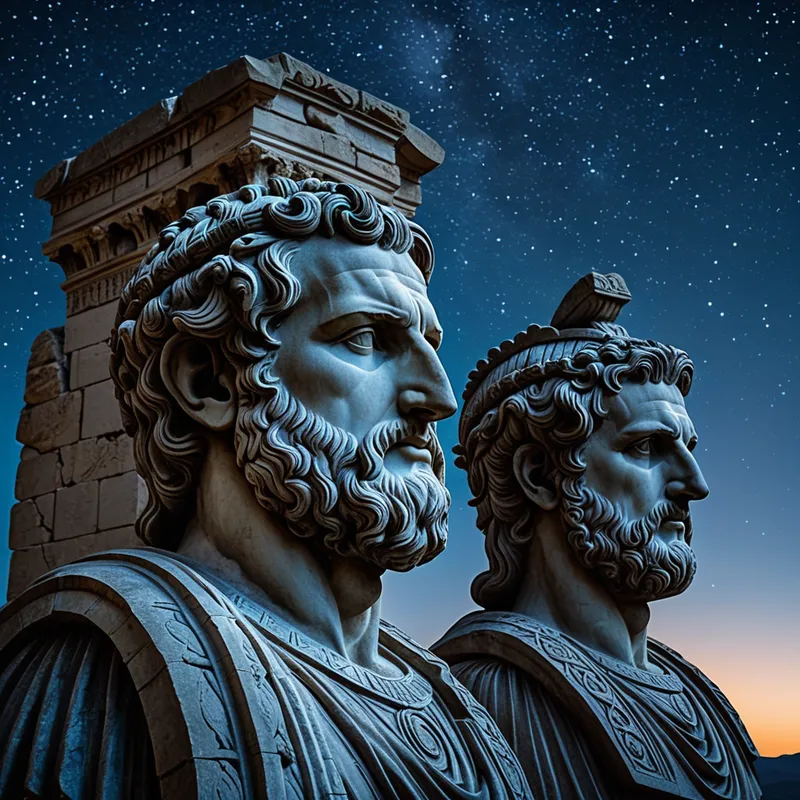
He is depicted there in clay or bronze, a figure with two faces set back-to-back. One face, often bearded and lined with the grooves of time, looks inward, into the dark, safe womb of the home. The other, clean-shaven and clear-eyed, looks outward, to the street, the forum, [the world](/myths/the-world “Myth from Tarot culture.”/) of action and strangers. The father murmurs a prayer, his breath a faint cloud in the dimness. He offers a pinch of incense, a few grains of salt. He is not asking for victory or riches. He is asking for permission. Permission to cross.
For Janus, Ianus Pater, holds the ianua—the door. Not just this wooden door, but every door. The gate of a city, the arch of a bridge, the passage from peace to war, from one year to the next, from life to birth and from life to death. He sees the path you have trodden and the path you will tread. He knows what you carry out and what you hope to bring back in.
When the legions march, it is through a gateway dedicated to him, its doors left swinging open until they return, for he must witness their departure and their hoped-for return. When the priests sacrifice, the first offering is always to Janus, for without his blessing, no communication with the other gods can pass through. He is the first, the primordial. In the oldest stories, he ruled a [golden age](/myths/golden-age “Myth from Universal culture.”/) in Latium, a time of natural law and peace, before the coming of kings. He is the stone at the foundation, the post of the gate, the moment of breath between an idea and an act.
His is a silent myth, without epic battles or tragic loves. His story is the creak of a hinge, the click of a latch, the suspended foot on [the threshold](/myths/the-threshold “Myth from Folklore culture.”/). It is the story of the in-between itself, given a face. Or rather, two.
Cultural Origins & Context
Janus is a uniquely Roman divinity, with no clear equivalent in Greek mythology. This singularity points to his deep, indigenous roots in the Italic and Roman worldview. He was not a god of lofty Olympus, but of the tangible, daily reality of boundaries. His worship was woven into the fabric of Roman state religion and domestic life.
His primary temple in Rome, the Janus Geminus, was a small, double-arched structure that served as a profound symbolic indicator. Its gates were open in times of war, signifying that the god’s gaze—and the army’s path—was directed outward. In times of peace, the gates were ceremoniously shut, a rare and celebrated event that contained the community within a state of harmony. This made Janus a divine barometer of the empire’s state of being.
On a personal level, every Roman home honored him at the entrance. The month of January (Ianuarius), later placed at the head of the reformed calendar, was sacred to him, marking the transition from the old year to the new. His priests, the Rex Sacrorum, began all public religious rites with an invocation to him. Janus was the necessary first step, the acknowledgment that all action occurs within a field of transition, and that every beginning requires a conscious departure from what came before.
Symbolic Architecture
Janus is the archetypal personification of the threshold, a [symbol](/symbols/symbol “Symbol: A symbol can represent an idea, concept, or belief, serving as a powerful tool for communication and understanding.”/) of immense psychological [depth](/symbols/depth “Symbol: Represents profound layers of consciousness, hidden truths, or the unknown aspects of existence, often symbolizing introspection and existential exploration.”/). His two faces are not a symbol of deceit, but of comprehensive [awareness](/symbols/awareness “Symbol: Conscious perception of self, surroundings, or internal states. Often signifies awakening, insight, or heightened sensitivity.”/). He embodies the essential duality of [consciousness](/symbols/consciousness “Symbol: Consciousness represents the state of awareness and perception, encompassing thoughts, feelings, and experiences.”/): [memory](/symbols/memory “Symbol: Memory symbolizes the past, lessons learned, and the narratives we construct about our identities.”/) and [anticipation](/symbols/anticipation “Symbol: A state of excited expectation about future events, often involving hope, anxiety, or readiness for what is to come.”/), experience and potential, introspection and [action](/symbols/action “Symbol: Action in dreams represents the drive for agency, motivation, and the ability to take control of situations in waking life.”/).
To stand in the Janus moment is to hold the totality of one’s story—the weight of the past and the pull of the future—without fleeing into either.
He represents the [limen](/myths/limen “Myth from Roman culture.”/), the [boundary](/symbols/boundary “Symbol: A conceptual or physical limit defining separation, protection, or identity between entities, spaces, or states of being.”/) that both separates and connects. A [door](/symbols/door “Symbol: A door symbolizes transition, opportunity, and choices, representing thresholds between different states of being or experiences.”/) is not merely a [barrier](/symbols/barrier “Symbol: A barrier symbolizes obstacles, limitations, and boundaries that prevent progression in various aspects of life.”/); it is a point of intentional [passage](/symbols/passage “Symbol: A passage symbolizes transition, movement from one phase of life to another, or a journey towards personal growth.”/). Psychologically, Janus governs all our inner thresholds: the [decision](/symbols/decision “Symbol: A decision in a dream reflects the choices one faces in waking life and can symbolize the pursuit of clarity and resolution.”/) to change a habit, to leave a [relationship](/symbols/relationship “Symbol: A representation of connections we have with others in our lives, often reflecting our emotional state.”/), to start a project, to forgive, to speak a difficult [truth](/symbols/truth “Symbol: Truth represents authenticity, honesty, and the quest for knowledge beyond mere appearances.”/). He is the psychic function that allows us to reflect on where we have been before committing to where we are going. He is the embodiment of [choice](/symbols/choice “Symbol: The concept of choice often embodies decision-making, freedom, and the multitude of paths available in life.”/) itself, which only exists in the present [moment](/symbols/moment “Symbol: The symbol of a ‘moment’ embodies the significance of transient experiences that encapsulate emotional depth or pivotal transformations in life.”/), at the point of [tension](/symbols/tension “Symbol: A state of mental or emotional strain, often manifesting physically as tightness, pressure, or unease, signaling unresolved conflict or anticipation.”/) between what was and what might be.
His association with beginnings is absolute because every true beginning is a conscious transition. He is the god of the “first time,” not of naive novelty, but of the deliberate, witnessed step across a line from one state of being to another.
The Dreamer’s Resonance
When the archetype of Janus stirs in the modern unconscious, it often manifests in dreams of thresholds, corridors, and mirrors. One might dream of standing before a significant door, unable to decide whether to open it. The door itself may shift—from a childhood home’s front door to a vast, ornate gate, to a simple, ominous, unmarked door in a blank wall.
Other common motifs include seeing one’s own reflection show a different age or expression, encountering two identical paths, or being in a vehicle (a modern “vessel of transition”) at a crossroads or a border checkpoint. The somatic feeling is one of suspension, of held breath, of acute awareness. There is often anxiety, but it is a focused anxiety, the body’s signal of a pending psychic shift.
This dream pattern signifies that the dreamer is at a critical point of internal transition. The [psyche](/myths/psyche “Myth from Greek culture.”/) is presenting the two “faces” of a situation: the known past (the comforts, wounds, and identities we carry) and the unknown future (the possibilities, risks, and new selves awaiting). The dream is an invitation to consciously occupy this liminal space, to do the “Janus work” of looking both ways before proceeding, of integrating reflection with intention.

Alchemical Translation
In the alchemy of individuation—the process of becoming a whole, integrated Self—the Janus archetype is the essential operator of the [nigredo](/myths/nigredo “Myth from Alchemical culture.”/) and the albedo. It is the function that allows for conscious separation from an old, outworn state (seeing it clearly with the backward face) and the clarification of intention for a new one (envisioning it with the forward face).
The psychic transmutation Janus models is not a blind leap, but a pivotal turn. One must fully face what is behind to truly orient toward what is ahead.
The modern individual is perpetually at thresholds: career changes, relational shifts, spiritual awakenings, reconciliations with mortality. The Janus process demands we pause at these junctures. It asks us to ritualize our transitions, however small. To consciously reflect on what a past phase taught us, what we are leaving behind, and what we hope to invite in. This is the act of “naming the month of January” for our own lives.
To integrate Janus is to develop a dual capacity: the sage’s reflective wisdom and the explorer’s forward momentum. It is to understand that every ending is structured like a door, and every beginning requires us to pass through it, carrying the wisdom of the face that looks back into the courage of the face that looks forward. In this sacred, suspended moment of choice, we become, like Janus, the guardians of our own becoming.
Associated Symbols
Explore related symbols from the CaleaDream lexicon: