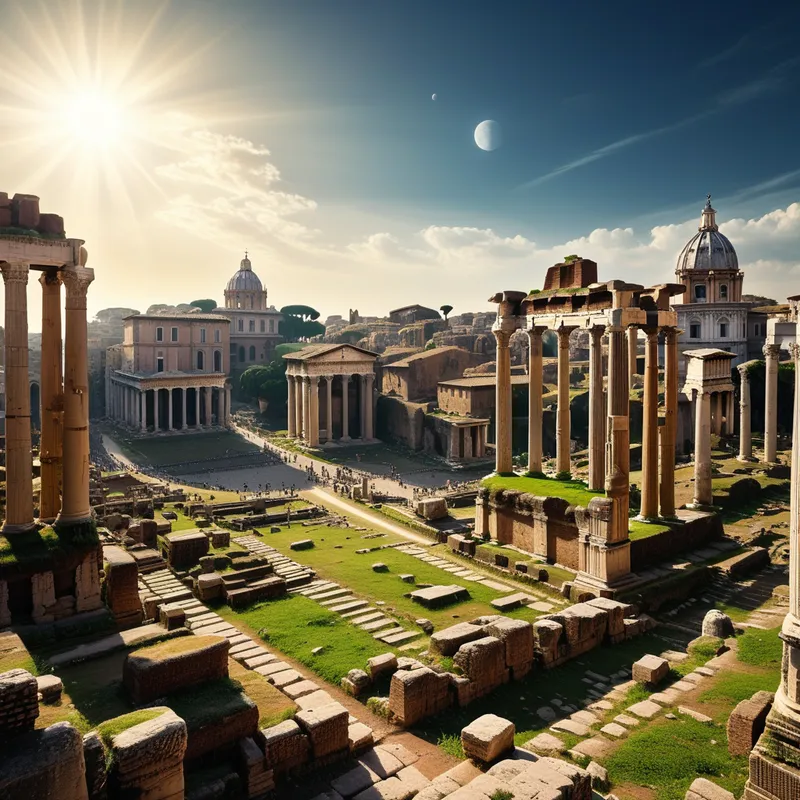
The Roman Forum Myth Meaning & Symbolism
The mythic founding of the Forum, where Romulus and Tatius reconciled, transforming a marshy battlefield into the sacred heart of law, commerce, and the Roman soul.
The Tale of The Roman Forum
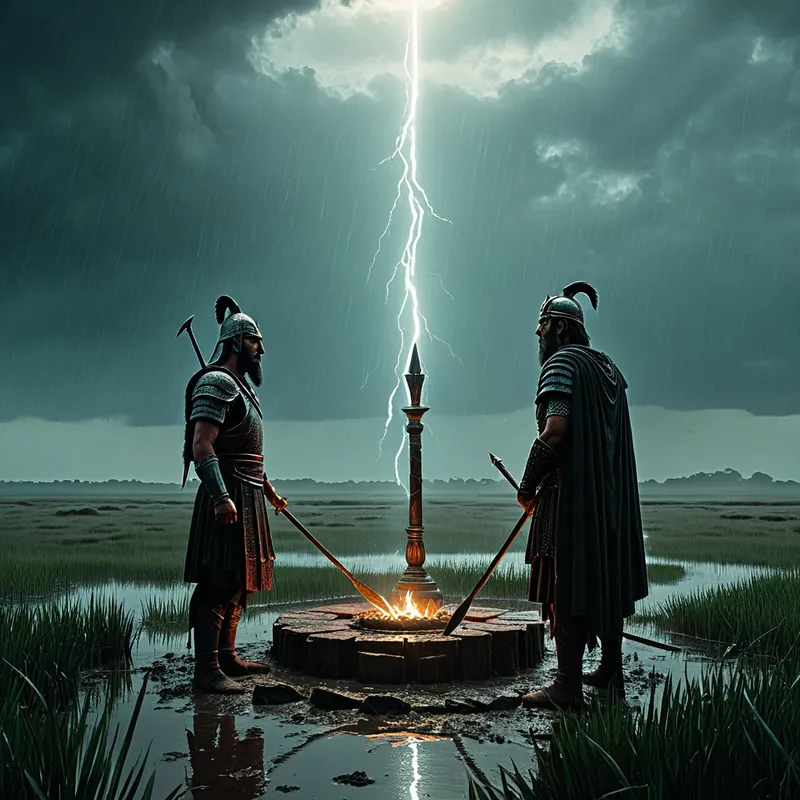
Listen. Before the marble gleamed, before the arches soared, there was only the silence of the swamp. A low, wet place between the hills, where the Tiber sighed and the willows wept. It was a place of mud and memory, a no-man’s-land between the Palatine, where [Romulus](/myths/romulus “Myth from Roman culture.”/) had drawn his sacred boundary, and the Quirinal, where the Sabine king Tatius nursed his wrath. The air hung thick with the ghosts of battle, for here, Roman and Sabine had clashed, steel ringing, a chaos born of stolen women and shattered oaths.
But the gods tire of endless strife. They speak in omens, in the flight of birds, in the sudden stillness of [the wind](/myths/the-wind “Myth from Various culture.”/). And so it was that Romulus, his cloak still stained with [the earth](/myths/the-earth “Myth from Hindu culture.”/) of his new city, looked upon the marsh and did not see a wasteland. He saw a threshold. Tatius, across the mire, felt the same pull—not of vengeance, but of a profound, weary necessity. Their people were now one people, bound by marriage and blood, yet divided by custom and grief. The land itself seemed to call for a different kind of offering.
They met in the center of the bog, the muck sucking at their sandals. No grand pavilions, only the open sky and the watching eyes of their blended people on the slopes above. They brought not weapons, but fire. From [the hearth](/myths/the-hearth “Myth from Norse culture.”/) of the Palatine and the hearth of the Quirinal, embers were carried down and combined upon a simple altar of turf. This was the first act: the creation of a common Ignis, a flame that would belong to neither, but to the space between.
Then, with solemn chants, they called upon Jupiter to witness, upon [Vesta](/myths/vesta “Myth from Roman culture.”/) to guard the new flame, and upon [Terminus](/myths/terminus “Myth from Roman culture.”/) to mark this not as an end, but as a beginning. They drained the marsh, not with magic, but with the sweat of shared labor, channeling the waters into the Cloaca Maxima. As the land dried, they paved it with stone, calling it the Via Sacra.
And from that stone, life erupted. The Curia rose for the voices of men. The Temple of Vesta housed [the eternal flame](/myths/the-eternal-flame “Myth from Universal culture.”/). The Rostra gave stage to argument and agreement. Commerce buzzed in the Basilica. This was no mere plaza; it was a living organism, a psychic anatomy made manifest. The conflict was not erased, but translated. The battlefield became the courtroom. The war cry became the legal argument. The spoils of war became the goods of trade. The marsh, that place of formless potential and stagnant memory, had been alchemized into the mundus, the ordered world—the Forum.
Cultural Origins & Context
The myth of the Forum’s founding is not a single authored tale, but a consensus of memory woven into the historical narratives of Livy, Dionysius of Halicarnassus, and Plutarch. It functioned as Rome’s foundational psycho-drama, recited by fathers to sons and embodied in every public ritual. Its tellers were the entire civic body; every lawsuit argued, every treaty signed, every [triumph](/myths/triumph “Myth from Roman culture.”/) processed down the Via Sacra was a re-enactment and reinforcement of the myth.
Societally, it served a critical function: to explain and sanctify the radical Roman concept of civitas (citizenship). Rome was unique in its willingness to absorb the conquered, to grant them a stake in the project. The Forum myth provided the sacred charter for this. It said: our origin is not purity, but synthesis. Our strength is not in erasing difference, but in creating a sacred, neutral ground—a templum in the original sense of a ritually defined space for observing auguries—where difference could be negotiated under shared, higher laws. The Forum was the physical and spiritual engine of this process, the place where the raw material of human conflict was refined into the gold of civil order.
Symbolic Architecture
Psychologically, the Forum is not a place, but a function of the [psyche](/myths/psyche “Myth from Greek culture.”/). It represents the conscious ego’s [capacity](/symbols/capacity “Symbol: A measure of one’s potential, limits, or ability to contain, process, or achieve something, often reflecting self-assessment or external demands.”/) to create an inner templum—a sanctioned, sacred [space](/symbols/space “Symbol: Dreaming of ‘Space’ often symbolizes the vastness of potential, personal freedom, or feelings of isolation and exploration in one’s life.”/) where opposing forces can meet, not for annihilation, but for [dialogue](/symbols/dialogue “Symbol: Conversation or exchange between characters, representing communication, relationships, and narrative flow in games and leisure activities.”/) and [integration](/symbols/integration “Symbol: The process of unifying disparate parts of the self or experience into a cohesive whole, often representing psychological wholeness or resolution of internal conflict.”/).
The primordial marsh symbolizes the undifferentiated, chaotic state of the unconscious, where emotions and complexes swirl without form or [direction](/symbols/direction “Symbol: Direction in dreams often relates to life choices, guidance, and the path one is following, emphasizing the importance of navigation in personal journeys.”/). It is the psychic “no-man’s-land” between conflicting internal factions: the aggressive, founding drive (Romulus) and the wounded, defensive, yet vital other (Tatius). The act of draining the marsh is the heroic, ego-driven work of [consciousness](/symbols/consciousness “Symbol: Consciousness represents the state of awareness and perception, encompassing thoughts, feelings, and experiences.”/)-making—bringing light, [structure](/symbols/structure “Symbol: Structure in dreams often symbolizes stability, organization, and the framework of one’s life, reflecting how one perceives their environment and personal life.”/), and dry land to the swampy [depths](/symbols/depths “Symbol: Represents the subconscious, hidden emotions, or foundational aspects of the self, often linked to primal fears or profound truths.”/) of instinct and [trauma](/symbols/trauma “Symbol: A deeply distressing or disturbing experience that overwhelms the psyche, often manifesting in dreams as unresolved emotional wounds or psychological injury.”/).
The altar built on bog-land is the first act of civilization: the establishment of a sacred center in the midst of chaos, a declaration that meaning will be made here.
Each building is an [organ](/symbols/organ “Symbol: An organ symbolizes vital aspects of life and health, often representing one’s emotional or physical state.”/) of a mature psyche. The Curia is the function of rational deliberation. The [Temple](/symbols/temple “Symbol: A temple often symbolizes spirituality, sanctuary, and a deep connection to the sacred aspects of life.”/) of Vesta is the [heart](/symbols/heart “Symbol: The heart symbolizes love, emotion, and the core of one’s existence, representing deep connections with others and self.”/)-center, the guarded core of [identity](/symbols/identity “Symbol: Identity represents the sense of self, encompassing personal beliefs, cultural background, and social roles.”/) and continuity. The Rostra is the voice, the capacity for [expression](/symbols/expression “Symbol: Expression represents the act of conveying thoughts, emotions, and individuality, emphasizing personal communication and creativity.”/) and persuasion. The Basilica is the function of exchange and [relationship](/symbols/relationship “Symbol: A representation of connections we have with others in our lives, often reflecting our emotional state.”/) with the outer world. Together, they form a model of the individuated Self, where all parts have a designated, respected place under the gaze of the inner [authority](/symbols/authority “Symbol: A symbol representing power structures, rules, and control, often reflecting one’s relationship with societal or personal governance.”/) (Jupiter).
The Dreamer’s Resonance
To dream of a forum is to dream of a critical moment of internal negotiation. Perhaps you wander a vast, empty Forum at dusk—this speaks to a feeling that your internal governance is vacant, that your inner laws are unenforced or ignored. The dream ego feels like a ghost in its own civic center.
To dream of arguing eloquently on the Rostra suggests you are successfully articulating a complex inner position, bringing a shadow element to conscious, persuasive speech. Conversely, to dream of being shouted down in the Forum indicates a feeling that your internal voice is being overwhelmed by other factions—perhaps the critical parent, the fearful child, or the rebellious saboteur.
A flooded Forum, with dark [water](/myths/water “Myth from Chinese culture.”/) lapping at the columns, is a powerful image of the unconscious threatening to reclaim the conscious order. It signals an emotional overwhelm that is dissolving the hard-won structures of [the ego](/myths/the-ego “Myth from Jungian culture.”/), a return of the repressed marsh. The somatic sensation here is often one of sinking, of being ungrounded. The dream calls not for higher walls, but for attending to the neglected Cloaca Maxima of the soul—the channels meant to healthily process and carry away psychic waters.
Alchemical Translation
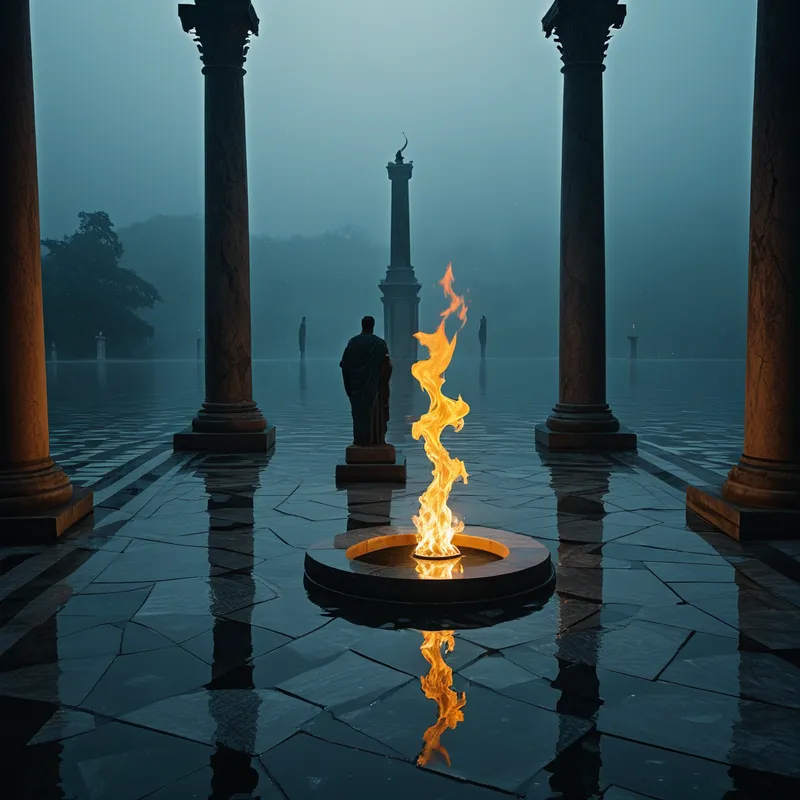
The alchemical process modeled here is coagulatio—the making solid. The [prima materia](/myths/prima-materia “Myth from Alchemical culture.”/) is the conflict itself, the bitter strife between Romulus and Tatius. This is not discarded, but is recognized as the essential, volatile ingredient. The first fire on the altar is the calcinatio, the burning off of pure hostility, leaving behind the ash of a shared reality: “We are now intertwined.”
The draining of the marsh is the [solutio](/myths/solutio “Myth from Alchemical culture.”/), the dissolving of old, rigid boundaries in the waters of shared labor, which then allows for a new, more complex form to precipitate. The paving of the Via Sacra is the true coagulatio: the spirit of the pact made solid in stone, walkable, real. The ongoing life of the Forum—the lawsuits, the elections, the debates—is the circulatio, the endless cycling and recycling of psychic material through this new vessel, leading to its refinement.
The ultimate goal is not peace, but pax deorum—the peace of the gods, which is a dynamic, ritualized state of right relationship between all parts of the system.
For the modern individual, the myth instructs that integration is an architectural feat. You cannot simply wish opposing parts of yourself into harmony. You must first sanctify a space for their meeting. You must build your inner Rostra to give them voice, your inner Curia to judge their claims, and tend your inner Vesta flame to maintain the core warmth of selfhood throughout the process. The conflict is not the problem; the absence of a Forum is. The myth of the Forum is the blueprint for building that psychic agora where the soul’s democracy can, however messily, govern.
Associated Symbols
Explore related symbols from the CaleaDream lexicon: