The Robe of Nessus from Greek Myth Meaning & Symbolism
A poisoned garment, a gift of love, becomes an instrument of agonizing death, revealing how the shadow can corrupt even our purest intentions.
The Tale of The Robe of Nessus from Greek
Hear now the story not of a glorious battle, but of a quiet, creeping doom. It begins not with a roar, but with a river’s deceptive murmur.
The great hero Heracles had won his bride, the beautiful Deianeira, through contest and strength. They traveled the wild lands, a king and queen of the road. Their journey brought them to the wide, rushing waters of the river Evenus. The current was a fury, impossible to ford. But there stood a ferryman, a creature of two natures: Nessus. From the waist up, a man, cunning and strong; from the waist down, the powerful haunches of a stallion. He offered his service.
Heracles, trusting in his own might to see him through, plunged into the torrent himself, leaving his beloved wife in the centaur’s care. But as Heracles fought the current, a darker fire kindled in Nessus. The centaur, beholding Deianeira’s beauty, was seized by a bestial lust. No sooner had Heracles reached the far bank than he heard his wife’s cry. He turned to see the centaur galloping away with her, his hooves pounding the earth in a rhythm of theft.
A cold fury settled in Heracles’ heart. He fitted an arrow to his bow—no ordinary arrow, but one whose tip was black with the venomous blood of the Lernaean Hydra. The string sang. The arrow flew, a streak of fatal light. It found its mark in the centaur’s back, piercing heart and lung. Nessus stumbled, his life fleeing into the river mud.
But as the centaur lay dying, a final, poisonous thought took root. With his last breath, he called Deianeira to him. “Lady,” he gasped, blood flecking his lips, “I am a dying wretch. Take my tunic, soaked in my blood. It is a powerful philtre. If ever your husband’s love should wane, anoint this robe and have him wear it. His heart will return to you, burning as it did on your wedding day.” Deianeira, her own heart a tumult of fear and gratitude, took the garment. She folded it away, a secret treasure, a hidden safeguard against a future sorrow.
Years passed. Heracles, ever the hero, waged his wars and founded cities. Yet rumor, that sly serpent, found its way to Deianeira’s ear. It whispered of a new captive, the princess Iole, and of Heracles’ newfound passion. The old fear awoke. Remembering the centaur’s gift, she acted. In secret, she soaked the robe in the centaur’s clotted blood and sent it to her husband as a gift of victory, a garment woven with desperate love.
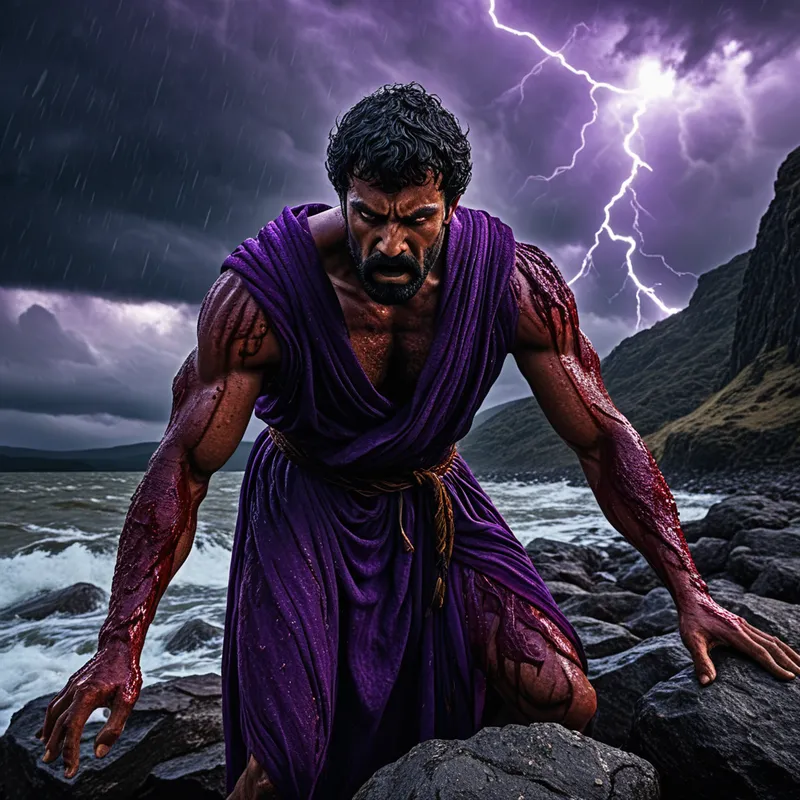
Heracles, preparing a sacrifice to the gods, donned the robe. At first, it was merely fine cloth. Then, as the heat of the altar fire and the sun touched it, a change began. The blood in the weave awoke. It seethed. It burned. The robe clung to his skin, not as fabric, but as a second layer of flesh made of acid and fire. The greatest hero in the world was brought to his knees not by a giant or a god, but by a shirt. He screamed, a sound that shook the trees, and tore at the cloth, but it fused to him, eating into muscle and bone. In his agony, he understood the centaur’s final, laughing revenge. There was no cure, no antidote. The love-gift had become a shroud. His mighty labors ended not in glory, but on a pyre of his own making, on Mount Oeta, where only fire could cleanse the unendurable pain.
Cultural Origins & Context
This harrowing conclusion to the saga of Heracles originates from the rich oral traditions of ancient Greece, crystallized in the tragic plays of Sophocles in his Women of Trachis and referenced in later works like those of Ovid. Unlike tales of straightforward monster-slaying, this myth functioned as a profound cautionary tale about the complexities of human relationships, the unintended consequences of action, and the inescapable weave of fate, or Moira.
It was a story told not just to celebrate heroism, but to interrogate it. It served society by illustrating that even the greatest strength is vulnerable to subtler poisons: jealousy, good intentions gone awry, and the lingering venom of past transgressions. The myth underscores a world where actions create chains of causality that even heroes cannot break, a core tenet of Greek tragic thought. It moved the heroic narrative from the external battlefield to the internal, psychological landscape, where the deadliest enemies are often the ones we carry with us, disguised as gifts.
Symbolic Architecture
The Robe of Nessus is one of mythology’s most potent symbols of the corrupted gift and the embodied shadow.
The most fatal poison is often delivered in the vessel of love, and the most persistent enemy is the one we invited in, believing him a friend.
The Robe itself symbolizes a poisoned inheritance or a fatal solution. It is the “cure” that kills, representing any ideology, relationship pattern, or unconscious complex we adopt to solve a problem, only to discover it is the problem itself, now worn on our very skin. The Blood of Nessus, mingled with the Hydra’s venom, is the essence of a defeated but unresolved shadow. Nessus, the lustful, bestial trickster, is not truly gone; his consciousness—his vengeful intent—is preserved in his blood, waiting for the heat of passion or circumstance to reactivate it.
Deianeira represents the innocent agent of fate, operating from fear and a desire to preserve love. Her action is not malicious, but it is unconscious. She attempts to manipulate love through a charm, a superficial fix for a deep relational wound, thereby activating a dormant curse. Heracles, in this final act, is the ego identified with its own invincibility, finally meeting a foe it cannot wrestle or strangle—a psychological toxin that works from the inside out.

The Dreamer's Resonance
When this myth pattern stirs in the modern dreamer, it often manifests as somatic nightmares of contamination or entrapment. To dream of a piece of clothing that cannot be removed, that burns or constricts, signals that the psyche is processing a “poisoned garment”—a role, identity, or commitment that has turned toxic.
The dreamer may be entangled in a relationship or career path that once felt like a “gift” or a solution to loneliness or insecurity but has now become a source of slow, psychological dissolution. The feeling is one of being fused to one’s own mistake, of being unable to extricate oneself without tearing away a part of the self. The heat in the myth—the sacrificial fire that activates the poison—translates in dreams as a situation of intense pressure, conflict, or passionate emotion that catalyzes a latent psychological crisis, revealing the true, corrosive nature of a long-held belief or attachment.

Alchemical Translation
The alchemical journey modeled here is the brutal but necessary process of calcinatio—reduction by fierce fire. For the modern individual seeking individuation, the Robe of Nessus represents the ultimate confrontation with the shadow material we have unwittingly incorporated into our personality structure.
The path to the Self requires the incineration of the persona we thought was our salvation, for only in that ash can the gold of authentic being be found.
The first step is recognition: seeing that the “solution” (the robe of security, the identity of the lover, the caregiver, the hero) has become the source of agony. Heracles’ tearing at the fabric is the futile ego’s attempt to solve a problem on the level it was created. The myth tells us this is impossible. The only transmutation available is total, sacrificial surrender. The pyre on Mount Oeta is the symbolic death of the old, contaminated ego-structure.
For us, this translates as the willingness to let a part of our life—a defining relationship, a cherished self-image, a long-held narrative—burn away. It is not a gentle release but an agonizing dissolution. Yet, in the full myth, this fiery death is what allows Heracles’ divine, immortal part to ascend to Olympus. Psychologically, this is the emergence of the true Self, liberated from the poisoned garments of complex-driven behavior. The alchemy is catastrophic but purifying. We must be willing to be consumed by the truth of our situation to be freed from the enchantment of the false cure. The Robe teaches that salvation often looks like annihilation, and the gift that binds us must be utterly destroyed for the authentic self to be born.
Associated Symbols
Explore related symbols from the CaleaDream lexicon: