The Road to Emmaus Myth Meaning & Symbolism
Two disciples, shattered by loss, walk a dusty road. A stranger joins them, rekindles their hope, and reveals himself in the simple act of breaking bread.
The Tale of The Road to Emmaus
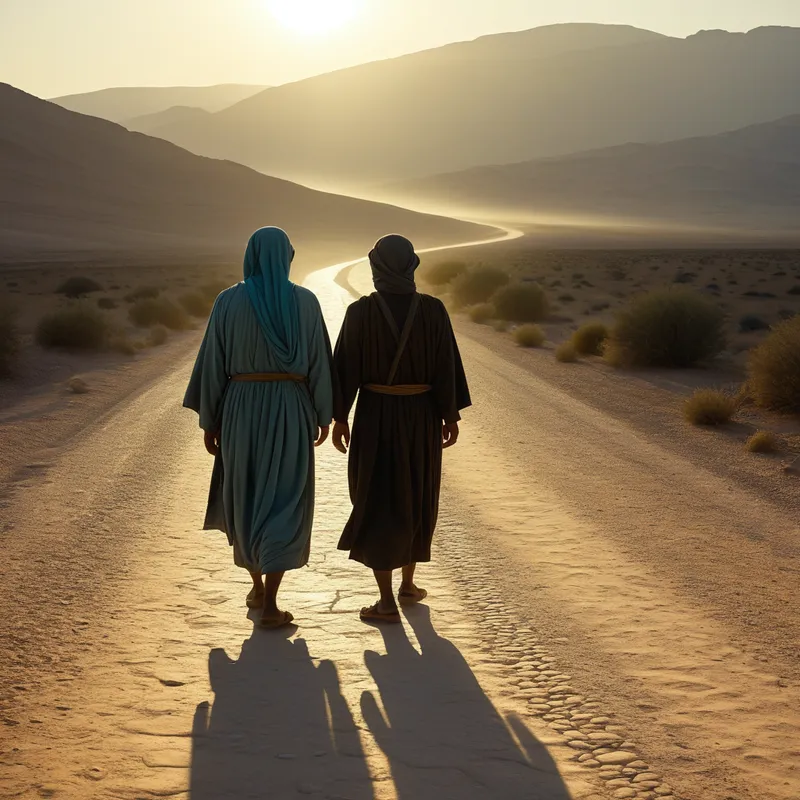
[The world](/myths/the-world “Myth from Tarot culture.”/) had broken. [The sky](/myths/the-sky “Myth from Persian culture.”/), which three days prior had torn itself black at noon, now hung a pale and indifferent blue over the dust of Judea. On a road leading away from [Jerusalem](/myths/jerusalem “Myth from Biblical culture.”/), a road of defeat and retreat, walked two men. Their names were Cleopas and his companion, their footsteps heavy as millstones, their voices the low, broken murmur of a shared wound.
They spoke of the shattered hope, the prophet mighty in deed and word, delivered up and crucified. They spoke of the strange, empty tomb reported by the women that very morning, a tale that felt like salt in the raw gash of their grief. The seven-mile stretch to Emmaus was a pilgrimage of despair.
Then, a presence. A stranger fell into step beside them. He walked as one who knew the road, yet his face was unknown, his manner calm amidst their storm. “What is this conversation you are holding as you walk?” he asked, his voice cutting the thick air of their sorrow.
They stopped, faces etched with a pain so profound it was a kind of blindness. “Are you the only visitor to Jerusalem who does not know the things that have happened there in these days?” Cleopas replied, the words bitter on his tongue. And they poured out the story: the betrayal, the trial, the horror of the cross, the third-day rumors that felt like cruel ghosts.
[The stranger](/myths/the-stranger “Myth from Biblical culture.”/) listened, a patient silhouette against the waning light. And then he spoke. Not with empty comfort, but with fire. “Was it not necessary that the Messiah should suffer these things and enter into his glory?” Beginning with [Moses](/myths/moses “Myth from Biblical culture.”/) and all [the Prophets](/myths/the-prophets “Myth from Biblical culture.”/), he interpreted to them in all the Scriptures the things concerning himself. The road itself seemed to change; the dust glowed, the scriptures they knew by heart cracked open like seeds, revealing a hidden, terrifying, glorious pattern they had never seen. Their hearts, moments ago cold stones in their chests, began to burn within them.
As they approached the village, the stranger made as if to go on. But they constrained him, their hospitality born of a desperate, newfound hunger. “Stay with us, for it is toward evening and the day is now far spent.” He entered their unassuming shelter.
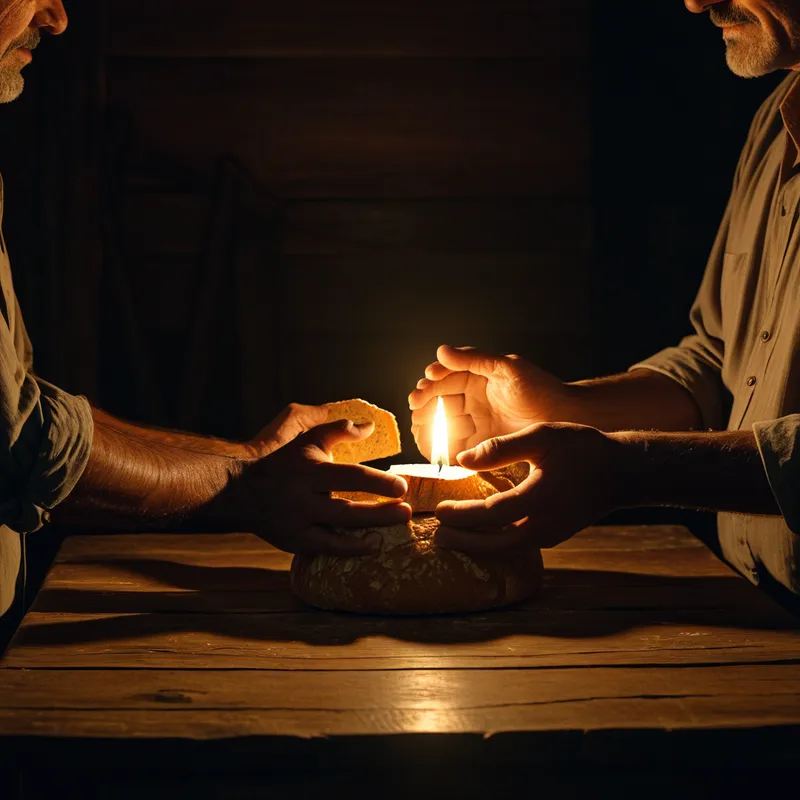
He reclined at their table. He took the bread. He blessed it. He broke it.
And in that simple, sacred, human act—the tearing of the loaf, the sharing of sustenance—the scales fell. Their eyes were opened, and they recognized him. It was him. The teacher. The crucified. The living. And in the very instant of recognition, he vanished from their sight.
They sat in the stunned silence of the aftermath, the broken bread before them. Then they spoke, voices trembling with awe. “Did not our hearts burn within us while he talked to us on the road, while he opened to us the Scriptures?” The night was no longer for hiding. Immediately, though the hour was late and the road dark, they rose and returned the seven miles to Jerusalem, not with the slow tread of defeat, but with the swift feet of witnesses, to proclaim a truth discovered not in [the temple](/myths/the-temple “Myth from Jewish culture.”/), but on the road, in the breaking of bread.
Cultural Origins & Context
This narrative is found solely in the Gospel of Luke (Chapter 24:13-35), a text composed in the latter half of the first century CE. It is a uniquely Lukan story, absent from the other canonical gospels, suggesting it originated within a specific stream of early Christian oral tradition that Luke accessed. Its function was multifaceted for a community defining itself in [the shadow](/myths/the-shadow “Myth from Jungian culture.”/) of the crucifixion and in the light of [the resurrection](/myths/the-resurrection “Myth from Christian culture.”/).
Societally, it served as a powerful etiological myth for the central Eucharistic practice. The story authorizes the experience of Christ’s real presence not in spectacular visions, but in the communal, scriptural, and sacramental life of the fledgling church. It was told to believers who had not witnessed the physical resurrection, assuring them that recognition of the divine occurs in fellowship (“while he talked to us on the road”) and ritual (“in the breaking of the bread”). Furthermore, it models a hermeneutic—a way of reading their own Jewish scriptures through a new, shocking lens that made sense of catastrophic suffering. The story passed from teller to listener as an invitation: your despair is the very road on which understanding walks beside you.
Symbolic Architecture
The myth is a masterful map of the [psyche](/myths/psyche “Myth from Greek culture.”/)’s [movement](/symbols/movement “Symbol: Movement symbolizes change, progress, and the dynamics of personal growth, reflecting an individual’s desire or need to transform their circumstances.”/) from [disintegration](/symbols/disintegration “Symbol: A symbol of breakdown, loss of form, or fragmentation, often reflecting anxiety about personal identity, control, or stability.”/) to re-[integration](/symbols/integration “Symbol: The process of unifying disparate parts of the self or experience into a cohesive whole, often representing psychological wholeness or resolution of internal conflict.”/). The road is the individuation [journey](/symbols/journey “Symbol: A journey in dreams typically signifies adventure, growth, or a significant life transition.”/) itself, taken in a state of profound disorientation. Jerusalem, the place of [trauma](/symbols/trauma “Symbol: A deeply distressing or disturbing experience that overwhelms the psyche, often manifesting in dreams as unresolved emotional wounds or psychological injury.”/) and shattered symbols, must be left behind for the work of meaning-making to begin.
The two disciples represent the dualistic, debating, analytical mind—[the ego](/myths/the-ego “Myth from Jungian culture.”/) conscious only of its [loss](/symbols/loss “Symbol: Loss often symbolizes change, grief, and transformation in dreams, representing the emotional or psychological detachment from something or someone significant.”/), walking in a literal and psychological “downward” [direction](/symbols/direction “Symbol: Direction in dreams often relates to life choices, guidance, and the path one is following, emphasizing the importance of navigation in personal journeys.”/) (away from the holy center). The [stranger](/symbols/stranger “Symbol: A stranger in dreams can represent unfamiliar aspects of the self or new experiences.”/) is the emergent [Senex](/symbols/senex “Symbol: The wise old man archetype representing spiritual authority, ancestral wisdom, and the integration of life experience into transcendent knowledge.”/) [archetype](/symbols/archetype “Symbol: A universal, primordial pattern or prototype in the collective unconscious that shapes human experience, behavior, and creative expression.”/), the latent wholeness of [the Self](/myths/the-self “Myth from Jungian culture.”/) that approaches the fractured ego not with grand [announcement](/symbols/announcement “Symbol: An announcement in dreams often symbolizes the arrival of new information or significant changes in one’s life.”/), but as a fellow [traveler](/symbols/traveler “Symbol: A person on a journey, representing movement, transition, and the search for new experiences or self-discovery.”/). He does not erase their [grief](/symbols/grief “Symbol: A profound emotional response to loss, often manifesting as deep sorrow, yearning, and a sense of emptiness.”/); he re-contextualizes it within a larger, sacred narrative.
The divine does not abolish the wound; it is revealed through the story of the wound, when that story is heard with new ears.
The “burning [heart](/symbols/heart “Symbol: The heart symbolizes love, emotion, and the core of one’s existence, representing deep connections with others and self.”/)” is the somatic signal of numinosity, the [body](/symbols/body “Symbol: The body in dreams often symbolizes the dreamer’s self-identity, personal health, and the relationship they have with their physical existence.”/)’s knowing before the mind’s recognition. It is the feeling-function awakening. Finally, the “breaking of the [bread](/symbols/bread “Symbol: Bread symbolizes nourishment, sustenance, and the daily essentials of life, often representing fundamental needs and comfort.”/)” is the ultimate [symbol](/symbols/symbol “Symbol: A symbol can represent an idea, concept, or belief, serving as a powerful tool for communication and understanding.”/). It is the act that shatters literal [perception](/symbols/perception “Symbol: The process of becoming aware of something through the senses. In dreams, it often represents how one interprets reality or internal states.”/). The shared [meal](/symbols/meal “Symbol: A meal often symbolizes nourishment, not just physically but emotionally and spiritually, representing the aspects of sharing and community.”/), the tearing of sustenance, becomes the [moment](/symbols/moment “Symbol: The symbol of a ‘moment’ embodies the significance of transient experiences that encapsulate emotional depth or pivotal transformations in life.”/) where the transcendent (numinous) intersects the immanent (the everyday). Recognition happens not in abstract theology, but in intimate, embodied participation.
The Dreamer’s Resonance
When this myth pattern stirs in the modern unconscious, it often manifests in dreams of companionship on a journey. The dreamer may be walking a long road, driving a car on an endless highway, or navigating a labyrinthine city. A figure is present—a quiet passenger, a fellow hiker, a taxi driver. This figure is often faceless, familiar-yet-strange, exuding a calm authority. The conversation in the dream is crucial; the companion may be explaining something, re-telling the dreamer’s own story back to them in a way that makes sudden, poignant sense.
Somatically, upon waking, the dreamer may recall a feeling of profound warmth, clarity, or “burning” conviction in the dream, even if the narrative was mundane. The psychological process is one of the Anima/Animus or the Senex constellating to guide the ego through a period of meaning-loss—after a career ends, a relationship dissolves, or a long-held belief collapses. The dream says: you are not alone in your despair. The wisdom to understand your story is walking with you, waiting for the moment of “breaking,” of shared vulnerability, to be revealed.

Alchemical Translation
Psychic transmutation, in Jungian terms, follows the [nigredo](/myths/nigredo “Myth from Alchemical culture.”/), albedo, [rubedo](/myths/rubedo “Myth from Alchemical culture.”/) sequence. The Road to Emmaus is a perfect allegory for this alchemical opus.
The nigredo—the blackening, the descent—is the crushing despair of the crucifixion and the disciples’ retreat. All known meaning is dead; the ego is in ashes. The journey to Emmaus is the beginning of the albedo—the whitening, the washing. The stranger’s scriptural interpretation is the [solutio](/myths/solutio “Myth from Alchemical culture.”/), the dissolving of old, rigid understandings in the waters of a new perspective. The “burning heart” is the first inner heat of the process, the calcinatio.
The Self is not found by fleeing the road of despair, but by allowing it to become the crucible where old certainties are burned away, making space for a recognition that shatters perception.
The invitation to stay (“it is toward evening”) is the crucial coagulatio—the condensation of this new, fluid understanding into a concrete, hospitable moment. Then comes the supreme act: the rubedo, the reddening, the achievement of the philosopher’s stone. This is the breaking of the bread. In that act, the transcendent (the stranger/Christ/Self) and the immanent (the bread, the table, the disciples) are fused. The ego recognizes the Self. This is individuation achieved: not a solitary [triumph](/myths/triumph “Myth from Roman culture.”/), but a recognition within relationship and ritual. The final return to Jerusalem is the integrated individual taking this transformed consciousness back into the world, no longer as a victim of its trauma, but as a witness to a mystery discovered on the long road home.
Associated Symbols
Explore related symbols from the CaleaDream lexicon: