The Road Not Taken from Frost' Myth Meaning & Symbolism
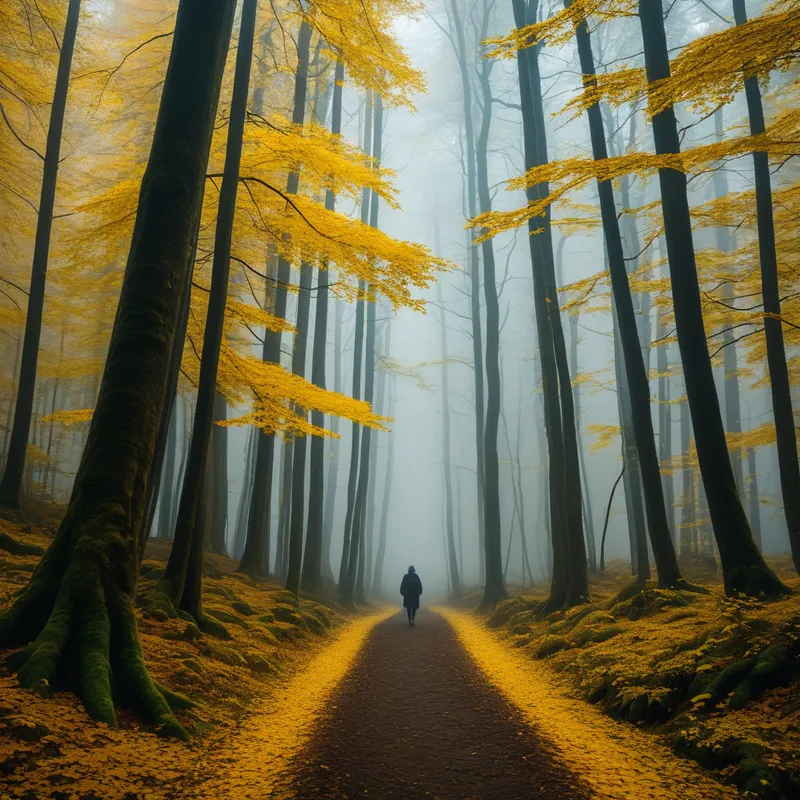
A traveler stands at a fork in a yellow wood, contemplating two paths, and the choice forever alters the story of their life.
The Tale of The Road Not Taken from Frost’
In the amber heart of a wood painted with the fire of a dying year, a figure comes to a halt. The air is cool and still, carrying the sweet decay of leaves and the distant promise of winter. Before them, the path—once singular, certain, and direct—splits irrevocably into two. They are alone. The only sound is the whisper of [the wind](/myths/the-wind “Myth from Various culture.”/) through the yellow canopy, a susurrus that seems to speak in a forgotten tongue.
The traveler looks down the first way. It is fair, its passage worn smooth by the tread of countless others. It curves gently into the undergrowth, a well-tended line through the gold and the russet, inviting and safe. Its destination is known, its journey predictable. It is the road of [the chorus](/myths/the-chorus “Myth from Theater culture.”/), the path of the collective sigh.
Then, the gaze shifts. The second path lies just as fair, perhaps more so, for it is grassy and wants wear. The leaves that blanket it are pristine, untouched by boot or burden. It delves into a denser part of the wood, where the light filters down in slanted, mysterious shafts. This road does not beckon; it simply is. It holds its silence like a secret, and its overgrown entrance speaks not of neglect, but of patience—a long wait for the one footstep destined to claim it.
A profound stillness settles upon the traveler. This is no mere intersection of dirt and root; it is a juncture of fates. To choose one is to forever renounce the other. With a sigh that mingles with the forest’s own breath, the traveler steps forward—onto the grassy, leaf-strewn path. The first step is a rustle, a crunch, a declaration. As they walk, the woods close softly behind them, the fork disappearing into memory. The journey continues, the new path unfolding with each step, but the ghost of the other road walks silently beside them, through all the miles yet to come.

Cultural Origins & Context
This is a myth of the modern age, born not around ancient fires but in the quiet spaces of the individual mind. Its primary teller was the poet Robert Frost, who first gave it voice in 1915. However, to label it merely a poem is to misunderstand its function. It quickly transcended its literary origins to become a universal folktale, a parabolic narrative recited at graduations, etched into greeting cards, and referenced in moments of personal dilemma. It is passed down not by tribal elders, but by teachers, parents, and friends seeking to frame life’s inevitable branchings.
Its societal function is that of a mirror and a compass. In a world increasingly defined by choice—of career, of identity, of belief—the myth provides a container for the anxiety and awe of self-determination. It does not prescribe which path to take; instead, it sanctifies the act of choosing and acknowledges the eternal shadow of the unchosen. It is a foundational story for the culture of individualism, giving poetic form to the burden and beauty of crafting one’s own destiny.
Symbolic Architecture
The myth’s power lies in its sparse, potent [symbolism](/symbols/symbolism “Symbol: The use of symbols to represent ideas or qualities, often conveying deeper meanings beyond literal interpretation. In dreams, it’s the language of the unconscious.”/). The yellow [wood](/symbols/wood “Symbol: Wood symbolizes strength, growth, and the connection to nature and the environment.”/) is the liminal [space](/symbols/space “Symbol: Dreaming of ‘Space’ often symbolizes the vastness of potential, personal freedom, or feelings of isolation and exploration in one’s life.”/) of mid-[life](/symbols/life “Symbol: The symbol of ‘Life’ represents a journey of growth, interconnectedness, and existential meaning, encompassing both the joys and challenges that define human experience.”/) or any significant transition, a place of both [beauty](/symbols/beauty “Symbol: This symbol embodies aesthetics, harmony, and the appreciation of life’s finer qualities.”/) and decay, where one [season](/symbols/season “Symbol: Represents cycles of life, change, and the passage of time. Symbolizes growth, decay, renewal, and different phases of existence.”/) must end for another to begin. The diverging roads are the archetypal [symbol](/symbols/symbol “Symbol: A symbol can represent an idea, concept, or belief, serving as a powerful tool for communication and understanding.”/) of dilemma itself. They represent more than simple alternatives; they are the [bifurcation](/symbols/bifurcation “Symbol: A fork, split, or division representing a critical choice, duality, or the branching of paths in life or consciousness.”/) of potentiality, the point where a single [life](/symbols/life “Symbol: The symbol of ‘Life’ represents a journey of growth, interconnectedness, and existential meaning, encompassing both the joys and challenges that define human experience.”/)-stream threatens to become two, forcing the [universe](/symbols/universe “Symbol: The universe symbolizes vastness, interconnectedness, and the mysteries of existence beyond the individual self.”/) of possibility to collapse into the [reality](/symbols/reality “Symbol: Reality signifies the state of existence and perception, often reflecting one’s understanding of truth and life experiences.”/) of [action](/symbols/action “Symbol: Action in dreams represents the drive for agency, motivation, and the ability to take control of situations in waking life.”/).
The road not taken is not a place, but a ghost—the persistent, shimmering echo of the self you did not become.
The [traveler](/symbols/traveler “Symbol: A person on a journey, representing movement, transition, and the search for new experiences or self-discovery.”/) is the [Everyman](/symbols/everyman “Symbol: A universal archetype representing the ordinary person, common humanity, and shared experiences across societies.”/)/Ego, confronted with the existential [weight](/symbols/weight “Symbol: Weight symbolizes burdens, responsibilities, and emotional loads one carries in life.”/) of authorship over their own [story](/symbols/story “Symbol: The symbol of ‘Story’ represents the narrative woven through our lives, embodying experiences, lessons, and emotions that shape our identities.”/). The [choice](/symbols/choice “Symbol: The concept of choice often embodies decision-making, freedom, and the multitude of paths available in life.”/) for the “[less](/symbols/less “Symbol: The concept of ‘less’ often signifies a need for simplicity, reduction, or minimalism in one’s life or thoughts.”/) traveled” [path](/symbols/path “Symbol: The ‘path’ symbolizes a journey, choices, and the direction one’s life is taking, often representing individual growth and exploration.”/) is often misinterpreted as a [celebration](/symbols/celebration “Symbol: The symbol of ‘celebration’ represents joy, accomplishment, and community, often serving as a collective acknowledgment of achievements or significant life milestones.”/) of nonconformity. On a deeper level, it symbolizes the necessary, often lonely, act of [differentiation](/symbols/differentiation “Symbol: The process of distinguishing or separating parts of the self, emotions, or identity from a whole, often marking a developmental or psychological milestone.”/) required for individuation. One must leave the collectively-[worn path](/symbols/worn-path “Symbol: The worn path represents the journey of life and the experiences that shape one’s identity, often signifying routine and exploration.”/) to discover one’s own unique imprint on [the world](/myths/the-world “Myth from Tarot culture.”/). Yet the concluding tone is not of [triumph](/myths/triumph “Myth from Roman culture.”/), but of poignant [reflection](/symbols/reflection “Symbol: Reflection signifies self-examination, awareness, and the search for truth within oneself.”/)—“I shall be telling this with a sigh.” The sigh holds the entire [psychology](/symbols/psychology “Symbol: Psychology in dreams often represents the exploration of the self, the subconscious mind, and emotional conflicts.”/): a [mixture](/symbols/mixture “Symbol: A mixture in dreams represents integration, blending of ideas, or conflicts between differing aspects of the self.”/) of pride, regret, wonder, and the profound [mystery](/symbols/mystery “Symbol: An enigmatic, unresolved element that invites curiosity and exploration, often representing the unknown or hidden aspects of existence.”/) of a life defined by a [choice](/symbols/choice “Symbol: The concept of choice often embodies decision-making, freedom, and the multitude of paths available in life.”/) whose full meaning can only be grasped in retrospect.
The Dreamer’s Resonance
When this myth patterns a modern dream, the dreamer is at a psychic crossroads. Dreaming of two identical doors, hallways, or staircases captures the somatic feeling of paralysis in the face of seemingly equal options. The body often feels heavy, rooted to the spot, in the dream. This is the [psyche](/myths/psyche “Myth from Greek culture.”/)’s way of staging the conflict between the [Persona](/myths/persona “Myth from Greek culture.”/) (which may lean toward the safe, known path) and the calling of the Self (which whispers from the overgrown, mysterious one).
The “ghost road” of the unchosen option frequently manifests in dreams as a doppelgänger, a shadowy figure seen taking the other path, or a persistent feeling of being watched or followed by an alternative version of oneself. This represents the psychological process of mourning potential selves. The dreamwork is an attempt to integrate the loss inherent in any definitive choice, to make peace with the infinite “what-ifs” that the conscious mind must set aside to move forward in reality.

Alchemical Translation
The alchemical process modeled here is the [separatio](/myths/separatio “Myth from Alchemical culture.”/). [The prima materia](/myths/the-prima-materia “Myth from Alchemical culture.”/)—the undifferentiated mass of life potential—is confronted with the necessity of division. The traveler, in the [nigredo](/myths/nigredo “Myth from Alchemical culture.”/) of the dark wood of confusion, must perform the crucial act of separation: self from collective, chosen path from forsaken path, actualized identity from phantom identity. This is a painful but essential dissolution of wholeness into duality, required for new creation.
The goal is not to choose the “right” road, but to fully become the person who did the choosing. The path is forged by the walking, and the self is forged by the path.
The subsequent journey on the chosen road is the ablutio and coniunctio. As one walks, the experiences, trials, and beauties of that unique path wash over and shape the traveler. They integrate the reality of their choice into their being. The final, reflective “sigh” years later is the [rubedo](/myths/rubedo “Myth from Alchemical culture.”/), the reddening. It is the achieved wisdom, the philosophical gold. It is the understanding that the meaning of the choice was never in the objective quality of the road, but in the subjective act of commitment that made all the difference. The alchemical stone produced is a coherent, authentic self, crystallized around the very moment of its own decisive branching.
Associated Symbols
Explore related symbols from the CaleaDream lexicon: