
The River of Souls Myth Meaning & Symbolism
A universal myth of the soul's perilous journey across a dark river to the afterlife, guided by a ferryman who demands a toll.
The Tale of The River of Souls
Listen, and hear the whisper that flows beneath all stories. It is the sound of water in the dark, the lap of a current that has no beginning and knows no end. This is the tale of the last journey, the one every soul must make.
There is a place where the world of breath and beating heart grows thin. It is a shore of grey pebbles and sighing reeds, where the light is the color of forgotten memory. Here, the air grows still and heavy. Before the newly arrived stands the River of Souls. Its waters are not water as we know it; they are the color of obsidian and moving shadow, cold to look upon, silent in their flow. No bird flies over it. No fish swims within it. It is the final boundary.
And on this shore waits the Ferryman. He is ancient, his form shrouded in a cloak the hue of river mud. His face is often hidden, but his eyes, when glimpsed, hold the patience of stone and the depth of the abyss. He stands in a simple, weathered boat, a long pole in his hand. He does not speak, but his presence asks the only question that matters here.
The soul, still clinging to the warmth of life, feels a chill that is not of the body. To cross is to accept the unmaking of all it once was. The far shore is veiled in mist, but sometimes a strange, soft light glimmers from within it, a light that promises both peace and oblivion. The soul hesitates. It looks back, but the path behind has already faded into fog. There is only forward, across the black mirror of the river.
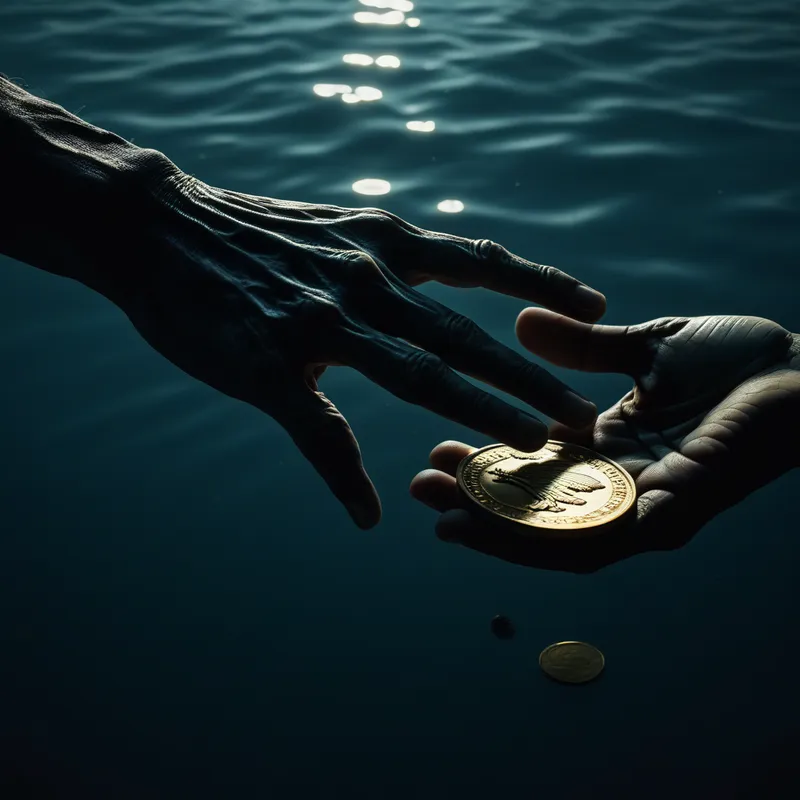
The Ferryman extends a hand. It is not a hand of flesh, but of something older. This is the moment of the Toll. The soul must offer payment. In some tales, it is a coin placed upon the tongue by loving hands. In others, it is a memory of pure joy, or a whispered secret. Without it, the Ferryman remains unmoving, and the soul is doomed to wander the grey shore for an age, listening to the hollow rush of the water it cannot cross.
But when the toll is given, the Ferryman accepts it. The coin disappears, or the memory fades from the soul’s grasp. Only then does he gesture to the boat. The step into the vessel is the true moment of death. The boat does not rock. It slides from the shore as if released from a long-held breath. The Ferryman poles into the deep, silent current. The shore of the living dissolves into mist. There is only the sound of the pole dipping into the black water, and the slow, inevitable drift toward the unknown light. The journey is long, or perhaps it is instantaneous. Time has no meaning on the river. The soul feels its attachments, its fears, its very identity, begin to soften and unravel in the river’s chill breath.
Then, the boat grounds itself on the far shore. This land is different. It may be fields of endless peace, a hall of ancestral heroes, or simply a gentle dissolving into the source of all things. The Ferryman does not disembark. His task is only the crossing. The soul steps out, transformed, its journey complete. The Ferryman pushes his empty boat back into the current, returning to the grey shore to wait for the next whisper of a ended life, forever the guardian of the threshold.
Cultural Origins & Context
The myth of the River of Souls is not the property of a single culture, but a profound archetypal pattern emerging independently across the globe. We see it in the Acheron and Styx of the Greeks, with Charon as its stern pilot. It flows through the Nile of the Night in Egyptian funerary texts. It appears in the <abbr title=“The “black water” river one must cross in some Buddhist and Hindu cosmologies”>Vaitarna of South Asian traditions, and in the dark rivers that border the afterlife in numerous indigenous North American and Mesoamerican beliefs.
This universality points to a shared human intuition about death. The river is a perfect natural symbol for a transition that is both a journey and a profound change of state. The myth was not mere entertainment; it was a crucial part of funerary ritual and societal psychology. The story was told by elders, priests, and mourners to frame the raw fact of death within a meaningful narrative. It provided a map for the deceased, often inscribed on coffin texts or recited in rites, and a ritual structure for the living—hence the widespread practice of burial with coins or grave goods as “toll.” Its function was to manage the terror of the unknown by giving it a known, albeit solemn, procedure, thereby integrating the reality of mortality into the culture’s cosmic order.
Symbolic Architecture
Psychologically, the river represents the unconscious itself—the deep, flowing, and often dark medium that separates the conscious ego (the land of the living) from the contents of the Self or the collective unconscious (the afterlife). It is the boundary between the known and the utterly unknown.
The Ferryman is not death, but the principle of necessary exchange at the threshold of transformation. He is the embodiment of the psychic law that one cannot gain new territory without surrendering old currency.
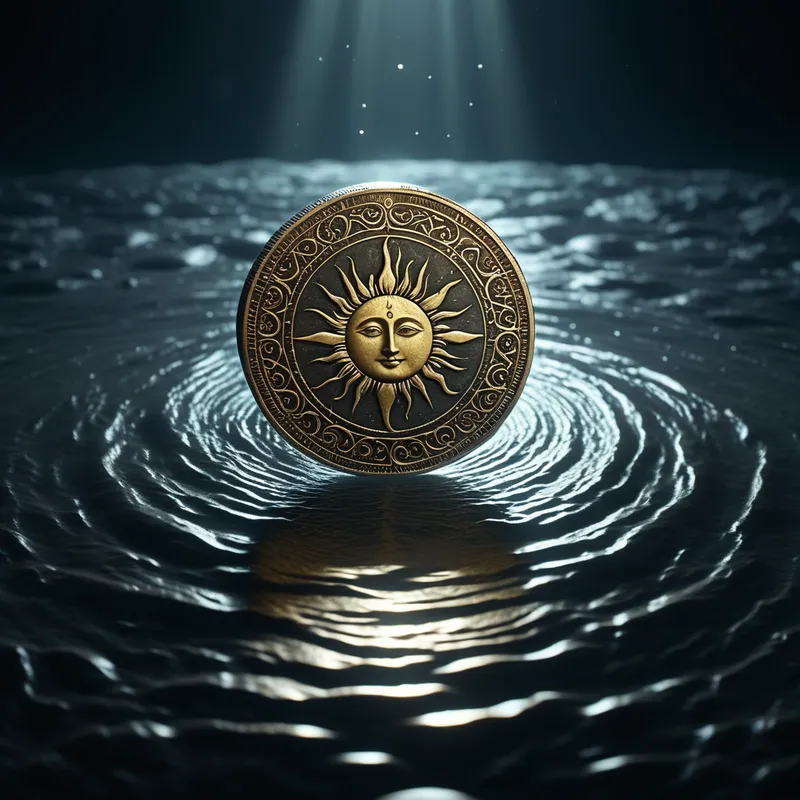
The Ferryman is the archetype of the psychopomp. He is not a judge, but a neutral facilitator of transition. His demand for a toll is perhaps the myth’s most profound insight. The coin represents the valued object of the conscious world—wealth, status, a specific identity. To cross into a new state of being, whether in death or in a psychological death-and-rebirth experience, the ego must relinquish what it holds most dear. It must pay with its old self.
The boat is the fragile vessel of consciousness or the temporary structure (a ritual, a therapy, a profound insight) that allows passage through the overwhelming waters of the unconscious. The far shore is not a “place,” but a symbol of re-integration, wholeness, or a new level of psychic organization achieved after the ego’s dominance has been dissolved in the journey.
The Dreamer’s Resonance
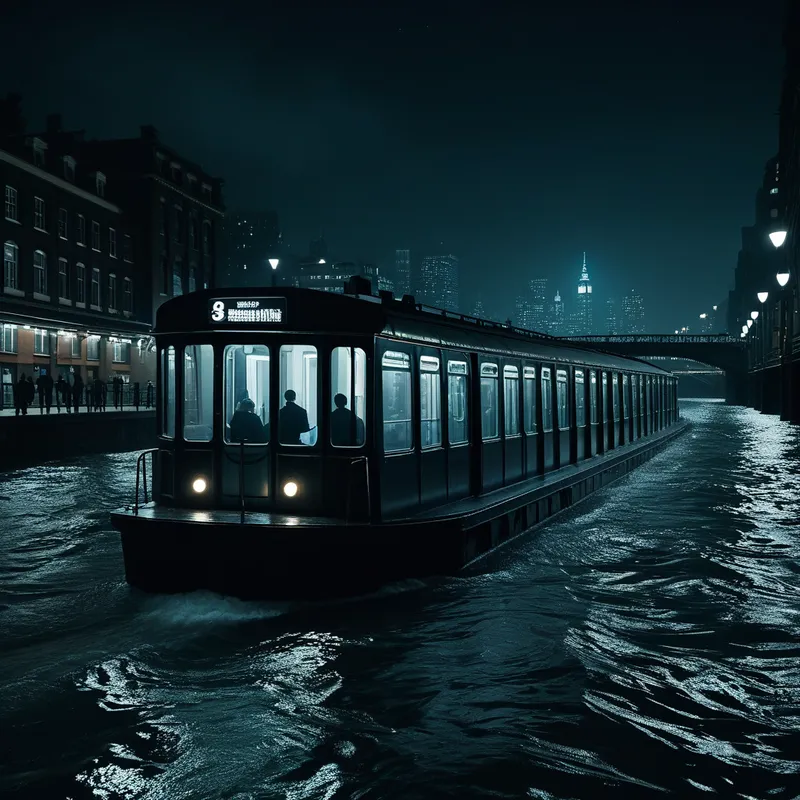
When this myth surfaces in modern dreams, it rarely appears in its classical garb. The dreamer may find themselves waiting for a late-night train on a deserted platform that overlooks a black canal. They may be in a taxi, driven by a silent, faceless driver through flooded city streets toward an unfamiliar district. They may be trying to board a ferry but cannot find the correct ticket.
These dreams signal that the psyche is at a major threshold. The somatic feeling is often one of anxious anticipation, a chill, or a weight of solemnity. Psychologically, the dreamer is facing an ending that is a prerequisite for a beginning. It could be the end of a career, a relationship, an identity, or a long-held belief system. The “toll” is the conscious acknowledgment and acceptance of this loss. The dream presents the internal Ferryman asking, “What are you willing to give up to move forward?” Resistance—dreams of missing the boat, being refused passage, or drowning in the river—indicates the ego’s terror of letting go of its familiar “currency.”
Alchemical Translation
In the alchemy of individuation, the myth of the river models the nigredo stage—the descent into the dark waters of the unconscious, where all certainties are dissolved. The conscious personality (the soul on the near shore) must consent to its own de-structuring.
The entire process is an alchemical transmutation where the lead of the ego’s fixed identity is dissolved in the river’s mercury, to be reconstituted on the far shore as a more integrated gold.
The modern individual undertaking this journey might experience it as a period of depression, stagnation, or profound confusion—the grey shore. The Ferryman is the inner voice of the Self, demanding a sacrifice. This is the “payment”: the rigid persona, the inflated self-image, the cherished grievance. Giving this “coin” feels like a death. The boat journey is the liminal period of therapy, creative incubation, or solitary reflection, where one is in transit, no longer what they were, not yet what they will be.
The arrival on the far shore symbolizes the albedo—the dawn of a new understanding. The individual has not “died” but has undergone a psychic death-and-rebirth. They have negotiated with the psychopomp within, paid the toll of their old self, and crossed the river of their own depths. They return to life, not to the same shore, but transformed, carrying the peace of one who has seen the other side and knows the river must be crossed, not feared.
Associated Symbols
Explore related symbols from the CaleaDream lexicon: