The ritual ablutions in the Ri Myth Meaning & Symbolism
A myth of a soul's descent into a sacred river to wash away the accretions of time, guided by the silent keeper of the waters.
The Tale of The ritual ablutions in the Ri
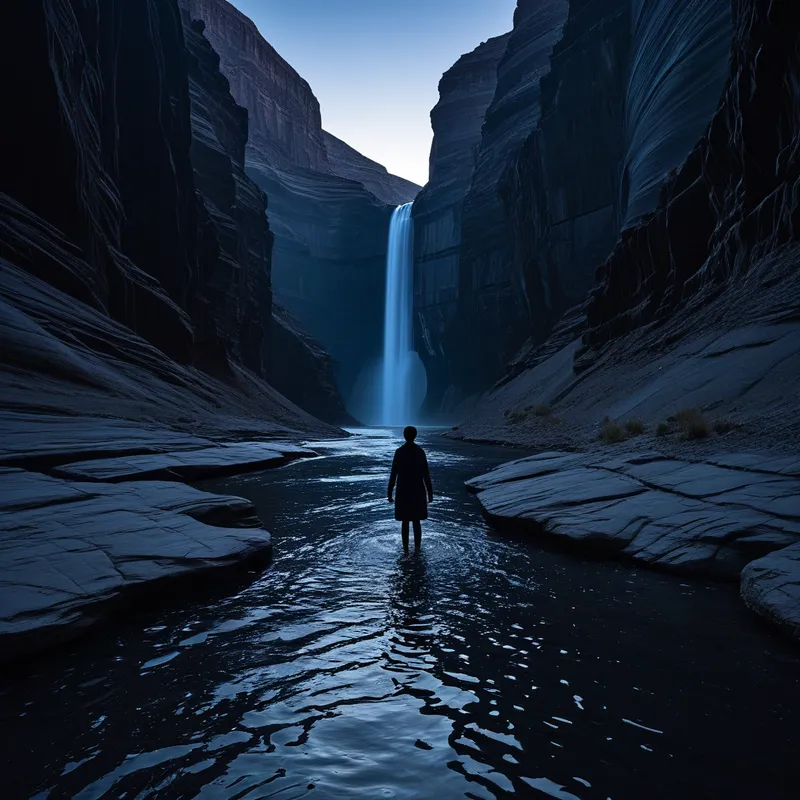
Listen. There is a place where [the world](/myths/the-world “Myth from Tarot culture.”/)’s memory runs like [water](/myths/water “Myth from Chinese culture.”/). It is not on any map, for it lies in the fold between the day-world and the night-world. They call it the Ri. Its waters are not blue, nor green, nor silver, but the color of forgetting and remembering mixed as one—a deep, swirling indigo shot through with sparks like distant stars.
To this place comes the one who is heavy. Not with stone or metal, but with the weight of lived days—the grit of old angers, the dust of sorrows long stifled, the clinging mud of words spoken and unspoken. The soul arrives at the bank, drawn by a thirst that no well in the waking world can quench. The air is still and smells of ozone and wet stone.
The keeper of the Ri is there, though no eye can truly see them. They are the sound of the current over smooth rock, the chill that rises from the water, the silence that listens. No words are exchanged, for the ritual is known in the blood, in the bone. The one who is heavy must enter the flow.
The first touch is agony. It is not cold, but truth. The water does not caress; it reads. It flows over the skin and each ripple is a question: Who were you when you wept here? What face did you wear when you lied there? The soul wades deeper, and the current tugs at the accretions. Flakes of hardened pride slough away like rust, dissolving into motes of light. Streaks of envy rinse clean, leaving the skin tingling and raw.
At the midpoint, where the water is deepest and the current strongest, the soul must submerge. This is the heart of [the ablution](/myths/the-ablution “Myth from Alchemical culture.”/). To go under is to consent to be unmade. In that suspension, time folds. The soul sees not its own life, but the lives it has touched—the joy it sparked as a bright fish darting away, the pain it caused as a dark stone sinking. All is held in the water, recorded, reflected. The soul drinks, and in drinking, is drunk by [the river](/myths/the-river “Myth from Buddhist culture.”/). It becomes, for a moment, both the cleansed and the cleanser, the memory and the forgetting.
Then, with a gasp that is both birth and relief, it breaks the surface. It stumbles back to the bank, not lighter, but true. The water that drips from its form is clear. Behind, in the Ri, the stirred-up silt of a lifetime slowly settles, becoming just another layer of the riverbed, another story in the endless flow. The keeper says nothing. The ritual is complete. The soul walks back into the world, leaving no footprints, carrying only the dampness of the real.

Cultural Origins & Context
The myth of the ablutions in the Ri is a ur-myth, a story without a single point of origin, whispered in the foundational layers of what we might call the global [psyche](/myths/psyche “Myth from Greek culture.”/). It is not the property of any one temple or scripture, but appears in fragments: in the description of a mikveh that speaks of returning to [the womb](/myths/the-womb “Myth from Various culture.”/) of creation; in the Hindu practice of snan in [the Ganges](/myths/the-ganges “Myth from Hindu culture.”/) to wash away [karma](/myths/karma “Myth from Hindu culture.”/); in the Orphic rites that sought purification before an afterlife journey; in the countless folk tales of healing springs and fairy pools where one emerges changed.
It was passed down not by bards in halls, but by mystics in caves, by midwives at birthings, by the dying to those who would listen. Its societal function was not to legislate behavior, but to map an internal process. It provided a psychic technology for dealing with the inevitable accumulation of experience—the “soul’s fatigue.” It taught that impurity was not sin, but weight; that purification was not punishment, but a necessary return to source. The ritual was the external form given to an internal, universal need: to shed the old skin of [the self](/myths/the-self “Myth from Jungian culture.”/) and remember one’s essence.
Symbolic Architecture
The myth’s power lies in its stark, elegant [symbolism](/symbols/symbolism “Symbol: The use of symbols to represent ideas or qualities, often conveying deeper meanings beyond literal interpretation. In dreams, it’s the language of the unconscious.”/). The Ri itself is the unconscious in its dynamic, flowing [aspect](/symbols/aspect “Symbol: A distinct feature, quality, or perspective of something, often representing a partial view of a larger whole.”/). It is not a stagnant pool of repressed [trauma](/symbols/trauma “Symbol: A deeply distressing or disturbing experience that overwhelms the psyche, often manifesting in dreams as unresolved emotional wounds or psychological injury.”/), but a living, moving [body](/symbols/body “Symbol: The body in dreams often symbolizes the dreamer’s self-identity, personal health, and the relationship they have with their physical existence.”/) that holds all [history](/symbols/history “Symbol: History in dreams often represents the dreamer’s past experiences, lessons learned, or unresolved issues that continue to influence their present.”/), all [memory](/symbols/memory “Symbol: Memory symbolizes the past, lessons learned, and the narratives we construct about our identities.”/), all potential.
The river does not judge the silt it carries; it simply offers the possibility of release from it.
The heavy [soul](/symbols/soul “Symbol: The soul represents the essence of a person, encompassing their spirit, identity, and connection to the universe.”/) represents the ego, encrusted with the dross of lived experience—the [shadow](/symbols/shadow “Symbol: The ‘shadow’ embodies the unconscious, repressed aspects of the self and often represents fears or hidden emotions.”/), the [persona](/symbols/persona “Symbol: The social mask or outward identity one presents to the world, often concealing the true self.”/), the unintegrated fragments of [identity](/symbols/identity “Symbol: Identity represents the sense of self, encompassing personal beliefs, cultural background, and social roles.”/). The descent into the [water](/symbols/water “Symbol: Water symbolizes the subconscious mind, emotions, and the flow of life, representing both cleansing and creation.”/) is the courageous act of introspection and [shadow](/symbols/shadow “Symbol: The ‘shadow’ embodies the unconscious, repressed aspects of the self and often represents fears or hidden emotions.”/)-work. It is a voluntary ego-[death](/symbols/death “Symbol: Symbolizes transformation, endings, and new beginnings; often associated with fear of the unknown.”/), a [dissolution](/symbols/dissolution “Symbol: The process of breaking down, dispersing, or losing form, often representing transformation, release, or the end of a state of being.”/) of rigid boundaries to allow contact with the deeper, fluid self.
The keeper is the silent, guiding intelligence of the unconscious itself—the Self, in Jungian terms. It does not intervene, because the process is intrinsic. The wisdom is in the water, and the will to enter must come from the soul. The final [emergence](/symbols/emergence “Symbol: A process of coming into being, rising from obscurity, or breaking through a barrier, often representing birth, transformation, or revelation.”/), dripping but true, symbolizes the [birth](/symbols/birth “Symbol: Birth symbolizes new beginnings, transformation, and the potential for growth and development.”/) of a more authentic [consciousness](/symbols/consciousness “Symbol: Consciousness represents the state of awareness and perception, encompassing thoughts, feelings, and experiences.”/), one that has faced its own contents and been reconstituted. [The ego](/myths/the-ego “Myth from Jungian culture.”/) is not destroyed, but cleansed of its pathological rigidity, now in better relation to the Self.
The Dreamer’s Resonance
When this myth stirs in modern dreams, it rarely appears as an ancient river. It manifests as the dreamer finding themselves in a shower that washes away not dirt, but black ink or clinging cobwebs. It is the dream of swimming in a pool that becomes an ocean, of drinking from a tap that flows with liquid light. The somatic sensation is often profound: a feeling of piercing cold that turns to warmth, of a great weight lifting from the chest, of choking followed by a deep, clear breath.
Psychologically, these dreams signal a critical phase of psychic purgation. The dreamer is likely undergoing a period where accumulated stress, unresolved grief, or outgrown identities have become unsustainable. The unconscious is presenting the ritual. To dream of resisting the water—of fearing its cold or refusing to enter—suggests resistance to this necessary dissolution. To dream of submersion and peaceful emergence indicates a soul-level engagement with the process, an active individuation where the psyche is cleansing and reordering itself.

Alchemical Translation
The alchemical process mirrored in the ablutions in the Ri is the quintessential operation of [solutio](/myths/solutio “Myth from Alchemical culture.”/)—dissolution. In [the alchemist](/myths/the-alchemist “Myth from Various culture.”/)‘s vessel, the hardened matter (the [nigredo](/myths/nigredo “Myth from Alchemical culture.”/)) must be dissolved in the aqua permanens before it can be reconstituted into a higher form.
The self cannot be transmuted while it remains solid. It must first consent to become fluid, to lose its shape in order to find its essence.
For the modern individual, this myth models the terrifying yet liberating journey of psychic transmutation. Our “matter” is our fixed identity, our cherished narratives, our hardened wounds. The “water” is the courageous descent into feeling, memory, and the unknown depths of our own being. We are called to let our certainties soften, to allow our storylines to blur, to be washed by the truth of what we have actually lived and felt.
This is not a passive cleansing, but an active participation. We must wade in, we must submerge. The [triumph](/myths/triumph “Myth from Roman culture.”/) is not in remaining dry and unchanged on the bank, but in emerging, dripping with the reality of our own experience, heavy no longer with repression but with the honest weight of integrated life. The ritual is never performed once. As we walk through the world, we gather dust anew. And so, in the cycles of our lives, we are called back, again and again, to the banks of the Ri, to remember how to forget what binds us, and to find, in the flowing dark, the shape of our own clear water.
Associated Symbols
Explore related symbols from the CaleaDream lexicon: